

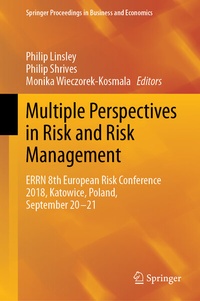
Multiple Perspectives in Risk and Risk Management
Description

This proceedings book presents a multidisciplinary perspective on risk and risk management. Featuring selected papers presented at the European Risk Research Network (ERRN) 8th European Risk Conference "Multiple Perspectives in Risk and Risk Management" held in Katowice, Poland, it explores topics such as risk management systems, risk behaviors, risk culture, big data and risk reporting and regulation. The contributors adopt a wide variety of theoretical approaches and either qualitative or quantitative methodologies.
Contemporary companies operate in a highly dynamic environment, accompanied by the constant development of the information technology, making decision-making processes highly complex and increasing the risk related to company performance. The European Risk Research Network (ERRN) was established in 2006 with the aim of stimulating cross-disciplinary research in the area of risk management. The network includes academics and industry experts from the fields of accounting, auditing, financial economics and mathematical finance. To keep the network lively and fruitful, regular "European Risk Conferences" are organized to present papers from a broad spectrum of risk and risk management areas.
Featuring contributions for Italy, South Africa, Germany and Poland, this proceedings book is a valuable reference resource for students, academics, and practitioners in risk and risk managementMore details
Other editions
Additional editions
Persons
Philip Linsley is Professor of Accounting and Risk at the York Management School, University of York, UK. His research interests are risk-related and include investigating risk disclosure, and risk and culture. He is particularly interested in applying the ideas of Mary Douglas to accounting. Philip is also a qualified chartered accountant and has significant experience as an academic lecturer and researcher.
Philip Shrives is a Professor of Accounting and Corporate Governance at Northumbria University. He is a Chartered Accountant, a Fellow of the UK Higher Education Academy and has a PhD from University College Dublin. He lectures in risk reporting, corporate governance, impression management and research methods. He has published a range of papers in journals such as The British Accounting Review, Accounting, Auditing & Accountability Journal, Critical Perspectives on Accounting, The International Journal of Accountingand the Journal of Accounting Literature. He was previously Director of Academic Staff Development.
Monika Wieczorek-Kosmala
is an academic lecturer and researcher at the University of Economics in Katowice, Poland. Her research interests include corporate finance, insurance and enterprise risk management. She is particularly focused on the value-creation benefits of ERM implementation, as well as the relationship between ERM and company's capital structure optimization. She gained practical experience on insurance market as an insurance broker.
