

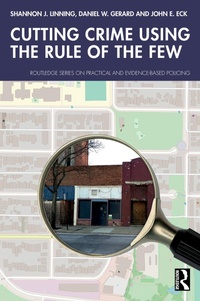
Cutting Crime Using the Rule of the Few
1st Edition
Published on 29. May 2026
352 pages
978-1-040-70293-2 (ISBN)
Description

Based on decades of research, this book reveals how the rule of the few can redirect your focus to create effective crime control policies. Many crime reduction strategies fail because they apply common crime fallacies. They assume that: solutions to crime need to be complicated, crime is widespread, residents matter the most, more arrests reduce crime, and police can solve all crime problems. At the heart of each fallacy is a failure to consider an old idea: the rule of the few. The rule of the few means a tiny fraction of inputs cause most of the outcomes. Research shows that solving problems at smaller scales can cut crime substantially, crime is highly concentrated at a few places in any city, only a few residents can usually effect change, only a few people commit most of the crime, and a few everyday people can dismantle crime opportunities.
Cutting Crime Using the Rule of the Few shows that crime is not merely a police problem. It explains how those who own or manage property and design the products we use have far more power to suppress crime opportunities than they realize. Cutting Crime reveals how to use the rule of the few to identify and solve crime problems. It provides a set of tools and spells out specific strategies that the police, property owners, business owners, and government agencies can use to reduce crime. Just as it only takes a few to create a lot of crime, it only takes a few to prevent those crimes.
Cutting Crime Using the Rule of the Few shows that crime is not merely a police problem. It explains how those who own or manage property and design the products we use have far more power to suppress crime opportunities than they realize. Cutting Crime reveals how to use the rule of the few to identify and solve crime problems. It provides a set of tools and spells out specific strategies that the police, property owners, business owners, and government agencies can use to reduce crime. Just as it only takes a few to create a lot of crime, it only takes a few to prevent those crimes.
Reviews / Votes
Very few places are the source of most community crime. City managers and local law enforcement have greater ability than we realize to change these places, though it takes different approaches. Cutting Crime lays out tools local government leaders can use to reduce crime through a placed-based strategy.-Tom Carroll, City Manager, City of Lexington, Virginia (USA)
Cutting Crime Using the Rule of the Few offers a clear blueprint to reduce crime by eliminating opportunities for crime. Essential reading for government executives, police departments, business owners, insurance underwriters, property managers, and anyone invested in making communities safer.
-Edward L. Chavez, Chief Justice (retired), New Mexico Supreme Court (USA)
Cutting Crime provides an innovative framework for practitioners to manage solutions for crime reduction and control. A "must read" for police leaders, and city executives, Cutting Crime serves as an evidence-based practical working manual designed to develop focused, purposeful and sustainable solutions to reduce crime.
-Mike John, Assistant Police Chief (retired), City of Cincinnati (USA)
The Rule of the Few is all around us. In this wide-ranging and accessible book, Linning, Gerard and Eck provide compelling evidence that crime too conforms to the Rule of the Few, with important implications for crime prevention theory and practice. This valuable book is a must-read for academics, practitioners and policymakers interested in understanding and preventing crime.
-Aiden Sidebottom, Professor of Security and Crime Science, University College London (UK)
More details
Series
Edition
1. Auflage
Language
English
Place of publication
London
United Kingdom
Publishing group
Taylor & Francis Ltd
Target group
Professional and scholarly
Product notice
Reflowable
Illustrations
18 Tables, black and white; 16 Line drawings, black and white; 22 Halftones, black and white; 38 Illustrations, black and white
File size
7,29 MB
ISBN-13
978-1-040-70293-2 (9781040702932)
Copyright in bibliographic data and cover images is held by Nielsen Book Services Limited or by the publishers or by their respective licensors: all rights reserved.
Schweitzer Classification
Other editions
Additional editions
Shannon J. Linning | Daniel W. Gerard | John E. Eck
Cutting Crime Using the Rule of the Few
Book
05/2026
1st Edition
Routledge
€191.50
Shipment within 10-20 days

Shannon J. Linning | Daniel W. Gerard | John E. Eck
Cutting Crime Using the Rule of the Few
Book
05/2026
1st Edition
Routledge
€47.50
Shipment within 10-20 days
Persons
Shannon J. Linning, PhD, is an Assistant Professor of Criminology at Simon Fraser University. She teaches courses in crime prevention, policing, and research methods. Her research explores how the owners and managers of property can create safer areas by suppressing crime opportunities at and around their properties. Her research explores how the owners and managers of property can create safer areas by surpressing crime opportunities at and around their properties. Her research appears in many academic journals, and she is the co-author of books, including Place Management and Crime: Ownership and Property Rights as a Source of Social Control.
Daniel W. Gerard, MS, is a retired captain and 32-year veteran of the Cincinnati, Ohio Police Department. He has published articles in both academic and practitioner journals and has served as an invited consultant, speaker, trainer, and instructor for numerous police agencies, universities, and organizations throughout the United States and Canada.
John E. Eck, PhD, is an Emeritus Professor of Criminal Justice at the University of Cincinnati. His work spans five decades, working with police agencies around the world, conducting research and developing thinking tools to aid crime prevention. He is one of the key architects of widely used crime problem-solving tools such as the SARA model, the crime problem triangle, the CHEERS criteria, and the General Problem-Solving Matrix. He has worked for the Police Executive Research Forum as its Research Director, the Washington/Baltimore High Intensity Drug Trafficking Area as its Evaluation Director, and at the University of Cincinnati, where he taught courses on police effectiveness, crime prevention, and professional writing.
Daniel W. Gerard, MS, is a retired captain and 32-year veteran of the Cincinnati, Ohio Police Department. He has published articles in both academic and practitioner journals and has served as an invited consultant, speaker, trainer, and instructor for numerous police agencies, universities, and organizations throughout the United States and Canada.
John E. Eck, PhD, is an Emeritus Professor of Criminal Justice at the University of Cincinnati. His work spans five decades, working with police agencies around the world, conducting research and developing thinking tools to aid crime prevention. He is one of the key architects of widely used crime problem-solving tools such as the SARA model, the crime problem triangle, the CHEERS criteria, and the General Problem-Solving Matrix. He has worked for the Police Executive Research Forum as its Research Director, the Washington/Baltimore High Intensity Drug Trafficking Area as its Evaluation Director, and at the University of Cincinnati, where he taught courses on police effectiveness, crime prevention, and professional writing.
Content
1. The Hockey Stick Epiphany Part 1: How Many Get Crime Wrong 2. Is Crime Widespread? 3. Do Residents Matter Most? 4. Do Arrests Reduce Crime? Part 2: Re-Thinking Crime 5. Crime as a By-Product of Everyday Life 6. Small Wins That Count 7. The Power of Place Managers Part 3: What's Your Problem? 8. What is a Problem? 9. How Do Crime Problems Arise? 10. How Do We Fix Problems? 11. What If Place Managers Do Not Cooperate? 12. Won't Offenders Just Move Around the Corner? Part 4: Putting the Rule of the Few into Practice 13. Lessons from a Homicide Scene 14. Crime Radiation and Place Network Investigations 15. Deployment with a Purpose 16. Finding Public Characters 17. SCRAP What Does Not Work
