

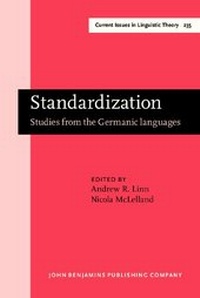
Standardization
Studies from the Germanic languages
1st Edition
Published on 31. December 2002
XII, 258 pages
978-90-272-8367-2 (ISBN)
Description

This volume presents fourteen case studies of standardization processes in eleven different Germanic languages. Together, the contributions confront problematic issues in standardization which will be of interest to sociolinguists, as well as to historical linguists from all language disciplines. The papers cover a historical range from the Middle Ages to the present and a geographical range from South Africa to Iceland, but all fall into one of the following categories: 1) shaping and diffusing a standard language; 2) the relationship between standard and identity; 3) non-standardization, de-standardization and re-standardization.
More details
Other editions
Additional editions
Book
12/2002
John Benjamins Publishing Co
€116.60
Shipment within 10-15 days
Persons
Content
- STANDARDIZATION STUDIES FROM THE GERMANIC LANGUAGES
- Editorial page
- Title page
- Copyright page
- Table of contents
- INTRODUCTION
- References
- STANDARDIZATION AND SOCIAL NETWORKS THE EMERGENCE AND DIFFUSION OF STANDARD AFRIKAANS
- 1. Introduction: Historical sociolinguistics and the study of languagestandardization
- 2. Variation and standardization: The Cape Dutch variety spectrum around 1900
- 3. Afrikaner nationalism and early standardization efforts at the Cape
- 4. Social mobility, nationalism and types of knowledge: A macro-level approach to social network analysis and language standardization
- 5. Language use, innovativeness and linguistic diffusion: A micro-level approach to social network analysis and language standardization
- 6. Ties of coalition and cooperation - the Afrikaner nationalists ' network
- 7. A new standard language at the Cape: The rise of Afrikaans
- 8. Conclusion: network analysis, the diffusion of standard languages and sociolinguistic theory
- References
- DUTCH ORTHOGRAPHY IN LOWER, MIDDLE ANDUPPER CLASS DOCUMENTS IN 19TH-CENTURY FLANDERS
- 1. Introduction
- 2. Spelling norms
- 3. Spelling reality
- 4. Discussion
- 5. Conclusion
- References
- STANDARD GERMAN IN THE 19TH CENTURY?(COUNTER-) EVIDENCE FROM THE PRIVATE CORRESPONDENCE OF 'ORDINARY PEOPLE'
- 1. Introduction: German standard(s)
- 2. Literacy in the German speaking countries in the 19* century
- 3. Standardization processes as reflected in private correspondence
- 4. Analysis of selected grammatical features
- 5. Conclusion: Standard German in the 19* century - a myth?
- References
- ON THE IMPORTANCE OF FOREIGN LANGUAGE GRAMMARS FOR A HISTORY OF STANDARD GERMAN
- 1. Introduction
- 2. The history of standard German
- 3. The importance of Early L2 Grammars
- 4. The data
- 5. Conclusion
- References
- NORMS AND STANDARDSIN 16TH-CENTURY SWEDISH ORTHOGRAPHY
- Introduction
- Norms and standards
- Orthographic representations and automatic writing
- 16th-century standard
- Changes in 16th -century periodic norms
- 16th-century social norms
- Group identity and provenance
- Discussion
- Conclusion
- References
- EMERGING MOTHER-TONGUE AWARENESS THE SPECIAL CASE OF DUTCH AND GERMAN IN THE MIDDLE AGES AND THE EARLY MODERN PERIOD
- References
- TWO HUNDRED YEARS OF LANGUAGE PLANNING IN BELGIUM
- 1. Introduction
- 2. Theoretical background
- 3. 'Belgium ' before 1830
- 4. Belgium from 1830 onwards
- 5. Conclusions
- References
- POLITICAL INFLECTIONS GRAMMAR AND THE ICELANDIC SURNAME DEBATE
- 1. Introduction
- 2. Background
- 3. Guömundur Kamban
- 4. Jóhannes L.L. Jóhannsson
- 5. Íslenzk mannanöfn (1915)
- 6. Conclusion
- References
- STANDARDIZATION, LANGUAGE CHANGE, RESISTANCE AND THE QUESTION OF LINGUISTIC THREAT 18TH-CENTURY ENGLISH AND PRESENT-DAY GERMAN
- 1. Introduction
- 2. Standardization and purism
- 3. Germany today - purism in old and new guises
- 4. Conclusion
- References
- THE STANDARDIZATION OF LUXEMBOURGISH
- Introduction
- The language situation
- Internal change
- External change
- Education Act of 1912
- Radio
- Luxembourg Linguistic Society
- Spelling
- Purism
- The Luxembourgish Dictionary
- Grammars of Luxembourgish
- Luxembourgish as a school subject
- Reaction to the official orthography and a move to standard forms
- Conclusion
- References
- LANGUAGE PLANNING IN NORWAY A BOLD EXPERIMENT WITH UNEXPECTED RESULTS
- Introduction
- Conclusion
- References
- 'DEMOCRATIC' AND 'ELITIST' TRENDS AND A FRISIAN STANDARD
- 1. Introduction
- 2 Old Frisian (11th century -1500/1550)
- 3. Gysbert Japicx (1603-1666)
- 4. J.H. Halbertsma (1789-1869)
- 5. Harmen Sytstra (1817-1862)
- 6. After 1915
- 7. Some aspects of the present situation
- 8. Conclusion
- References
- YIDDISH NO STATE, NO STATUS - NO STANDARD?
- References
- STANDARDIZATION PROCESSES AND THE MID-ATLANTIC ENGLISH PARADIGM
- Introduction
- Official and unofficial governing bodies
- British English norms and sanctioned EFL standards in Europe
- Competing standards
- Lesser-used languages and languages with global spread
- Rejecting the culture-specific norm
- English as the lingua franca
- Kachru and the deconstruction of native-speaker hegemony
- The postcolonial dimension of English standardization
- Standardization f or learners of the world's lingua franca
- English in mainland Europe
- Mid-Atlantic English in a mainland European context
- The demise of 'valued' and 'less valued' varieties
- Standardization and the MAE paradigm
- Processes of Americanization
- MAE and the international status of English
- The ideology of internationalism
- The Swedish origins of MAE
- English in a culturally pluralistic EU
- Studies in Mid-Atlantic English
- Variety building
- The symposium
- BrE and the challenge of MAE and American English
- Conclusion
- References
- INDEX
