

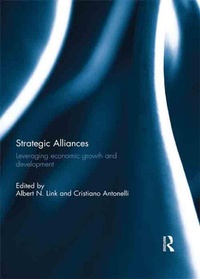
Strategic Alliances
Leveraging Economic Growth and Development
1st Edition
Published on 2. February 2018
176 pages
978-1-317-40613-6 (ISBN)
Description

Strategic alliances have generally been used to refer to relationships that allow an organization to access the strengths and capabilities of other organizations, with the organization often focused on being the firm. The strategy behind such an alliance is for each firm in the alliance to draw on the core competencies of the other firm(s) with the goal of facilitating the growth and development of each member.
Strategic alliances have long been studied from several perspectives, including the way in which the alliance is brought about, alternative forms of relationships that form the structure of the alliance, efficiency gains from the alliance, and the life cycle of the alliance. The strategic alliances that are now being observed are those that involve partners other than firms. In many advanced nations, strategic alliances are subsidized by the public sector in the belief that they advance economic growth. One such form of this public/private partnership involves universities as the public partner; another form involves a government agency as the public partner; and a third form involves both.
This book transcends the traditional approach to a strategic alliance. As such, this collection might represent the locus of observational points that make up a new frontier, re-defining the scope of research that falls under the rubric of 'strategic alliances'. This book was originally published as a special issue of Economics of Innovation and New Technology.
Strategic alliances have long been studied from several perspectives, including the way in which the alliance is brought about, alternative forms of relationships that form the structure of the alliance, efficiency gains from the alliance, and the life cycle of the alliance. The strategic alliances that are now being observed are those that involve partners other than firms. In many advanced nations, strategic alliances are subsidized by the public sector in the belief that they advance economic growth. One such form of this public/private partnership involves universities as the public partner; another form involves a government agency as the public partner; and a third form involves both.
This book transcends the traditional approach to a strategic alliance. As such, this collection might represent the locus of observational points that make up a new frontier, re-defining the scope of research that falls under the rubric of 'strategic alliances'. This book was originally published as a special issue of Economics of Innovation and New Technology.
More details
Edition
1. Auflage
Language
English
Place of publication
London
United Kingdom
Publishing group
Taylor & Francis Ltd
Target group
College/higher education
File size
4,02 MB
ISBN-13
978-1-317-40613-6 (9781317406136)
Copyright in bibliographic data and cover images is held by Nielsen Book Services Limited or by the publishers or by their respective licensors: all rights reserved.
Schweitzer Classification
Other editions
Additional editions

Book
09/2018
1st Edition
Routledge
€59.60
Shipment within 10-20 days
Book
04/2016
1st Edition
Routledge
€141.12
Shipment within 10-20 days
Persons
Cristiano Antonelli has been the Chair of Political Economy of the University of Turin, Italy, since 1997. He is the President of the School of Economics and Statistics and a Fellow of the Collegio Carlo Alberto where he guides the Bureau of Research on Innovation, Complexity and Knowledge. He is also the Managing Editor of Economics of Innovation and New Technology.
Albert N. Link is Professor of Economics at the University of North Carolina, Greensboro, NC, USA. He is currently the Editor-in-Chief of Journal of Technology Transfer. He served as the U.S. Representative to the United Nations Team of Specialists on Innovation and Competitiveness Policies (2007-2012) in Geneva, Switzerland.
Albert N. Link is Professor of Economics at the University of North Carolina, Greensboro, NC, USA. He is currently the Editor-in-Chief of Journal of Technology Transfer. He served as the U.S. Representative to the United Nations Team of Specialists on Innovation and Competitiveness Policies (2007-2012) in Geneva, Switzerland.
Content
Introduction - Strategic Alliances 1. Strategic Technology Alliances and Networks 2. Academic Faculty as Intellectual Property in University-Industry Research Alliances 3. University Research Alliances, Absorptive Capacity, and the Contribution of Startups to Economic Growth 4. Personal Strategic Alliances: Enhancing the Scientific and Technological Contributions of University Faculty in Malaysia 5. The Impact of Public Investment in Medical Imaging Technology: An Interagency Collaboration in Evaluation 6. Public Investments in Sustainable Technology: An Evaluation of North Carolina's Green Business Fund 7. Standards and Innovation: U.S. Public/Private Partnerships to Support Technology-Based Economic Growth 8. Knowledge Interactions and Productivity Growth
