

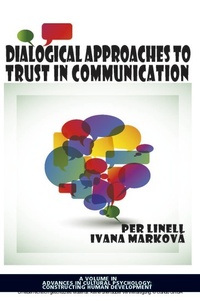
Dialogical Approaches to Trust in Communication
1st Edition
Published on 1. October 2013
295 pages
978-1-62396-450-4 (ISBN)
Description

Trust has a constituent role in human societies. It has been treated as a scientific topic in many disciplines. Yet, despite the fact that trust and distrust come to life primarily in human communication and through language, it has seldom been analyzed from a communicative or linguistic perspective. This is the theme of this path-breaking volume.
This volume contains 12 chapters, plus introduction and epilogue by the editors. They have been authored by leading specialists on trust in language and communication, coming from many disciplines and from different cultures and countries. Most of the authors share a conceptual basis in dialogical theories.
This book is a follow-up volume to two previous volumes on trust within cultural psychology, Trust and Distrust (Marková & Gillespie, 2008) and Trust and Conflict (Marková & Gillespie, 2012). It will be of interest to anyone seriously interested in trust in societies, and in trust and distrust as displayed in communication and language.
All prices
More details
Other editions
Additional editions
Per Linell | Ivana Markova
Dialogical Approaches to Trust in Communication
Book
10/2013
Information Age Publishing
€69.10
Shipment within 3-4 weeks
Content
- Cover
- Dialogical Approaches to Trust in Communication
- Advances in Cultural Psychology: Constructing Human Development
- Dialogical Approaches to Trust in Communication
- Copyright
- CONTENTS
- EDITORS' PREFACE
- SERIES EDITOR'S PREFACE: Trusting the World-Through the Word
- EQUIFINALITY OF TRUST: DIALOGICAL AND MONOLOGICAL
- HOW CAN TRUST BE CONSTRUCTED THROUGH WORDS?
- REFERENCES
- EDITORS' INTRODUCTION: Dialogism and Monologism in the Study of Trust in Communication
- MONOLOGIST AND DIALOGIST APPROACHES IN THE STUDY OF THE HUMAN MIND
- THIS BOOK
- REFERENCES
- I: MORALITIES IN DISCOURSE ON TRUST AND DISTRUST
- 1: FORMS OF TRUST/DISTRUST AND DIALOGICALITY IN FOCUS-GROUP DISCUSSIONS ABOUT MEDICAL CONFIDENTIALITY
- TRUST: AN "ATMOSPHERIC" AND MULTIFACETED NOTION
- THE VARIOUS FORMS OF TRUST
- TRUST AND MEDICAL CONFIDENTIALITY
- METHOD: ONE DILEMMA FOR SIX FOCUS GROUPS
- Data
- Method of Analysis
- BRINGING TRUST INTO DISCOURSE
- Explicit Verbalisation of Trust
- Trust Indirectly Evoked
- Implicit Reference to Trust
- TRUST/DISTRUST IN THE PARTICIPANTS' DISCOURSE
- Trust Mediated by Regulation in the Doctor-Pauline and Doctor-Jean
- Trust Assuming Uncertainty in the Dyads "Doctor-Jean" and "Doctor-Pauline"
- Trust Mediated by Regulation in the Couple
- TRUST ASSUMING ATTACHMENT BETWEEN JEAN AND PAULINE
- TRUST AS AN INDICATOR OF DIALOGICALITY
- APPENDIX: NORMS OF TRANSCRIPTS
- REFERENCES
- 2: TRUST AND THE CONTESTATION OF BLAME NARRATIVES: Veiled Stances in an Institutional Assessment Context
- TOWARD AN ANALYSIS OF VEILED STANCES
- TOWARD A SITUATED ANALYSIS OF ALTERNATIVE VERSIONS
- INSTITUTIONAL IDENTITIES AND CONTRASTING NARRATIVES
- NARRATIVE VOICE: BLAME-IMPLICATIVE ATTRIBUTIONS OF AGENCY
- Summaries and Extreme Case Formulations
- Blame-Implicative Attributions of Deliberate Intentions (Causing Trouble)
- Example 2. [SA10117: 342-365]
- Innuendos Drawing On Contrasts to the Past
- Example 3 [Sofia A10117: 432-453]
- Example 4 [SA10117: 453-475]
- BLAME-IMPLICATIVE DEPLOYMENT OF NARRATIVE TENSE
- CONCLUDING DISCUSSION
- REFERENCES
- 3: "YOU CAN'T REALLY TRUST ANYONE ANYMORE": Trust, Moral Identity and Coming to Terms with the Past
- INTRODUCTION
- TRUST AS A PHENOMENON OF ORDER
- THE LAY GRAMMAR OF TRUST AND DISTRUST
- ANALYTICAL APPROACH
- ANALYSIS
- Public Disclosure
- PUBLIC REACTIONS AND COMMENTARIES
- CONCLUSION
- REFERENCES
- 4: TRUST AND DISTRUST: Dialogical Ways of Self-Other-Culture Relationships
- REVISITING THE POLYSEMY OF TRUST
- TRUST AND DISTRUST IN SELF-OTHER-CULTURE RELATIONSHIPS
- IN CONCLUSION
- REFERENCES
- II: TRUST AND DISTRUST IN INSTITUTIONAL COMMUNICATION
- 5: THE NORTHERN ROCK BANK RUN: An Analysis of Communication within a Distrust Sequence
- A BANK RUN AS A COMMUNICATION SEQUENCE
- OVERVIEW OF ANALYSIS
- 1) Creating Trust: Receiving £24 Billion in Deposits
- 2) The Emergency Loan: Turning Trust into Distrust
- 3) The Bank Run: Withdrawals Catalysing Withdrawals
- 4) Ignored Reassurances
- 5) The UK Government Guarantee
- 6) "A Message from Northern Rock"
- COMMUNICATION AND THE TRANSFORMATIONS OF TRUST/DISTRUST
- ACKNOWLEDGEMENTS
- REFERENCES
- 6: SEARCHING FOR TRUST IN PSYCHOTHERAPY: The Developmental Dynamics of Trust Within a Dialogical Perspective
- DEFINING TRUST: IN THE MIDST OF DIFFERENT SENSES
- A DIALOGICAL SYNTHESIS ABOUT TRUST
- PSYCHOTHERAPY AS A SOCIALLY DISTRIBUTED INSTITUTION AND THE ROLE OF TRUST
- PSYCHOTHERAPY AS AN INTERPERSONAL ENCOUNTER: BUILDING A TRUSTFUL ALLIANCE
- PSYCHOTHERAPY AND SELF-TRUST: THE MICRO-LEVEL OF TRUST
- CONCLUSION: UNITING THE TRANSPERSONAL, INTERPERSONAL, AND INTRAPERSONAL DOMAINS OF TRUST
- ACKNOWLEDGEMENT
- REFERENCES
- 7: TRUSTING FOR LEARNING
- A SOCIOCULTURAL PERSPECTIVE ON LEARNING
- Learning as a Developmental Process
- Learning as a Social Process
- TRUST IN EDUCATION
- Macrosocial Trust
- Interpersonal Trust
- Epistemic Trust
- INNER DIALOGICALITY AND TRUST
- TRUST AND LEARNING IN A SECONDARY SCHOOL CLASS
- Documenting Trusting Practices
- Teacher Trusting Students
- Laura-13:5
- Laura-13:23
- The Teacher Being Trusted as Learner
- Laura 13:52
- Laura 13:45-46
- Trusting the Learners' Capacities
- Laura 13 :21
- Displaying Trust
- Laura 13:33
- Students Trusting the Process of Learning
- Sara 9 :26
- Sara 58 :15
- THE GENERATIVITY OF TRUST AND LEARNING
- Displaying trust might bring trust
- Relational trust might generate epistemic trust
- Interpersonal Dynamics of Trust Might Lead to Critical Learning
- Intergenerational Trust
- MACROSOCIAL DYNAMICS OF (MIS)-TRUST
- DISCUSSION: TRUST IN LEARNING
- REFERENCES
- 8: TRUST IN EDUCATIONAL DISCOURSE: A Risky Undertaking
- INTRODUCTION
- EARLIER STUDIES
- THEORETICAL APPROACH
- THE STUDY
- DATA EXCERPTS
- ANALYSIS AND DISCUSSION
- NOTES
- REFERENCES
- 9: TRUST, DISTRUST AND LANGUAGE
- THE BIOLOGY OF TRUST AND THE HUMAN MIND
- TRUST, DECEPTION AND LANGUAGE
- TRUSTING THE OTHER
- TRUSTING THE COLLECTIVE
- THE INDIVIDUAL WITHIN A SYSTEM
- THE APPLICATION OF TRUST: FROM THEORY TO PRACTICE
- CONCLUDING COMMENTS
- REFERENCES
- III: THEORETICAL PERSPECTIVES ON TRUST AND DISTRUST IN DIALOGUE
- 10: TRUST AS A COMMUNICATIVE AND EPISTEMIC SIMPLIFIER AND FACILITATOR
- 1. INTRODUCTION
- 2. WHAT IS TRUST?
- 2.1. The Semantic Field of Trust
- 2.2. The Meaning Potential of Trust
- 2.3. Levels of Interpersonal Trust
- (1) Basic Trust
- (2) Collaborative Trust
- (3) Cooperative Trust
- (4) Trust with Respect to Commitments and Obligations
- (5) Trust with Respect to Competence
- (i) Temporal Duration and Task Dependence of Trust
- (ii) Degree of Trust
- (iii) Types of Trust
- 2.4 Some Other Definitions of Trust
- 3. TRUST AND DIALOGUE
- 3.1. Why Study Trust in Dialogue?
- 3.2 The Relation of Trust to Dialogue
- 3.3. What is Non-Trust?
- 3.4. What Behavior Can Be Expected in Connection with Trust, Lack of Trust and Mistrust/Distrust?
- 4. AN EXAMPLE OF THE ROLE OF TRUST IN DIALOGUE
- 4.1. Trust as a Default
- Travel Dialogue
- (i) Trust as an Expectation of Basic Competence, Striving Toward Joint Understanding, Ethical Consideration and Ethical Treatment
- (ii) Trust as Expectation of Reliability and Dependability Regarding Commitments and Obligations Related to the Interlocutors and Their Joint Activity
- (iii) Trust as an Expectation of Normal Competence (i.e. Rational, Motivated, Causally Bound Behavior and Action) as Well as Special Competence Relevant for the Activity
- 4.2. Some Evidence of Lack of Trust
- 5. SOME POSSIBLE CONSEQUENCES OF INTRODUCING TRUST AS A DEFAULT ASSUMPTION IN THE ANALYSIS OF DIALOGUE
- 5.1. Trust and Implicit Understanding
- 5.2. Epistemology and Trust
- 5.3. Trust and Social Regulation
- 6. CONCLUDING REMARKS
- REFERENCES
- 11: TRUST AND DISTRUST IN INTERACTION: Some Theoretical and Methodological Points
- 1. THE ABSENCE OF TRUST IN THEORETICAL ACCOUNTS OF THE PRAGMATICS OF LANGUAGE
- 2. COGNITIVE AND ETHICAL ASPECTS OF COOPERATION IN PRAGMATIC APPROACHES
- 3. ETHICS OF TRUST: MONOLOGIST AND DIALOGIST ACCOUNTS
- 4. COMMUNICATION AS A CONTRACT
- 5. THE HERMENEUTICS OF TRUST AND THE HERMENEUTICS OF SUSPICION
- 6. ETHNOMETHODOLOGICAL THEORISATIONS OF TRUST
- 7. TRUST IN COMMUNICATIVE CONTRACTS OF SECRETS AND NON-DISCLOSURE
- 8. TRUST AND DISTRUST IN ASYLUM INTERVIEWS
- 9. DISCUSSION: THEORY AND METHOD
- REFERENCES
- 12: ON TRUST AND DISTRUST IN THE LIFEWORLD
- INTRODUCTION
- TRUST IN THE NATURAL AND SOCIAL WORLD
- WHAT DO I KNOW WHEN I TRUST?
- DANCING RATHER THAN NEGOTIATING
- TRUST IN THE LIFEWORLD
- REFERENCES
- EPILOGUE: Trust Seen as Embodiment, Culture, Language and Morality
- REFERENCES
- ABOUT THE AUTHORS
- SUBJECT INDEX

