

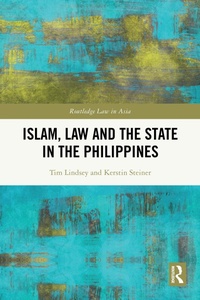
Islam, Law and the State in the Philippines
1st Edition
Published on 6. May 2025
224 pages
978-1-040-34760-7 (ISBN)
Description

This book investigates the development of Islam in the Philippines from a legal perspective, investigating Islam through the lens of the institutions of Islamic law.
Drawing on original fieldwork, including in Mindanao, this comprehensive book covers a wide range of topics, including Islamic leadership and authority (mufti, darul ifta, and fatawa); Islamic judges and dispute resolution in Islamic courts, and alternative forms of dispute resolution; legislative codification of Islamic law especially in private law (marriage and divorce); Islamic banking and finance; and madrasahs and Islamic education. The book also offers a comprehensive, detailed, and timely socio-legal analysis of controversies relating to Islam and the long-running conflict in the Southern Philippines as Moro communities struggle with the challenges of transition to the long-awaited Bangsamoro Autonomous Region of Muslim Mindanao. This is contextualised against the wider history and politics of the southern Philippines, from pre-colonial times to 2024. The authors offer a detailed and nuanced analysis based on primary documents, as well as an account of the existing literature in the field.
The book greatly enhances understandings of the social, political, and historical context of current developments in Islam in the Philippines. It will be of interest to researchers studying Islam and the administration of Islamic law, Malay Muslim communities in Southeast Asia, and the history and politics of the Philippines.
Drawing on original fieldwork, including in Mindanao, this comprehensive book covers a wide range of topics, including Islamic leadership and authority (mufti, darul ifta, and fatawa); Islamic judges and dispute resolution in Islamic courts, and alternative forms of dispute resolution; legislative codification of Islamic law especially in private law (marriage and divorce); Islamic banking and finance; and madrasahs and Islamic education. The book also offers a comprehensive, detailed, and timely socio-legal analysis of controversies relating to Islam and the long-running conflict in the Southern Philippines as Moro communities struggle with the challenges of transition to the long-awaited Bangsamoro Autonomous Region of Muslim Mindanao. This is contextualised against the wider history and politics of the southern Philippines, from pre-colonial times to 2024. The authors offer a detailed and nuanced analysis based on primary documents, as well as an account of the existing literature in the field.
The book greatly enhances understandings of the social, political, and historical context of current developments in Islam in the Philippines. It will be of interest to researchers studying Islam and the administration of Islamic law, Malay Muslim communities in Southeast Asia, and the history and politics of the Philippines.
Reviews / Votes
"This book is a unique and important book that is likely to quickly become the main reference point on law, Islam, and the state in the Philippines. It fills an important gap and will probably find its most receptive audience amongst those interested primarily in political science and law. It will also appeal to those working on Islamic law, comparativists and those interested in regional studies."Simon Butt, The University of Sydney, Australia
"This new book is superbly well presented. It will redefine and redirect the study of Islam and Islamic law in the Philippines and is likely to become the standard reference on the topic. Situated at the interface of Islamic studies, Islamic legal studies, political science, sociology and anthropology, it is a much needed reference for scholars of Islam and Islamic law in Asia and the broader Muslim world."
Robert W. Hefner, Boston University, USA
More details
Series
Edition
1. Auflage
Language
English
Place of publication
London
United Kingdom
Publishing group
Taylor & Francis Ltd
Target group
College/higher education
Illustrations
1 Tables, black and white; 6 Line drawings, black and white; 6 Illustrations, black and white
File size
4,58 MB
ISBN-13
978-1-040-34760-7 (9781040347607)
Copyright in bibliographic data and cover images is held by Nielsen Book Services Limited or by the publishers or by their respective licensors: all rights reserved.
Schweitzer Classification
Other editions
Additional editions
Tim Lindsey | Kerstin Steiner
Islam, Law and the State in the Philippines
Book
05/2025
1st Edition
Routledge
€207.50
Shipment within 10-20 days

Timothy Lindsey
Islam, Law, and the State in the Philippines
Book
05/2025
Routledge
Unfortunately, price unknown
Available (delivery time upon request)
Persons
Tim Lindsey is Malcolm Smith Professor of Asian Law, Redmond Barry Distinguished Professor, and Director of the Centre for Indonesian Law, Islam and Society in the Law School of the University of Melbourne, where he completed PhD, LLB, B. Arts and B. Litt degrees. His more than 110 publications include Islam, Law and the State in Southeast Asia and he is an executive editor of The Australian Journal of Asian Law.
Kerstin Steiner is an Associate Professor in the Law School of La Trobe University and an Associate of the Asian Law Centre and Senior Associate of the Centre for Indonesian Law, Islam and Society, both at the University of Melbourne. She is an award-winning and widely published researcher examining the intersection of law, politics, economics, and society in Southeast Asia.
Kerstin Steiner is an Associate Professor in the Law School of La Trobe University and an Associate of the Asian Law Centre and Senior Associate of the Centre for Indonesian Law, Islam and Society, both at the University of Melbourne. She is an award-winning and widely published researcher examining the intersection of law, politics, economics, and society in Southeast Asia.
Content
Chapter 1 Introduction: Governing the Muslim Minority - Islam, Law and Moro Resistance
Part I. The Moros and the Legacy of Colonialism
Chapter 2. Islam and the Moros under Colonial Law
Part II. Islamic Law After Independence
Chapter 3. Post-Independence Laws for Muslims and Moro Autonomy Initiatives
Part III. State Islamic Institutions
Chapter 4. Islamic Advisory Institutions: State and Non-state Actors
Chapter 5. The Shari'ah Courts
Chapter 6. Islamic Education
Chapter 7. Islamic Banking and Finance
Chapter 8. Conclusion
Part I. The Moros and the Legacy of Colonialism
Chapter 2. Islam and the Moros under Colonial Law
Part II. Islamic Law After Independence
Chapter 3. Post-Independence Laws for Muslims and Moro Autonomy Initiatives
Part III. State Islamic Institutions
Chapter 4. Islamic Advisory Institutions: State and Non-state Actors
Chapter 5. The Shari'ah Courts
Chapter 6. Islamic Education
Chapter 7. Islamic Banking and Finance
Chapter 8. Conclusion
