

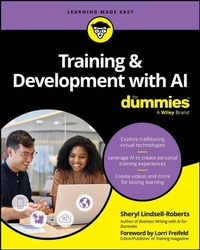
Training & Development with AI For Dummies
Description

An indispensable guide to learning how the dynamic partnership of human intelligence and AI can transform your T&D from good to brilliant
Training & Development with AI For Dummies helps you and your organization implement AI to give your training an effectiveness boost. You'll learn to use AI to help create personalized training, training videos, stories that resonate, and beyond. Major companies like Adobe and Amazon have paved the way for AI-enhanced training creation and delivery. With this book, you can join their ranks and discover the many ways AI can create efficiency and real-time feedback in workplace training.
- Learn how to use AI to automate administrative tasks for training and development
- Determine the best mode of delivery for training content
- Use AI to help you build effective virtual training and gamification
- Explore the possibilities of virtual reality, augmented reality, blockchain technology, and quantum computing
There are lots of ways to transform your training and development programs with AI-creating tailor-made content, speeding up content generation, analyzing gap areas. Seasoned trainers and developers, newbies, content creators, corporate trailblazers, storytellers, team leaders, facilitators, human resources professionals, managers, curators, coaches, or consultants looking to revolutionize their organization's training approach will get the insights they need in Training & Development with AI For Dummies.
More details
Other editions
Additional editions
Person
Sheryl Lindsell-Roberts is an experienced corporate trainer, facilitator, consultant, and business writing specialist. She's the author of Technical Writing For Dummies, Business Writing with AI For Dummies, Grant Writing For Dummies, and Storytelling in Presentations For Dummies. Her articles have been featured in Training magazine, Talent Development, CIO, and other business and training publications.
Content
Foreword xvii
Introduction 1
Part 1: Revolutionizing Training and Development with AI 5
Chapter 1: Igniting T&D with AI Sparks 7
Chapter 2: Exploring the AI Training Emporium 23
Chapter 3: Shaping Your Future as a T&D Extraordinaire 35
Chapter 4: Navigating AI's Legal, Ethical, and Regulatory Compliance Worldwide 53
Part 2: Harnessing Core Principles of T&D in the AI Era 67
Chapter 5: AI Prompt Writing Skill Sprint 69
Chapter 6: Transforming Instructional Design 87
Chapter 7: Structuring Training for Lasting Results 103
Part 3: Doing It Yourself (DIY) with AI 119
Chapter 8: Discovering All You Can About Your Learners 121
Chapter 9: Weaving Stories into the Learning Journey 137
Chapter 10: Revving Up Visuals with AI 159
Chapter 11: Nailing the Right Tone Every Time 171
Part 4: Leveraging AI for Effective Training 189
Chapter 12: Building Connections with Virtual Instructor-Led Training 191
Chapter 13: Upping the Ante with Game-Based Learning 205
Chapter 14: Navigating the Podcast Scene 221
Chapter 15: Supercharging Your Training Videos 237
Part 5: Entering Dynamic Dimensions Aided by AI 255
Chapter 16: Entering the Immersive World of Virtual Reality 257
Chapter 17: Discovering Augmented Reality 269
Chapter 18: Demystifying Blockchain Technology 279
Part 6: The Part of Tens 289
Chapter 19: Ten Tips for Turning Feedback into Your Superpower 291
Chapter 20: Ten (Plus One) Ways to Find Funding for Training Initiatives 297
Chapter 21: Ten Ways Hackathons Can Turn T&D on Its Head 303
Appendix: Lingo Lounge 309
Index 313
Chapter 1
Igniting T&D with AI Sparks
IN THIS CHAPTER
Demystifying the basics of AI
Comparing the rise of AI to the internet's evolution
Aligning AI with T&D business goals
Using AI while staying in charge
Knowing AI's shortcomings
Peeking into the future of AI
Have you ever sat through a training session that felt like a slow march through boredom? The slides were endless, the content felt like it was built for someone - anyone - else, and feedback was nonexistent. Every minute dragged on, making the training feel less like an opportunity and more like an endless marathon.
On the flip side: think of a session where everything just clicks. You're fully engaged, concepts land perfectly, and it feels like the training was designed just for you. You're not zoning out in a sea of generic slides because every moment feels relevant. This training isn't a chore - it's an interactive challenge that keeps you motivated and moving forward. That's the magic artificial intelligence (AI) can bring to training and development (T&D).
Whether through videos, gaming, podcasting, virtual reality (VR), augmented reality (AR), or other methods, AI is making training faster, smarter, and more personalized. Imagine lessons that adapt in real time, adjusting to individual needs without endless prep work. AI insights track learners' progress and highlight where they're thriving or struggling. It's a shift from a one-size-fits-all approach to training that truly engages learners, making knowledge stick and learning more impactful.
In this chapter, you dive into how AI is shaking up T&D, helping trainers teach smarter and learners learn better. Who knows? You may just have a few "Aha!" moments along the way as you explore how AI is flipping traditional T&D on its head. So, buckle up: Personalized learning, smarter tools, and a future full of possibilities await.
Grasping the Essence of AI
Of course, you know that AI means artificial intelligence, but what exactly is it? Think of AI as a really smart assistant you can chat with that can understand you and respond intelligently. (In Chapter 5, you find out how prompts can make that happen.)
When you chat with AI on your phone, tablet, or computer, it's like talking (or writing) to a person, but instead, you're communicating with a computer program called a chatbot. This chatbot has been trained to understand words, answer questions, do research, and even have conversations. It's like having a super helpful robot buddy who's always ready to chat, share ideas, or lend a hand when you're looking for information.
AI supports skill building by providing instant feedback, creating personalized learning paths, and tracking progress. It suggests topics, quizzes and adapts content to keep you and your learners challenged. AI also simulates real-world scenarios, offering a risk-free space in which learners refine their skills.
Reframing AI as the New Internet Revolution
Compare AI to what the internet was in the 1990s. Back then, people were worried that the internet would replace jobs, complicate their lives, or even take over the world. Sure, it did lead to job losses. Brick-and-mortar stores continue to close down as more people shop online. Office work changed, too. Paper-based systems gave way to digital files, customer service moved from the phone to email and online forms, and entire industries had to rethink how they operated. But on the flip side, the internet has generated a whole new system of delivering goods and services. It's created tons of jobs in e-commerce, logistics, and technology. It has also introduced jobs for app developers, online content creators, social media managers, cybersecurity specialists, and so many others.
Platforms like YouTube have given rise to an entirely new way to get information, while e-commerce giants like Amazon have created jobs in warehousing, customer service, and supply chain management. Remote work opportunities have exploded with roles for virtual assistants, freelance writers, and digital marketers. The internet didn't just replace jobs; it reshaped the workforce and opened doors to countless new opportunities.
Following similar paths
With all the unease about AI, it's following a similar path. AI is creating opportunities in AI-assisted healthcare for medical imaging specialists and precision medicine analysts, as well as in education, with roles focusing on developing AI-powered learning systems and designing personalized curricula. You'll also find growing demand in fields like law (e-discovery and contract analysis), finance (AI-driven risk modeling and fraud detection), and manufacturing (predictive maintenance and smart automation). Chapter 3 explores the path to becoming an AI pro, along with the wide range of opportunities and industries it's transforming.
Transforming T&D job opportunities
Just like the internet revolutionized the job market, creating roles for social media managers, SEO specialists, and online course creators, AI is reshaping T&D by introducing innovative jobs that redefine how people teach, learn, and grow. Here's a sampling of some new opportunities that are paving the way for a more dynamic and personalized future in T&D:
- AI Instructional Designer
- AI Integration & Curriculum Consultant
- AI Ethics & Compliance Trainer
- AI Training Project Manager
- Chatbot, VR, & Simulation Developer
- Learning Data & Analytics Specialist
- AI Learning Systems Support Specialist
- Lifelong Learning Strategist (AI Focus)
- AI-Powered Assessment Developer
- Prompt Engineer for Training Tools
- UX Designer for Learning Technologies
- Data Annotator for AI Training Content
So fear not. The potential of AI to transform industries and generate entirely new career paths mirrors the internet's impact, offering a future of innovation, reinvention, and expanded opportunities. Just like the internet of the 1990s, AI is poised to revolutionize the workforce and open new doors of opportunity. It's not about replacing workers; it's about redefining their roles in the workplace and seizing the opportunities of the future. You either embrace the change or become a dinosaur.
Forging a Path to Success
Here's a quick example of AI in action: I originally titled this chapter "Transforming T&D with AI." You'll probably agree that's not exactly gripping. So, I prompted ChatGPT for a little creativity, asking it for five options for "Transforming T&D with AI" starting with a gerund. (Learn about prompting in Chapter 5.) Following is a small nibble of what AI can offer. I could have prompted for more, but No. 1 hit the mark.
The following sections don't simply describe what AI can do; they highlight strategic power moves. With AI riding shotgun, your initiatives don't just run smoothly; they soar. Innovation meets efficiency, creating a future where your organization thrives at the speed of change.
Enhancing employee management
By leveraging AI's employee management capabilities, organizations can foster a more stable, skilled, and secure work environment in the following ways:
- Adaptive learning and skills analysis: AI customizes training, adjusts pacing, and identifies skill gaps for targeted development.
- AI predictive analytics: AI's analytics identify turnover risks and enable proactive HR interventions.
- Cross-functional training: AI created virtual simulations exposing employees to different roles, thereby fostering adaptability.
- Personalized employee experience: AI tailors benefits, career growth, and recruitment for better job satisfaction and retention.
- Workplace safety and risk management: AI predicts hazards, monitors compliance, and enhances safety training with VR/AR. (Find out more about each in Chapters 16 and 17, respectively.)
Gaining the competitive advantage
Staying competitive in today's market means embracing innovative technologies - and that includes how companies train and develop their workforce. AI plays a key role not just in tracking industry trends and competitors' strategies, but also in shaping smarter training programs. By analyzing skill gaps, personalizing learning experiences, and forecasting future needs, AI helps organizations build agile, future-ready teams.
With AI-driven analytics, businesses can streamline operations, boost efficiency, and spark innovation - both in how they work and how they learn. This dual impact enables them to adapt quickly to market changes while setting new benchmarks for delivering exceptional products and services. For example, companies like Netflix use AI not only to track content trends but also to train teams based on real-time audience insights and global preferences.
Extending markets and customer relations
Expanding into new markets and building strong customer relationships are key to driving business growth and staying competitive. With AI, organizations can...
