

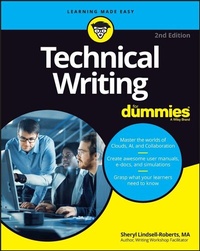
Technical Writing For Dummies
Description

Technical Writing For Dummies is a master class on how to build a career writing user manuals, e-learning, streaming, simulations, and more. It even zooms into the metaverse. Whether you're new to the field, a seasoned professional, or a technical person who needs to write, this guide arms you with the skills you need to cash in on this flourishing world of technical writing. This isn't your average how-to. It's a compendium of innovative industry knowledge that will help you set yourself apart with the latest trends and best practices in technical writing. As a tech writer, you'll need a robust skillset that allows you to offer clear and concise documentation for just about anything. This new edition of Technical Writing For Dummies--updated for all of today's tech writing advances--can get you there.
* Uncover the basics of technical writing and master common documentation types
* Get insight into the career paths available to tech writers today
* Discover new remote collaboration options and cloud-based tools for technical writers
* Learn how to elevate your documents for high search engine optimization (SEO) rankings
* Improve your craft to connect with diverse, global audiences
Whether you're a technical writer or technical professional who needs to write--you can learn the best practices of effective technical writing, as well as how to navigate its various formats and platforms, thanks to this handy Dummies guide.
More details
Other editions
Additional editions
Person
Content
Part 1: What It Takes to Write Technical Docs 5
Chapter 1: Working as a Technical Writer 7
Chapter 2: Putting Together a Team and a Plan 25
Part 2: The Write Stuff 37
Chapter 3: Completing a Technical Writing Brief 39
Chapter 4: Crafting a Draft 51
Chapter 5: Designing Documents to Enhance the User Experience 57
Chapter 6: Honing the Tone 85
Chapter 7: Fine-Tuning toward the Ideal 97
Part 3: Frequently Written Docs 107
Chapter 8: Writing User Manuals and More 109
Chapter 9: Preparing Abstracts 127
Chapter 10: Creating Spec Sheets 133
Chapter 11: Generating Questionnaires 141
Chapter 12: Preparing for Technical Presentations 149
Chapter 13: Abridging for Executive Summaries 159
Part 4: Tech Tools 167
Chapter 14: Collaborating with Others 169
Chapter 15: Videoconferencing 183
Chapter 16: Offering eLearning 195
Chapter 17: Surfing the Net 211
Chapter 18: Protecting Intellectual Property 221
Part 5: The Part of Tens 233
Chapter 19: Ten Tips for Writing a Whitepaper 235
Chapter 20: Ten Tips for Publishing in a Technical Journal 241
Chapter 21: Ten Frustrations of Technical Writers 247
Appendix A: Punctuation Made Easy 253
Appendix B: Grammar's Not Grueling 265
Appendix C: Abbreviations and Metric Equivalents 275
Appendix D: Tech Talk: Glossary of Terms 285
Appendix E: Technical Writing Brief 289
Index 293
Chapter 1
Working as a Technical Writer
IN THIS CHAPTER
Discovering who writes technical documents
Understanding how business and technical documents differ
Creating a portfolio and business cards
Learning about different career trajectories
I didn't go to film school. My grandpa always says just watch a lot of movies. He didn't go to film school; he went to theatre school. It's interesting to learn about the technical side of it, but I think it's more important to learn about writing and working with actors.
-Gia Coppola, Granddaughter of Francis Ford Coppola
Although formal training in technical writing may be helpful, you don't need it any more than Francis Ford Coppola needed film school to become one of the most successful figures of Hollywood filmmaking. What you need is
- A love of learning
- An attention to detail
- A good command of the English language
- An understanding of how people use and process information
- The ability to manage tasks and work well as part of a team
If you arranged your alphabet soup into acronyms when you were a kid, you constantly asked "why" when people told you to stop asking questions, or you sent Santa lists with headings and subheadings, you're a natural-born technical writer.
Technical Writers Spring from All Walks of Life
People who write technical documents come from all walks of life - and most aren't technical writers per se. Here are some actual situations of people who were called upon to write technical documents in the course of their professions:
- Computer programmer: Octavia graduated with a degree in computer science and was hired as a software developer for a company. Several months later, the company felt a financial pinch and laid off the technical writers. Octavia had a big deliverable due in a few months, and her supervisor told her that she had to write a user manual. Sophomore English (which Octavia struggled through and loathed) didn't prepare her for this type of assignment. After all, Shakespeare wasn't a technical sort of guy. Poor Octavia had to muddle through writing the user manual and got gray hair prematurely.
- Manufacturing specialist: Bill worked for a manufacturing company for many years and developed a piece of equipment that was expected to revolutionize the industry. The equipment made its debut in Germany at the industry's largest conference. Bill's supervisor asked him to deliver a paper (the industry term for a making technical presentation) at the conference. The audience would consist of more than 200 high-level industry professionals. Not only did Bill fear the podium more than the dentist's drill, he didn't know how to prepare or deliver a technical paper - especially in a foreign country for an audience of this caliber.
- Biotech scientist: While working at a pharmaceutical company, Abdul had a major breakthrough on a treatment that promised to prevent baldness. The company president asked him to write an article for a major medical journal. Although Abdul was flattered by the president's request, he didn't know the first thing about writing or submitting a technical article.
BRIGHT AND EXCITING FUTURES FOR TECH WRITERS
The Bureau of Labor Statistics released its annual Occupational Handbook for Technical Writers. It predicts that job growth in this field is expected to outpace the national average for all other occupations. This is due in part to the growing high-tech and electronics industries that are embracing the value of superior-quality technical communications - paving the way to solve problems more quickly and easily by intersecting the human experience with the digital world.
- Sales representative: Lynette was a sales representative for a worldwide computer distributor. She'd often be away from home for weeks at a time. After 15 years as a road warrior, Lynette suffered from burnout. (She used to leave her picture on the fireplace mantle so that her family wouldn't forget what she looked like.) Lynette had been reading about the burgeoning field of tech writing. She called a local college, got all the literature, and decided to pursue a degree in technical writing.
Although I changed the names to protect the innocent, scenarios such as these are typical. Technical people who aren't trained writers are constantly asked to write technical documents. Their education and work experience rarely prepare them for this type of challenge. This book can help bridge the gap!
Documentation Is Part of Our Everyday Lives
Whether you realize it or not, documentation is part of our everyday lives - both personal and business. When you buy a new piece of electronics, it comes with instructions. When you buy a DYI (do-it-yourself) furniture kit, it comes with assembly instructions. When you get a prescription for medication, it comes with a leaflet on how often to take the medication and what the side effects may be. Documents are written for all of us, not just for computer geeks who assemble rockets or plasma generators. And it's not just the computer geeks who write technical documents - all technical people do at some point in their careers.
THE HUMBLE BEGINNINGS OF TECH WRITING
Technical writing as we know it today took root in World War II when the U.S. military persuaded "those who served" to write manuals to aid the war effort. The military needed to teach soldiers about weapons, transport vehicles, and other hardware. These "technical writers" had little or no training. They just sat down at their manual typewriters and banged out whatever made sense to them. I don't know whether it made sense to the poor soldiers trying to decipher their writing. But we did win the war!
Technical writing means different things to different people. It covers the fields of electronics, aircraft, computer manufacturing and software development, chemical, biotech, pharmaceuticals, health, and much more. It spans the public and private sectors as well as government and academic institutions.
Technical Writing Differs from Business Writing
Many people ask the difference between business writing and technical writing. The difference is analogous to apples and watermelon. For example, at the very core (pardon the pun), apples and watermelons are fruits. And at the very core, documents are words and graphics. Beyond the core, business and technical documents are different species.
Documents of the business kind
Emails are the crux of business writing and account for as much as 90 percent of all business communication. Other type of business writing include letters, reports, blog posts, articles, and more. One major difference between business and technical documents is that business documents are generally written by one person, often for a single learner or small, select group of learners. Following are some commonly written business documents:
- Agendas
- Emails
- Letters
- Meeting minutes
- Proposals
Documents of the technical kind
People in specialized fields write documents that relate to technical or complex subjects. Unlike business documents, technical documents are often a collaborative effort between a technical writer, UX writer, subject matter expert (SME), editor, and others. Technical documents are generally intended for a vast number of learners. Following are some commonly written technical documents. You find chapters about the specifics of writing each of these documents later in this book.
- Abstracts
- Articles for publication
- eLearning
- Executive summaries
- Functional and detail specifications
- Online help
- Questionnaires
- Reports
- User manuals
Assigning Responsibility for Technical Documents
The responsibility for writing technical documents depends on a company's structure and resources. Following are several ways that companies typically generate technical documents:
- Technical gurus (engineers, software developers, and others) write their own documents. Some of these people may have taken writing courses, but most have no training in writing a cohesive document. These "technical writers" often overlook steps in the process. They write what's obvious to them. And they often haven't identified the needs of their learners.
- These same gurus may draft documents and then turn the drafts over to technical writers to edit, format, and polish. Unless the technical writer has an opportunity to learn the subject matter intimately, many of the steps that may have been overlooked by the gurus aren't identified by the writer or editor. This process does, however, produce a document that may be more pleasing to the eye.
- A technical writer is called in from the onset of a project. The writer works with the developer who's the subject matter expert (SME). They work as a collaborative team, each adding their expertise to the project. This approach is the best of all possible worlds.
It's About Strategy, Not Software
Anyone who writes...
