

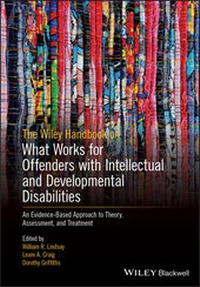
The Wiley Handbook on What Works for Offenders with Intellectual and Developmental Disabilities
Description

Written by a team of international experts, this comprehensive and informative book provides a contemporary picture of evidence-based practice for offenders with intellectual and developmental disabilities. By adopting a scientist-practitioner position directed at an academic level with practitioner guidelines, it provides a valuable reference source for professionals from allied disciplines who are using or seeking to apply research for this client group.
The Wiley Handbook of What Works for Offenders with Intellectual and Developmental Disabilities: An Evidence Based Approach to Theory, Assessment and Treatment is divided into five sections: Introduction, Phenotypes & Genotypes and Offending Behavior, Validated Assessments, Treatment, and Conclusions. The Introduction offers an overview of the entire book and is followed by a second overview covering the ethics of evidence-based practice. After that come chapters on protecting the rights of people with intellectual disabilities in correctional settings, and behavioral and cognitive phenotypes in genetic disorders associated with offending. The third part of the book studies the assessment of individuals with anger and violence issues, inappropriate sexual behavior, alcohol abuse, and emotional difficulties. Next comes a section that looks how to offenders can be treated. The final section discusses future directions and requirements for offenders with intellectual and developmental disabilities.
* Provides an overview of the ethical challenges and issues faced by those who work with intellectually and developmentally disabled offenders
* Focuses on proof of treatment effectiveness and validation of assessment methods to direct readers toward "What Works"
* Features contributions from authors across the entire English-speaking world including the UK, US, Canada, Australia, and New Zealand
The Wiley Handbook of What Works for Offenders with Intellectual and Developmental Disabilities: An Evidence Based Approach to Theory, Assessment and Treatment will appeal to all who work in the field of offenders with intellectual and developmental disabilities, including nursing staff, social workers and probation officers, medical and psychology staff, and more.
More details
Other editions
Additional editions
Persons
William R. Lindsay, PhD, was a Consultant Forensic Clinical Psychologist and Head of Research for Danshell, and Professor of Learning Disabilities and Forensic Psychology at Abertay University, Dundee, Scotland.
Leam A. Craig, PhD, is a Consultant Forensic Clinical Psychologist and Partner at Forensic Psychology Practice Ltd. He is a visiting Professor of Forensic Clinical Psychology, Birmingham City University, Hon. Professor of Forensic Psychology, University of Birmingham, and Hon. Assoc. Professor of Forensic Psychology, University of Nottingham, UK.
Dorothy Griffiths, PhD, is Emerita Professor at the Department of Child and Youth Studies and Centre for Applied Disability Studies, and former Co-Director of the International Dual Diagnosis Certificate Programme, Brock University, St. Catharines, Ontario, Canada.
Content
Acknowledgements ix
About the Editors xi
Notes on Contributors xiii
Foreword xxiii
Part I Introduction 1
1 What Works for Offenders with Intellectual and Developmental Disabilities: Systems for Evaluating Evidence and Book Overview 3
Leam A. Craig, William R. Lindsay, and Dorothy Griffiths
2 What Works: Ethical Considerations When Treating Offenders with Intellectual and Developmental Disabilities 17
Dorothy Griffiths
3 Protecting the Rights of People with Intellectual Disabilities in Correctional Settings 41
Frank Lambrick, Astrid Birgden, Chelsea Troutman, and Danielle McLeod
Part II Phenotypes and Genotypes and Offending Behaviour 67
4 Behavioural and Cognitive Phenotypes in Genetic Disorders Associated with Offending 69
Lauren J. Rice, Stewart L. Einfeld, and Patricia Howlin
Part III Validated Assessments 97
5 Diagnosis of Personality Disorder in Offenders with Intellectual and Developmental Disabilities 99
Nigel Beail
6 Assessment of Anger and Aggression 113
Paul Willner, Andrew Jahoda, and Ken MacMahon
7 Psychological Assessment Procedures for Sex Offenders with Intellectual and Developmental Disabilities 133
Lesley R. Steptoe and Amanda M. Michie
8 Assessment for Social Problem-Solving, Social Information Processing, and Criminal Thinking 167
Peter E. Langdon
9 Assessment of Alcohol Use Disorder and Alcohol-Related Offending Behaviour 181
Joanne E.L. VanDerNagel, Neomi van Duijvenbode, and Robert Didden
10 Assessing People with Intellectual Disabilities Who Have Engaged in Fire Setting 193
Samuel J. Tromans, Verity Chester, and Regi T. Alexander
11 Biopsychosocial Assessment Approach for Offenders with Intellectual Disabilities 219
Deborah Richards, Tyler Oswald, and J. Paul Fedoroff
12 Using a Multicomponent Model in the Assessment of Persons with Intellectual Disabilities and Problems in Sexual Behaviour 239
Robin J. Wilson, Stephanie Ioannou, and Kendra Thomson
Part IV Treatment 261
13 Supporting People with Intellectual and Developmental Disabilities Leaving Prison 263
Kathy Ellem, Michelle Denton, and Danielle Davidson
14 Prison-based Programmes for People with Intellectual and Developmental Disabilities 283
Phillip Snoyman, Berindah Aicken, and Jayson Ware
15 Treatment of Anger and Violence in Individuals with Intellectual Disability 297
Robert Didden, Henk Nijman, Monique Delforterie, and Marije Keulen-De Vos
16 Treatment of Inappropriate Sexual Behaviour by People with Intellectual Developmental Disabilities 311
Leam A. Craig
17 Treatment for Social Problem Solving and Criminal Thinking 327
Susan Hayes
18 Treating Substance Misuses Amongst Offenders with Intellectual and Developmental Disabilities 341
Danielle Newton and Jane McGillivray
19 Treatment for Emotional Difficulties Related to Offending for People with an Intellectual Disability 357
Paul Oxnam and Emma Gardner
20 Treatment Outcomes for People with Autistic Spectrum Disorder in Forensic Settings 373
Peter Sturmey
21 Pharmacological Approaches for Offenders with Intellectual and Developmental Disabilities 389
Daniel Turner and Peer Briken
Part V Conclusions 405
22 Future Directions for What Works for Offenders with Intellectual and Developmental Disabilities 407
Dorothy Griffiths and Leam A. Craig
Index 421
Notes on Contributors
Berindah Aicken, is the State-wide Manager of Specific Needs and has worked for Corrective Services New South Wales, Australia in the roles of Forensic, Senior, and Chief Psychologist. Her work and research interests include offenders with disability, mental health impairment, ageing offenders, female offenders with children, and those at risk of suicide/self-harm, particularly the intersection of these issues with broader systemic concerns and the implications for policy and practice.
Regi T. Alexander, MD, is a Consultant Psychiatrist at Hertfordshire Partnership University NHS Foundation Trust and Honorary Senior Lecturer, Department of Health Sciences, University of Leicester.
Nigel Beail, PhD, is a Consultant Clinical Psychologist and Professional Lead for Psychological Services for South West Yorkshire Partnership NHS Foundation Trust, and Professor of Psychology at the Clinical Psychology Unit, Department of Psychology at the University of Sheffield, UK. He is a Fellow of the British Psychological Society, a Trustee of the British Institute for Learning Disabilities, former President of the European Association for Mental Health in Intellectual Disability, and a founder and Fellow of the Institute for Psychotherapy and Disability. He has published extensively on practice-based research from his clinical work.
Astrid Birgden, PhD, is a Forensic and Clinical Psychologist with over 30 years experience working with serious offenders, including clients with intellectual disability. As a practitioner, Dr Birgden conducts assessments, designs programmes and training packages, and develops policy in correctional and human services systems. She is also an Adjunct Clinical Associate Professor at Deakin University and has published in the areas of offender rehabilitation, human rights, and therapeutic jurisprudence.
Peer Briken is a Professor of Sexual Research and Forensic Psychiatry and Director of the eponymous institute at the University Hospital Hamburg-Eppendorf. The Institute was the first institution of post-war university-sexology in Germany and is today the largest interdisciplinary institution of sexual science in Germany. His research focuses on the diagnosis and therapy of sexual disorders and sexual violence. He also works as a court expert and is co-editor of the Journal of Sexual Research and the journal Personality Disorders: Theory and Therapy. Until 2016 he was the first chairman of the German Society for Sexual Research. Since January 2016, he has been a member of the Independent Commission on the Treatment of Child Sexual Abuse.
Verity Chester is a PhD Candidate in the Norwich Medical School at the University of East Anglia, and a Research Associate at St Johns House, a forensic intellectual disability service in Norfolk.
Leam A. Craig, CPsychol, CSci, MAE, FBPsS, FAcSS, EuroPsy, PhD, is a Consultant Forensic Clinical Psychologist, a Chartered and Registered [Forensic and Clinical] Psychologist, and a Partner at Forensic Psychology Practice Ltd. He is the Hon. Professor of Forensic Psychology, Centre of Applied Psychology, University of Birmingham; Visiting Professor of Forensic Clinical Psychology, School of Social Sciences, Birmingham City University; and Hon. Associate Professor of Forensic Psychology, University of Nottingham, UK. He was awarded a Fellowship of the British Psychological Society and the Academy of Social Sciences for distinguished contributions to psychology and the social sciences. He has previously worked in forensic psychiatric secure services, learning disability hospitals, and consultancy to prison and probation services throughout England, Wales, and Northern Ireland, specializing in high-risk, complex cases. He is currently a Consultant to the National Probation Service on working with offenders with personality disorders. He has over 100 publications including 11 books. In 2013 he received the Senior Academic Award from the Division of Forensic Psychology for distinguished contributions to academic knowledge in forensic psychology and in 2018 won an Emerald Literati Award for a Highly Commended paper. In 2015 he co-authored a Ministry of Justice report into the use of expert witnesses in family law and in 2016 he was appointed as Chair of the British Psychological Society, Expert Witness Advisory Group. His research interests include sexual and violent offenders, personality disorder, and forensic risk assessment and the use of psychologists as expert witnesses in civil and criminal courts.
Danielle Davidson, PhD, is a lecturer in social work and human services in the School of Public Health and Social work, Queensland University of Technology. She has a multi-discipline background with degrees the areas of criminology, psychology, and counselling, and a PhD in social work and human services. She has extensive social research experience across these three disciplines and is passionate at teaching and carrying out applied research. Since completing her PhD on youth counsellors' experiences of telephone counselling she has continued her interest in exploring the experiences and well-being of human service practitioners, through the lenses of critical, complexity, and organizational theories. Her current publications include an evaluation report and journal article about a relational case management programme to assist those experiencing generational poverty, and a conference paper outlining the limitations of the existing employment service system in Australia and the need for more holistic service provision in this area of practice.
Monique Delforterie, PhD, is a senior researcher at Trajectum, a treatment facility for adults with mild intellectual disability and severe behavioural and mental health problems.
Michelle Denton, RN, MBA, PhD, has worked for over 30 years in a range of clinical, management, research, and policy roles in mental health as well as some involvement in the disability and refugee health sectors. She has worked in numerous senior policy and strategic planning roles such as managing The Queensland Forensic Mental Health Service for 14 years including the development of mental health services in prisons across the state. After completing her PhD in 2014 on the prison-to community experience of men with co-occurring mental illness and substance use disorder she was awarded a postdoctoral research fellowship in the School of Nursing, Midwifery, and Social Work at The University of Queensland to teach mental health and undertake research on the health service user experience and experience-based co-design. She retains a strong commitment to collaboratively supporting the development of human service organizations, particularly for people with mental illness and disability.
Robert Didden, PhD, is a Professor of Intellectual Disability, Learning, and Behaviour at the Radboud University at Nijmegen. In addition he is a health care psychologist and senior researcher at Trajectum, a treatment facility for adults with mild intellectual disability and severe behavioural and mental health problems.
Stewart L. Einfeld is a child and Adolescent Psychiatrist, Emeritus Professor at the Faculty of Health Sciences, University of Sydney, and a Senior Scientist at the Brain and Mind Centre. Professor Einfeld has research interests in the area of child and adolescent psychiatry, developmental disabilities, including intellectual disability and its genetic causes, and autism. Professor Einfeld is co-developer of the Developmental Behaviour Checklist. This instrument is widely used in clinical and research settings both within Australia and internationally, and has been translated into 21 languages. Professor Einfeld was co-Chief Investigator of the Australian Child to Adult Development (ACAD) Study, funded by the National Health and Medical Research Council and National Institutes of Health. This study examined a broad range of biological, psychological, and social factors of potential protection and vulnerability in the development of behavioural and emotional problems in children and adolescents with intellectual handicap. Professor Einfeld has played a major role in promoting a re-emergence of interest in intellectual disability in the psychiatric profession in NSW in particular. Professor Einfeld's awards include the World Health Organisation Travelling Fellow, Australian Society for Psychiatric Research Junior Travel Award, National Research Prize from the Australian Society for Study of Intellectual Deficiency.
Kathy Ellem, PhD is a Senior Lecturer in social work at the School of Nursing, Midwifery, and Social Work, University of Queensland. She has many years of practice experience as a social worker in the disability sector in both government and non-government services and is currently a member of the Regional Disability Advisory Council for the Queensland government. Her research publications include qualitative life-story work with ex-offenders with intellectual disability, and practice research on working with people with a disability and their families. Her current research examines the experiences of young people with cognitive disabilities and the police, and the transition experiences of young people with complex needs (including intellectual and developmental disability) through multiple service systems, including youth justice, child protection, homelessness, and drug and alcohol services.
J. Paul Fedoroff, MD, is the Director of the Sexual Behaviors Clinic...
