

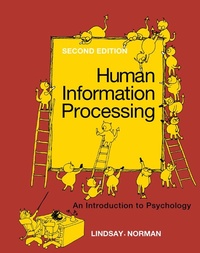
Human Information Processing
An Introduction to Psychology
2nd Edition
Published on 22. October 2013
802 pages
978-1-4832-5823-2 (ISBN)
Description

Human Information Processing: An Introduction to Psychology, Second Edition, was written to reflect recent developments, as well as anticipate new directions, in this flourishing field. The ideas of human information processing are relevant to all human activities, most especially those of human interactions. The book discusses all the traditional areas and then goes beyond: consciousness, states of awareness, multiple levels of processing (and of awareness), interpersonal communication, emotion, and stress. The book begins with an introduction to some of the more interesting phenomena of perception and poses some of the puzzles faced by those who would attempt to unravel the structures. Separate chapters cover the systems of most interest for human communication: the visual system and the auditory system; the structure of the nervous system; and the systems of memory: sensory information storage, short-term memory, and long-term memory. Subsequent chapters deal with the different aspects of memory, including show how memory is used in thought, in language, and in decision making. Also examined are the neurological basis of memory and the representation of knowledge within memory.
More details
Other editions
Additional editions

Book
05/1977
2nd Edition
Academic Press
€27.24
Article exhausted; check different version
Previous edition
E-Book
09/2013
1st Edition
Academic Press
€70.95
Available for download
Content
PrefaceAcknowledgments1. Human Perception Preview Interpreting Sensory Messages Matching Templates Data-Driven and Conceptually Driven Processing Some Perceptual Phenomena Organizing Degraded Images Competing Organizations Organization without Meaning Making the Data Fit the Conceptualization The Importance of Rules Perception of Space The Importance of Context Feature Analysis Stopping the Image Aftereffects The Explanation of Aftereffects Orientation-Specific Color Adaptation Perception without Features Review of Terms and Concepts Suggested Readings Perception Art2. The Visual System Preview Light Decibels The Optical Path The Pupil The Lens The Retina Chemical Responses to Light The Photochemical Reaction The Neuroanatomy of Vision The Retinal Network The Pathway to the Brain Sampling Visual Information Eye Movements The Localizing Channel Vision without a Visual Cortex Vision without a Superior Colliculus Review of Terms and Concepts Suggested Readings3. The Dimensions of Vision Preview Sensory Experiences The Perception of Brightness Brightness Contrast Mach Bands Spatial Frequency Analysis The Measurement of Visual Sensitivity Equibrightness Contours Temporal Characteristics of Vision Integration Time When Flashing Lights Become Continuous Critical Flicker Colors The Color Circle Making Paints Mix as Lights Color Sensitivity of Cones Induced Contrast Opponent Process Color Theory Review of Terms and Concepts Suggested Readings Color Vision Spatial Frequency Analysis4. The Auditory System Preview The Ear The Physics of Sound The Frequency of Sound The Intensity of Sound The Mechanics of the Ear The Inner Ear Movements of the Basilar Membrane The Hair Cells Electrical Responses to Sound Tuning Curves Temporal Coding in Neural Responses Coding of Intensity Information Review of Terms and Concepts Suggested Readings5. The Dimensions of Sound Preview Sensory Experiences Loudness Equiloudness Contours Listening To Music Masking The Measurement Of Loudness Pitch The Musical Scale The Mel Scale Place Theory: Position on the Basilar Membrane Periodicity Pitch Masking the Missing Fundamental Evidence against the Periodicity Pitch Theory The Duplicity Theory of Pitch Perception The Critical Band Auditory Space Perception Localization Importance Of Binaural Listening The Precedence Effect Recordings Review of Terms and Concepts Suggested Readings6. Neural Information Processing Preview Part I: Neural Processes The Eye of a Frog Physiological Procedures Basic Neural Circuits Lateral Inhibition Responding to Movement Part II: Brain Processes From the Eye to the Brain Extracting Features Acoustic Information Processing What Next? Conclusion Review of Terms and Concepts Suggested Readings7.
