

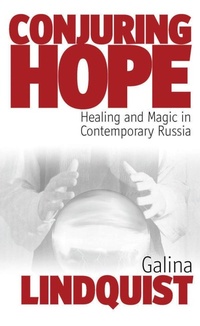
Conjuring Hope
Description

Notions of magic and healing have been changing over past years and are now understood as reflecting local ideas of power and agency, as well as structures of self, subjectivity and affect. This study focuses on contemporary urban Russia and, through exploring social conditions, conveys the experience of living that makes magic logical. By following people's own interpretations of the work of magic, the author succeeds in unraveling the logic of local practice and local understanding of affliction, commonly used to diagnose the experiences of illness and misfortune.
More details
Other editions
Additional editions
Person
Galina Lindquist (1955-2008) was a Senior Lecturer in the Department of Social Anthropology, Stockholm University. She received her Ph.D. in 1998, and did fieldwork among neo-shamans in Sweden, among alternative healing practitioners and patients in Moscow, and among shamans and lamas in Tyva, Southern Siberia. She authored Conjuring Hope: Healing and Magic in Contemporary Russia (2006), The Quest for the Authentic Shaman: Multiple Meanings of Shamanism on a Siberian Journey (2006), co-edited four volumes, and published numerous articles in professional journals.
Content
Acknowledgements
Preface
Introduction
Chapter 1. Marketing Magic
Chapter 2. Magic as Semiotic Changes: Ontologies, Rituals and Terms of Affliction
Chapter 3. Magic as Management of Emotions
Chapter 4. The Icons of Power: Constructing Charisma from the Means at Hand
Chapter 5. Charisma of the Office: Healing Power and Biomedical Legitimacy
Chapter 6. The Unspeakable Emotions: Spells and Their Use in Working Life
Chapter 7. The Magic of Business and the Fostering of Hope
Epilogue
Bibliography
Index
