

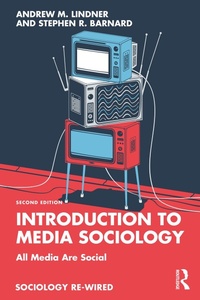
Introduction to Media Sociology
All Media Are Social
2nd Edition
Published on 18. May 2026
234 pages
978-1-040-54003-9 (ISBN)
Description

From streaming platforms to smartphone apps to good old-fashioned newspapers, media are nearly omnipresent in contemporary life and act as a powerful social institution. In this new edition of Introduction to Media Sociology, Lindner and Barnard encourage readers to think critically about topics such as the power of big media companies; state-media relations; politics and journalism; representations of race, class, gender, and sexuality in media; and what social media may or may not be doing to our brains. Each chapter explores pressing questions about media by synthesizing insights from classic and contemporary social scientific research, both quantitative and qualitative, with examples drawn from new and traditional media from across the globe. The second edition reflects the evolving power of Big Tech firms, the proliferation of misinformation, and voices from outside the mainstream. It also features a new chapter on generative artificial intelligence that addresses its potential to disrupt the creation, distribution, and reception of media, including by supercharging scams, deepfakes, and hate speech, or by reshaping social relationships. With strong emphases on theory and methods, Lindner and Barnard once again provide students and general readers alike with the tools to better understand the ever-changing media landscape.
Reviews / Votes
"This is a thoroughly engaging and endlessly provocative introduction to media sociology. Lindner and Barnard address both classic and contemporary debates about communications and culture, raising key questions about power, policy, and media ownership as well as concerns about creativity, disinformation, and generative AI. An excellent textbook."Eric Klinenberg, Helen Gould Shepard Professor in the Social Sciences, New York University
"Introduction to Media Sociology is delightful to read and packed with fresh data and vivid case studies. Impressively, it is of the moment in an uncertain time. Students need the tools it offers-not just understanding, but the capacity to wrest some autonomy from an increasingly powerful industry."
Lisa Wade, Associate Professor of Sociology, Tulane University
"Brimming with insight, Introduction to Media Sociology: All Media Are Social is an indispensable guide to the contemporary world of media, from legacy newspapers to AI. If today's media is the water we swim in - both pervasive and yet often invisible - the book's comprehensive and astute analysis is like a life raft arriving just in time. With cogent explanations of the political, cultural and economic forces at work, the book covers and explains the emerging paradoxes of media in our time, such as: How has there been both an explosion of diverse media and yet more homogeneity in the media we see? How can media be both a force for insurgency and a tool of the repressive state? What comes first, political polarization or the rise of partisan media? How can crime be at record low levels and yet the subject of burgeoning media coverage? A vital resource for those looking to decode the mysteries of modern media, Introduction to Media Sociology: All Media Are Social offers the deep reckoning we need."
Allison Pugh, Professor of Sociology, Johns Hopkins University
"The magic of sociology is that it leads us to see the familiar in startling new ways. In the best of this tradition, Lindner and Barnard's idea-packed introduction to media sociology is truly eye-opening. Whether you are a media professional, a student, or a concerned citizen, this one-of-a-kind book will help you navigate the increasingly complex maze of our media-saturated world."
Rodney Benson, New York University Professor of Media, Culture, Communication, and Sociology, and lead author of How Media Ownership Matters
"With firm sociological grounding, Introduction to Media Sociology maintains acute relevance in an ever-changing media landscape. Sophisticated, accessible, and all around exemplary. This is at once a piece of scholarship and pedagogy, and students of all kinds are better for it."
Jenny L. Davis, Gertrude Conaway Vanderbilt Chair and Professor of Sociology, Vanderbilt University
More details
Series
Edition
2nd edition
Language
English
Place of publication
London
United Kingdom
Publishing group
Taylor & Francis Ltd
Target group
College/higher education
Illustrations
1 Tables, black and white; 20 Line drawings, black and white; 8 Halftones, black and white; 28 Illustrations, black and white
File size
111,77 MB
ISBN-13
978-1-040-54003-9 (9781040540039)
Copyright in bibliographic data and cover images is held by Nielsen Book Services Limited or by the publishers or by their respective licensors: all rights reserved.
Schweitzer Classification
Other editions
Additional editions
Book
05/2026
2nd Edition
Routledge
€50.00
Shipment within 10-20 days
Book
05/2026
2nd Edition
Routledge
€179.50
Shipment within 10-20 days
Persons
Andrew M. Lindner is Professor of Sociology at Skidmore College in Saratoga Springs, New York. He studies the intersection of culture, mass media, and politics. His research has appeared in publications including Proceedings of the National Academy of the Sciences, New Media & Society, and Social Problems.
Stephen R. Barnard is Professor of Sociology and Criminology at Butler University in Indianapolis, Indiana. His work on media, politics, and culture has appeared in publications including Information, Communication & Society, New Media & Society, and Journalism. He is also the author of Hacking Hybrid Media: Power and Practice in an Age of Manipulation.
Stephen R. Barnard is Professor of Sociology and Criminology at Butler University in Indianapolis, Indiana. His work on media, politics, and culture has appeared in publications including Information, Communication & Society, New Media & Society, and Journalism. He is also the author of Hacking Hybrid Media: Power and Practice in an Age of Manipulation.
Content
List of Figures and Tables Preface Acknowledgments 1. All Media Are Social, 2. Theorizing the Media, 3. Who Pays for It?, 4. In the Hands of a Few 5. Big Brother Knows You're Watching, 6. The Makers and the Breakers, 7. Fear and Loathing on Cable News 8. Doing Gender and Sexuality in Media 9. Unequal Images in an Unequal Age 10. Are We Robots? 11. Or Are We Rebels? 12. A Ghost in the Machine Recommended Resources
