

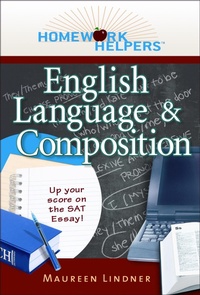
Homework Helpers: English Language & Composition
Published on 23. June 2023
355 pages
978-1-60163-848-9 (ISBN)
Description

Essential preparation for the new SAT Writing and Grammar Section.Homework Helpers: English Language & Composition is a user-friendly review book that will make any student-or those trying to help them-feel like he or she has a private tutor. Each chapter includes detailed questions that allow students to assess how well they've mastered each idea. Not only does the author provide the right answers to these self-study questions, but also detailed explanations of why the wrong answers are wrong.When is a comma used? Why are some titles capitalized? How are dangling modifiers prevented? There are hundreds of grammatical and compositional rules, many of them difficult to understand and memorize. And just as many exceptions to the rules!Homework Helpers: English Language and Composition focuses on all aspects of writing, with clear lessons and exercises on:. Parts of speech. Punctuation. Tone. The writing process. Types of sentences. Types of essays. Revisions. Common errors to avoidStudents from high school through college will find this book to be an essential writing tool. Younger students can follow the lessons from beginning to end to learn everything they need to know about language and composition. The more experienced student can pick and choose lessons and exercises according to need-especially if they're facing the new SAT. The Homework Helpers Series is just what students need to boost their confidence and give them the help they need to ace even the most challenging classes and tests.
More details
Other editions
Additional editions
Book
08/2005
Career Press
€14.50
Article exhausted; check different version
Person
Maureen Lindner, a faculty member of Dobbs Ferry High School in Westchester County, NY, has been teaching English at all levels for the past eight years. Certified to teach English in the International Baccalaureate Program, she has experience in rural, suburban, and urban schools. Prior to pursuing her teaching career, she worked as an editor for a translation service in Westchester County. Ms. Lindner earned a Bachelor of Arts Degree in English and Secondary Education from S.U.N.Y. New Paltz, and a Master of Science Degree with Distinction from Mercy College. She continues her post-graduate studies in English and Education through various programs. Maureen resides in Hastings-on-Hudson, NY with her husband and three children. Her brother, Greg Curran, is the author of Homework Helpers: Chemistry.
Content
- Cover
- Copyright
- Contents
- Introduction
- 1. Parts of Speech
- Lesson 1-1: Nouns
- Lesson 1-2: Pronouns
- Lesson 1-3: Verbs and Verb Phrases
- Lesson 1-4: Adjectives and Adverbs
- Lesson 1-5: Prepositions
- Lesson 1-6: Conjunctions
- 2. Phrases, Cluses, and Sentences
- Lesson 2-1: Types of Sentences
- Lesson 2-2: The Simple Sentence
- Lesson 2-3: Phrases
- Lesson 2-4: Clauses
- Lesson 2-5: Sentence Structures
- 3. Tense Review
- Lesson 3-1: Verb Forms
- Lesson 3-2: Simple Tenses
- Lesson 3-3: Perfect Tenses
- Lesson 3-4: Progressive Tenses
- Lesson 3-5: Perfect Progressive Tenses
- Lesson 3-6: The Passive Voice
- Lesson 3-7: Mood and the Subjunctive
- Lesson 3-8: Irregular Verbs
- 4. Selecting Effective Words
- Lesson 4-1: Choosing the Correct Word
- Lesson 4-2: Spelling Rules
- Lesson 4-3: Vocabulary
- Lesson 4-4: Diction
- 5. Capitalization and Punctuation
- Lesson 5-1: Capitalization
- Lesson 5-2: Periods
- Lesson 5-3: Exclamation Marks
- Lesson 5-4: Question Marks
- Lesson 5-5: Commas
- Lesson 5-6: Semicolons
- Lesson 5-7: Colons
- Lesson 5-8: Quotation Marks
- Lesson 5-9: Apostrophes
- Lesson 5-10: Parentheses
- Lesson 5-11: Underline or Italics
- Lesson 5-12: Hyphens
- 6. The Writing Process
- Lesson 6-1: Subject, Auduence, and Purpose
- Lesson 6-2: Exploring a Topic
- Lesson 6-3: Creating a Thesis Statement
- Lesson 6-4: Organization
- Lesson 6-5: The Paragraph
- Lesson 6-6: The Outline
- Lesson 6-7: Editing and Revising
- 7. Types of Essays
- Lesson 7-1: The Expository Essay
- Lesson 7-2: The Narrative Essay
- Lesson 7-3: The Descriptive Essay
- Lesson 7-4: The Compare or Contrast Essay
- Lesson 7-5: The Persuasive Essay
- Lesson 7-6: The Process Essay
- Lesson 7-7: The Thematic Essay
- Lesson 7-8: The Definition Essay
- 8. Research and Citation
- Lesson 8-1: Planning Your Research
- Lesson 8-2: The Research Paper
- Lesson 8-3: Citation
- 9. Most Common Errors
- Lesson 9-1: Fragments and Run-Ons
- Lesson 9-2: Subject/Verb Agreement
- Lesson 9-3: Comma Errors
- Lesson 9-4: Pronoun Errors
- Lesson 9-5: Tense Errors
- Lesson 9-6: Preposition Errors
- Lesson 9-7: Homonym Errors
- Lesson 9-8: Spelling Errors
- Lesson 9-9: Tone
- Glossary
- Index
- About the Author
