

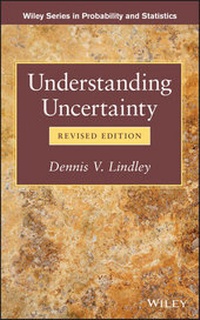
Understanding Uncertainty, Revised Edition
Description

More details
Other editions
Additional editions
Person
Content
Preface xi
Prologue xiii
1. Uncertainty 1
1.1. Introduction 1
1.2. Examples 2
1.3. Suppression of Uncertainty 7
1.4. The Removal of Uncertainty 8
1.5. The Uses of Uncertainty 9
1.6. The Calculus of Uncertainty 11
1.7. Beliefs 12
1.8. Decision Analysis 13
2. Stylistic Questions 15
2.1. Reason 15
2.2. Unreason 17
Literature 17
Advertising 17
Politics 18
Law 18
Television 18
2.3. Facts 19
2.4. Emotion 19
2.5. Prescriptive and Descriptive Approaches 20
2.6. Simplicity 22
2.7. Mathematics 23
2.8. Writing 25
2.9. Mathematics Tutorial 26
3. Probability 30
3.1. Measurement 30
3.2. Randomness 32
3.3. A Standard for Probability 34
3.4. Probability 35
3.5. Coherence 36
3.6. Belief 37
3.7. Complementary Event 39
3.8. Odds 40
3.9. Knowledge Base 43
3.10. Examples 44
3.11. Retrospect 46
4. Two Events 47
4.1. Two Events 47
4.2. Conditional Probability 49
4.3. Independence 51
4.4. Association 53
4.5. Examples 54
4.6. Supposition and Fact 56
4.7. Seeing and Doing 57
5. The Rules of Probability 59
5.1. Combinations of Events 59
5.2. Addition Rule 61
5.3. Multiplication Rule 62
5.4. The Basic Rules 64
5.5. Examples 66
5.6. Extension of the Conversation 68
5.7. Dutch Books 70
5.8. Scoring Rules 72
5.9. Logic Again 73
5.10. Decision Analysis 74
5.11. The Prisoners' Dilemma 75
5.12. The Calculus and Reality 76
6. Bayes Rule 79
6.1. Transposed Conditionals 79
6.2. Learning 81
6.3. Bayes Rule 82
6.4. Medical Diagnosis 83
6.5. Odds Form of Bayes Rule 86
6.6. Forensic Evidence 88
6.7. Likelihood Ratio 89
6.8. Cromwell's Rule 90
6.9. A Tale of Two Urns 92
6.10. Ravens 94
6.11. Diagnosis and Related Matters 97
6.12. Information 98
7. Measuring Uncertainty 101
7.1. Classical Form 101
7.2. Frequency Data 103
7.3. Exchangeability 104
7.4. Bernoulli Series 106
7.5. De Finetti's Result 107
7.6. Large Numbers 109
7.7. Belief and Frequency 111
7.8. Chance 114
8. Three Events 117
8.1. The Rules of Probability 117
8.2. Simpson's Paradox 119
8.3. Source of the Paradox 121
8.4. Experimentation 122
8.5. Randomization 123
8.6. Exchangeability 125
8.7. Spurious Association 128
8.8. Independence 130
8.9. Conclusions 132
9. Variation 134
9.1. Variation and Uncertainty 134
9.2. Binomial Distribution 135
9.3. Expectation 137
9.4. Poisson Distribution 139
9.5. Spread 142
9.6. Variability as an Experimental Tool 144
9.7. Probability and Chance 145
9.8. Pictorial Representation 147
9.9. The Normal Distribution 150
9.10. Variation as a Natural Phenomenon 152
9.11. Ellsberg's Paradox 154
10. Decision Analysis 15810.1. Beliefs and Actions 158
10.2. Comparison of Consequences 160
10.3. Medical Example 162
10.4. Maximization of Expected Utility 164
10.5. More on Utility 165
10.6. Some Complications 167
10.7. Reason and Emotion 168
10.8. Numeracy 170
10.9. Expected Utility 171
10.10. Decision Trees 172
10.11. The Art and Science of Decision Analysis 175
10.12. Further Complications 177
10.13. Combination of Features 179
10.14. Legal Applications 182
11. Science 186
11.1. Scientific Method 186
11.2. Science and Education 187
11.3. Data Uncertainty 188
11.4. Theories 190
11.5. Uncertainty of a Theory 193
11.6. The Bayesian Development 195
11.7. Modification of Theories 197
11.8. Models 199
11.9. Hypothesis Testing 202
11.10. Significance Tests 204
11.11. Repetition 206
11.12. Summary 208
12. Examples 211
12.1. Introduction 211
12.2. Cards 212
12.3. The Three Doors 213
12.4. The Newcomers to Your Street 215
12.5. The Two Envelopes 217
12.6. Y2K 220
12.7. UFOs 221
12.8. Conglomerability 224
13. Probability Assessment 226
13.1. Nonrepeatable Events 226
13.2. Two Events 227
13.3. Coherence 230
13.4. Probabilistic Reasoning 233
13.5. Trickle Down 234
13.6. Summary 236
Epilogue 238
Subject Index 243
Index of Examples 248
Index of Notations 250
Chapter 2
Stylistic Questions
2.1 Reason
The approach adopted, at least at the beginning of this book, is based firmly on reason, the wonderful facility that human beings possess, enabling them to comprehend and manipulate the world about them; and only later will emotional and spiritual aspects of uncertainty be considered. “Reason centers attention on the faculty for order, sense, and rationality in thought” says Webster's dictionary, going on to note that “reason is logic; its principle is consistency: it requires that conclusions shall contain nothing not already given in their premises”. A contrasting concept is emotion “the argument which is not an argument, but an appeal to the emotions”.
The program that will be adopted is to state some properties of uncertainty that seem simple and obvious, the premises mentioned in the second quotation above, and from them to deduce by reasoning other, more complicated properties that can be usefully applied. As an example of a premise, suppose you think it is more likely to rain tomorrow than that your train today will be late; also that the latter event is more likely than that your car will break down on traveling to the railway station; then it is necessary that you think rain is more likely than the breakdown. The references to rain, trains, and accidents are not important; the essential concept is contained in an abstraction. Recalling our use of “you”, “event”, and “belief” as described in § 1.7, the premise is that if you have stronger belief in event A than in event B; and, at the same time, stronger belief in event B than in event C, then necessarily you have stronger belief in A than in C, the exact meanings of A, B, and C being irrelevant. Starting from abstract premises like this, pure reasoning in the form of logic will be used to deduce other properties of uncertainty that can then be applied to concrete situations to give useful results. Thus, abstract A becomes “rain”, B refers to the train, and C refers to the breakdown. This premise is discussed in some detail in §12.10.
There are two points to be made about the premises. Firstly, they are intended to be elementary, straightforward, and obvious, so that no justification is needed and, after reasonable reflection, you will be able to accept them. Secondly, they should be judged in conjunction with the results that flow from them by pure reasoning. It is the package of premises and results that counts, more than the individual items, for if one of the premises is false, then all the consequences are suspect. If you, the reader, find one of the premises unacceptable, as you might that given above, then I would ask you to bear with it and follow through the argument to see where reason takes you; and only then to reach a final judgment. I know of no conclusion that follows by pure reason from the premises adopted here, which appears unsound. Although we shall meet conclusions that at first surprise, further reflection suggests that they are correct and that our common sense is faulty. Indeed, one of the merits of our approach is that it does produce results that conflict with common sense and yet, on careful consideration, are seen to be sound. In other words, it is possible to improve on common sense. The whole package will be termed a calculus, a method of calculating with beliefs.
There is an additional reason for thinking that the conclusions are sound, which rests on the fact that different sets of premises lead to the same conclusions. For example, the premise cited above can be avoided and replaced by another that some find more acceptable, without altering the whole structure. Though only one line of argument will be used in this book, mention will be made of other approaches, the important result being that all lead to the same calculus. It is like several people starting out from different places but finding that all roads lead to Rome. The metaphor is a happy one since one of the leaders in developing a proper understanding of uncertainty, Bruno de Finetti, was a professor in Rome and stood in an election there. Other writers have used premises that do not lead to Rome, while others have dispensed with premises and suggested a calculus that differs from ours. Some of these will be considered from §5.7 onward, but for the moment I ask you to go along, at least temporarily, with the premises and the logic, to see where they lead and how you feel about the construction as a whole. Remember that Newton's premises, his laws of motion, might appear to be abstract, but when they enable the time of an eclipse at a site to be predicted years in advance, they become real.
People are often very good at raising objections to even simple, direct statements. This is no doubt, on occasions, a useful ability, but objections alone are worthless; they must be accompanied by constructive ideas, for otherwise we are left with the miasma that uncertainty presents to us. For many years, I, and many others, had used a premise that appeared eminently sensible and led to apparently excellent results, only to have three colleagues come along with a demonstration that the premise led to an unacceptable conclusion but, at the same time, they showed how a change in the premise avoided the unsound result. This was good, constructive criticism. Our psychology makes us reluctant to admit errors, especially when the errors destroy some of our cherished results, but it has to be done and the amended results are strengthened by my colleagues' perspicacity. So if you think one of the premises used in this book is unsound, be constructive and not merely destructive.
The role of reasoning in appreciating uncertainty has been emphasized because reasoning does not play an important role in some books, so that ours will appear different in some regards from others. To appreciate some of the lines of argument taken here, let us look at the lack of reason in other places.
2.2 Unreason
Literature
Reasoning, quite sensibly, plays but a small role in literature. Some literature has the straightforward aim of telling a tale, of entertaining, and save for detective novels, few make a pretence of reasoning. Other literature tries, often successfully, to develop insights into the way people and society behave and, to use a term that will occur later, are essentially descriptive. Because people, either individually or collectively, do not use much reasoning, so neither does the description. For example, there is little reasoning in Othello's behavior as he lets his emotions reign with disastrous results. No criticism of Shakespeare is implied here for he does provide us with insights into the workings of the human mind.
Advertising
Whatever reasoning goes on in advertising agencies (and much of it must be good to judge from the effectiveness of the results), the final product is lacking in reason. An advertisement for beer will develop a macho image or a catchy phrase but will fail to mention the way the product is made or the effects that over-consumption might have. The advertisements for lotteries concentrate on the jackpot and fail to mention either the tax element or the profits, let alone the odds. The barrage of advertising that surrounds us does not encourage the faculty of reason; indeed, much of it is deliberately designed to suppress reason, as in the encouragement we receive to eat junk food. Many advertisements persuade us to buy the product, not by reasoning about its qualities but by associating it with an image that we regard favorably. Thus a car that might be attractive to a man has a beautiful woman in the advertisement but makes no mention of its cost. This method of inveigling you into a purchase is unfortunate but a more serious consequence of the continual repetition of this form of persuasion may cause you to abandon reason generally. For instance, you may be led to vote for one party in an election, in preference to another, because its image seemed more attractive, rather than because its policies were better. Spin overcomes substance and bad thinking drives out the good. It is sensible to claim that some advertising makes a contribution to the ills of society, by driving out logical approaches and thereby increasing the possibilities for serious errors.
Politics
In a democratic society with opposing parties, there is an element of conflict because the parties use different premises and the reasoning that flows from them, though these features are often not spelt out honestly. In their simplest form, seen in Europe, these are the premises of capitalism, with its emphasis on the individual: and in opposition, those of socialism with social considerations to the fore. The effect of the existence of at least two sets of arguments means that much of the political process consists in one party trying to convince the other that it is wrong, conviction gets involved with emotion so that the discussion becomes emotional and reason is displaced. This is in addition to the element of conflict mentioned in §1.5. The lack of reasoning is more recently emphasized by the use of spin.
Law
Good law is good reasoning but, in court, where the adversary system is used, emotion sometimes replaces reason. A lawyer, needing to show that the conclusions of this book, as applied to forensic science, were unsound and being unable to do so, resorted to defaming the scientist by referring to the more disreputable aspects of gambling, thereby using emotions to overcome the lack...
