

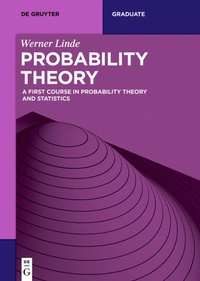
Probability Theory
Description

This book is intended as an introduction to Probability Theory and Mathematical Statistics for students in mathematics, the physical sciences, engineering, and related fields. It is based on the author's 25 years of experience teaching probability and is squarely aimed at helping students overcome common difficulties in learning the subject. The focus of the book is an explanation of the theory, mainly by the use of many examples. Whenever possible, proofs of stated results are provided. All sections conclude with a short list of problems. The book also includes several optional sections on more advanced topics. This textbook would be ideal for use in a first course in Probability Theory.
Contents:
Probabilities
Conditional Probabilities and Independence
Random Variables and Their Distribution
Operations on Random Variables
Expected Value, Variance, and Covariance
Normally Distributed Random Vectors
Limit Theorems
Mathematical Statistics
Appendix
Bibliography
Index
More details
Other editions
New editions
Additional editions
Person
Werner Linde , University of Jena, Germany.
Content
- Intro
- Preface
- Contents
- 1 Probabilities
- 1.1 Probability Spaces
- 1.1.1 Sample Spaces
- 1.1.2 3-Fields of Events
- 1.1.3 Probability Measures
- 1.2 Basic Properties of Probability Measures
- 1.3 Discrete Probability Measures
- 1.4 Special Discrete Probability Measures
- 1.4.1 Dirac Measure
- 1.4.2 Uniform Distribution on a Finite Set
- 1.4.3 Binomial Distribution
- 1.4.4 Multinomial Distribution
- 1.4.5 Poisson Distribution
- 1.4.6 Hypergeometric Distribution
- 1.4.7 Geometric Distribution
- 1.4.8 Negative Binomial Distribution
- 1.5 Continuous Probability Measures
- 1.6 Special Continuous Distributions
- 1.6.1 Uniform Distribution on an Interval
- 1.6.2 Normal Distribution
- 1.6.3 Gamma Distribution
- 1.6.4 Exponential Distribution
- 1.6.5 Erlang Distribution
- 1.6.6 Chi-Squared Distribution
- 1.6.7 Beta Distribution
- 1.6.8 Cauchy Distribution
- 1.7 Distribution Function
- 1.8 Multivariate Continuous Distributions
- 1.8.1 Multivariate Density Functions
- 1.8.2 Multivariate Uniform Distribution
- 1.9 *Products of Probability Spaces
- 1.9.1 Product 3-Fields and Measures
- 1.9.2 Product Measures: Discrete Case
- 1.9.3 Product Measures: Continuous Case
- 1.10 Problems
- 2 Conditional Probabilities and Independence
- 2.1 Conditional Probabilities
- 2.2 Independence of Events
- 2.3 Problems
- 3 Random Variables and Their Distribution
- 3.1 Transformation of Random Values
- 3.2 Probability Distribution of a Random Variable
- 3.3 Special Distributed Random Variables
- 3.4 Random Vectors
- 3.5 Joint and Marginal Distributions
- 3.5.1 Marginal Distributions: Discrete Case
- 3.5.2 Marginal Distributions: Continuous Case
- 3.6 Independence of Random Variables
- 3.6.1 Independence of Discrete Random Variables
- 3.6.2 Independence of Continuous Random Variables
- 3.7 *Order Statistics
- 3.8 Problems
- 4 Operations on Random Variables
- 4.1 Mappings of Random Variables
- 4.2 Linear Transformations
- 4.3 Coin Tossing versus Uniform Distribution
- 4.3.1 Binary Fractions
- 4.3.2 Binary Fractions of Random Numbers
- 4.3.3 Random Numbers Generated by Coin Tossing
- 4.4 Simulation of Random Variables
- 4.5 Addition of Random Variables
- 4.5.1 Sums of Discrete Random Variables
- 4.5.2 Sums of Continuous Random Variables
- 4.6 Sums of Certain Random Variables
- 4.7 Products and Quotients of Random Variables
- 4.7.1 Student's t-Distribution
- 4.7.2 F-Distribution
- 4.8 Problems
- 5 Expected Value, Variance, and Covariance
- 5.1 Expected Value
- 5.1.1 Expected Value of Discrete Random Variables
- 5.1.2 Expected Value of Certain Discrete Random Variables
- 5.1.3 Expected Value of Continuous Random Variables
- 5.1.4 Expected Value of Certain Continuous Random Variables
- 5.1.5 Properties of the Expected Value
- 5.2 Variance
- 5.2.1 Higher Moments of Random Variables
- 5.2.2 Variance of Random Variables
- 5.2.3 Variance of Certain Random Variables
- 5.3 Covariance and Correlation
- 5.3.1 Covariance
- 5.3.2 Correlation Coefficient
- 5.4 Problems
- 6 Normally Distributed Random Vectors
- 6.1 Representation and Density
- 6.2 Expected Value and Covariance Matrix
- 6.3 Problems
- 7 Limit Theorems
- 7.1 Laws of Large Numbers
- 7.1.1 Chebyshev's Inequality
- 7.1.2 *Infinite Sequences of Independent Random Variables
- 7.1.3 * Borel-Cantelli Lemma
- 7.1.4 Weak Law of Large Numbers
- 7.1.5 Strong Law of Large Numbers
- 7.2 Central Limit Theorem
- 7.3 Problems
- 8 Mathematical Statistics
- 8.1 Statistical Models
- 8.1.1 Nonparametric Statistical Models
- 8.1.2 Parametric Statistical Models
- 8.2 Statistical Hypothesis Testing
- 8.2.1 Hypotheses and Tests
- 8.2.2 Power Function and Significance Tests
- 8.3 Tests for Binomial Distributed Populations
- 8.4 Tests for Normally Distributed Populations
- 8.4.1 Fisher's Theorem
- 8.4.2 Quantiles
- 8.4.3 Z-Tests or Gauss Tests
- 8.4.4 t-Tests
- 8.4.5 72-Tests for the Variance
- 8.4.6 Two-Sample Z-Tests
- 8.4.7 Two-Sample t-Tests
- 8.4.8 F-Tests
- 8.5 Point Estimators
- 8.5.1 Maximum Likelihood Estimation
- 8.5.2 Unbiased Estimators
- 8.5.3 Risk Function
- 8.6 Confidence Regions and Intervals
- 8.7 Problems
- A Appendix
- A.1 Notations
- A.2 Elements of Set Theory
- A.3 Combinatorics
- A.3.1 Binomial Coefficients
- A.3.2 Drawing Balls out of an Urn
- A.3.3 Multinomial Coefficients
- A.4 Vectors and Matrices
- A.5 Some Analytic Tools
- Bibliography
- Index
