

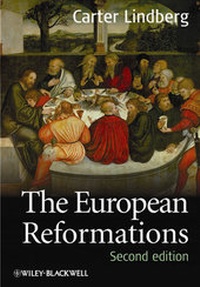
The European Reformations
Description

Reviews / Votes
"Derived from a lifetime of engagement with issues in Early ModernEuropean history and written in an eminently readable style,Professor Lindberg's The European Reformations will open up tostudent and scholar alike the fascinating world of the sixteenthcentury. Not only does Lindberg place the religious movements ofthe time in their political and, especially, social context, buthis knowledge of the theological debates provides the reader withsuccinct, clear explanations of the theological substance that gaverise to the great variety of the age's'Reformations'." Timothy J. Wengert, The LutheranTheological Seminary at Philadelphia "Carter Lindberg has written a compelling narrative regardingthe emergence and development of the various'Reformations' of the sixteenth century. Lindberg givesa compelling viewing of the Reformations primarily from atheological and religious perspective, in concert with others likeHeiko Oberman and Brad Gregory, even as he enriches thisperspective with the contributions of social historians. Lindbergdoes especially well in focusing on the reform of the liturgy from'the cult of the living in the service of the dead'designed to free departed loved ones from Purgatory, to a form ofworship that led directly to the service of the living, especiallythe sick, the poor, and the needy. He also shows how the reformmovements were strengthened and spread by the singing of hymns andpsalms by the women and men who joined these movements. This is aninsightful and cogent analysis of the complex of movements we callthe 'Reformations' of the sixteenth century."Randall Zachman, University of Notre DameMore details
Other editions
Additional editions
Person
Content
Preface to the Second Edition.
Preface to the First Edition.
List of Abbreviations.
1. History, Historiography, and Interpretations of the Reformations.
History and Historiography.
Interpretations of the Reformations.
Suggestions for Further Reading.
2. The Late Middle Ages: Threshold and Foothold of the Reformations.
Agrarian Crisis, Famine, and Plague.
Towns and Cities: Loci of Ideas and Change.
The Printing Press.
Of Mines and Militancy.
Social Tensions.
The Crisis of Values.
The western schism.
Conciliarism.
Anticlericalism and the Renaissance Papacy.
Suggestions for Further Reading.
Electronic resources.
3. The Dawn of a New Era.
Martin Luther (1483-1546).
Theological and Pastoral Responses to Insecurity.
Theological Implications.
Indulgences: The Purchase of Paradise.
The Squeaky Mouse.
Politics and Piety.
From the Diet of Worms to the Land of the Birds.
The diet of Worms.
Suggestions for Further Reading.
Electronic resources.
4. Wait for No One: Implementation of Reforms in Wittenberg.
In the Land of the Birds.
Melanchthon: Teacher of Germany.
Karlstadt and Proto-Puritanism.
Bishops, Clerical Marriage, and Strategies for Reform.
The Gospel and Social Order.
Suggestions for Further Reading.
5. Fruits of the Fig Tree: Social Welfare and Education.
Late Medieval Poor Relief.
Beyond Charity.
The Institutionalization of Social Welfare.
Bugenhagen and the Spread of Evangelical Social Welfare.
Education for Service to God and Service to the Neighbor.
The Catechisms and Christian Vocation.
Was the Early Reformation a Failure?
Suggestions for Further Reading.
6. The Reformation of the Common Man.
"Brother Andy".
Thomas Müntzer.
Müntzer's Origins and Theology.
Müntzer's Historical Development.
On to the Land of Hus.
The Revolution of the Common Man, 1524-1526.
The Role of Anticlericalism.
Luther and the Peasants' War.
Suggestions for Further Reading.
7. The Swiss Connection: Zwingli and the Reformation in Zurich.
The Affair of the Sausages.
Zwingli's Beginnings.
Magistracy and Church in Zurich.
Zwingli's Reform Program.
Excursus: Medieval Sacramental Theology.
The Marburg Colloquy, 1529.
Suggestions for Further Reading.
8. The Sheep against the Shepherds: The Radical Reformations.
The Anabaptists.
Excursus: Reformation Understandings of Baptism.
Zurich Beginnings.
Anabaptist Multiplicity.
The Münster Debacle.
The Subversive Piety of the Spiritualists.
Suggestions for Further Reading.
9. Augsburg 1530 to Augsburg 1555: Reforms and Politics.
The Trail of Worms.
The Diet of Worms.
The Diet of Speyer, 1526.
The Diet of Speyer, 1529.
The Diet of Augsburg, 1530, and the Augsburg Confession.
The Right of Resistance to the Emperor.
Reformation Ecumenism, War, and the Peace of Augsburg.
Suggestions for Further Reading.
10. "The Most Perfect School of Christ": The Genevan Reformation.
John Calvin (1509-1564).
Journey to Geneva.
The Reformation in Geneva.
Sojourn in Strasbourg.
Geneva under Calvin, 1541-1564.
Calvin's Consolidation of his Authority.
The Servetus Case.
Protestant Mission and Evangelism: The "International Conspiracy".
Suggestions for Further Reading.
11. Refuge in the Shadow of God's Wings: The Reformation in France.
The Shield of Humanism.
Evangelical Progress and Persecution.
Calvin's Influence in France.
The Colloquy of Poissy, 1561.
The Wars of Religion, 1562-1598.
The St Bartholomew's Day Massacre.
"Paris is Worth a Mass".
Suggestions for Further Reading.
12. The Blood of the Martyrs: The Reformation in the Netherlands.
"La secte Lutheriane".
Dissident Movements.
The Rise of Calvinism and the Spanish Reaction.
A Godly Society?
Suggestions for Further Reading.
13. The Reformations in England and Scotland.
Anticlericalism and Lutheran Beginnings.
The King's Great Matter.
Passions, Politics, and Piety.
Edward VI and Protestant Progress.
Mary Tudor and Protestant Regress.
Elizabeth I and the Via Media.
Mary Stuart (1542-1587) and the Reformation in Scotland.
Suggestions for Further Reading.
14. Catholic Renewal and the Counter-Reformation.
Late Medieval Renewal Movements.
The Index and the Inquisition.
Loyola and the Society of Jesus.
The Council of Trent, 1545-1563.
Suggestions for Further Reading.
Electronic resources.
15. Legacies of the Reformations.
Confessionalization.
Politics.
Culture.
The Reformations and Women.
Toleration and the "Other".
Economics, Education, and Science.
Literature and the Arts.
Back to the Future: The Reformations and Modernity.
Suggestions for Further Reading.
Electronic resources.
Chronology.
Genealogies.
The House of Valois and Bourbon, to 1610.
The family of Charles V.
The English crown, 1485-1603.
Ottoman sultans, 1451-1648.
Popes, 1492-1605.
Maps.
Europe about 1500.
Germany at the time of the Reformations.
The Empire of Charles V.
The Ottoman Empire.
The Portuguese and Spanish overseas empires.
Religious divisions in Europe about 1600.
Glossary.
Appendix: Aids to Reformation Studies.
Bibliography.
Index.
