

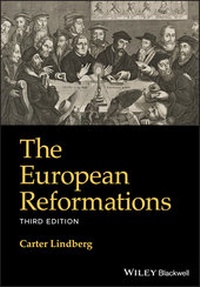
The European Reformations
Description

Amongst the authoritative works covering the European Reformation, Carter Lindberg's The European Reformations has stood the test of time. Widely used in classrooms around the world for over twenty-five years, the first two editions of the book were enjoyed and acclaimed by students and teachers alike.
Now, the revised and updated Third Edition of The European Reformations continues the author's work to sketch the various efforts to reform received expressions of faith and their social and political effects, both historical and modern. He has expanded his coverage of women in the Reformations and added a chapter on reforms in East-Central Europe.
Comprehensively covering all of Europe, The European Reformations provides an in-depth exploration of the Reformations' effects on a wide variety of countries. The author discusses:
* The late Middle Ages and the historical context in which the Reformations gained a foothold
* Martin Luther, the theological and pastoral responses to insecurity, and the theological implications of those responses
* The implementation of reforms in Wittenberg, Germany
* Zwingli's reform program, the Reformation in Zurich, Switzerland, and the impact of medieval sacramental theology
* The Genevan Reformation and "The Most Perfect School of Christ"
Perfect for undergraduate and graduate students in courses on Reformation studies, history, religion, and theology, this edition of The European Reformations also belongs on the bookshelves of theological seminary students and anyone with a keen interest in the Reformation and its ongoing impact on faith and society.
More details
Other editions
Additional editions
Person
Carter Lindberg is Professor Emeritus of Church History at the School of Theology, Boston University. He is co-Editor of The Forgotten Luther: The Social-Economic Dimensions of the Reformation, and author of the previous two editions of The European Reformations as well as editor of the companion volumes The European Reformations Sourcebook and The Reformation Theologians.
Content
List of Figures xi
Preface to the Third Edition xiii
Preface to the Second Edition xvi
Preface to the First Edition xviii
List of Abbreviations xxi
1 History, Historiography, and Interpretations of the Reformations 1
History and Historiography 1
Interpretations of the Reformations 6
Suggestions for Further Reading 19
2 The Late Middle Ages: Threshold and Foothold of the Reformations 20
Agrarian Crisis, Famine, and Plague 21
Towns and Cities: Loci of Ideas and Change 28
The Printing Press 29
Of Mines and Militancy 31
Social Tensions 32
The Crisis of Values 35
The Western Schism 35
Conciliarism 38
Anticlericalism and the Renaissance Papacy 43
Suggestions for Further Reading 45
Electronic Resources 45
3 The Dawn of a New Era 46
Martin Luther (1483-1546) 46
Theological and Pastoral Responses to Insecurity 51
Theological Implications 57
Indulgences: The Purchase of Paradise 59
The Squeaky Mouse 62
Politics and Piety 64
From the Diet of Worms to the Land of the Birds 66
The Diet of Worms 71
Suggestions for Further Reading 72
Electronic Resources 73
4 Wait for No One: Implementation of Reforms in Wittenberg 74
In the Land of the Birds 74
Melanchthon: Teacher of Germany 75
Karlstadt and Proto-Puritanism 76
Bishops, Clerical Marriage, and Strategies for Reform 78
The Gospel and Social Order 84
Suggestions for Further Reading 91
5 Fruits of the Fig Tree: Social Welfare and Education 92
Late Medieval Poor Relief 93
Beyond Charity 94
The Institutionalization of Social Welfare 98
Bugenhagen and the Spread of Evangelical Social Welfare 101
Education for Service to God and Service to the Neighbor 104
The Catechisms and Christian Vocation 106
Was the Early Reformation a Failure? 108
Suggestions for Further Reading 109
6 The Reformation of the Common Man 111
"Brother Andy" 111
Thomas Müntzer 117
Müntzer's Origins and Theology 118
Müntzer's Historical Development 121
On to the Land of Hus 122
The Revolution of the Common Man, 1524-1526 128
The Role of Anticlericalism 130
Luther and the Peasants' War 131
Suggestions for Further Reading 136
7 The Swiss Connection: Zwingli and the Reformation in Zurich 137
The Affair of the Sausages 137
Zwingli's Beginnings 137
Magistracy and Church in Zurich 140
Zwingli's Reform Program 141
Excursus: Medieval Sacramental Theology 146
The Marburg Colloquy, 1529 154
Suggestions for Further Reading 159
8 The Sheep against the Shepherds: The Radical Reformations 160
The Anabaptists 161
Excursus: Reformation Understandings of Baptism 164
Zurich Beginnings 168
Anabaptist Multiplicity 173
The Münster Debacle 176
The Subversive Piety of the Spiritualists 179
Suggestions for Further Reading 181
9 Augsburg 1530 to Augsburg 1555: Reforms and Politics 183
The Trail of Worms 183
The Diet of Worms, 1521 185
The Diet of Speyer, 1526 186
The Diet of Speyer, 1529 187
The Diet of Augsburg, 1530, and the Augsburg Confession 188
The Right of Resistance to the Emperor 192
Reformation Ecumenism, War, and the Peace of Augsburg 193
Suggestions for Further Reading 198
10 "The Most Perfect School of Christ": The Genevan Reformation 199
John Calvin (1509-1564) 199
Journey to Geneva 202
The Reformation in Geneva 204
Sojourn in Strasbourg 206
Geneva under Calvin, 1541-1564 210
Calvin's Consolidation of His Authority 212
The Servetus Case 215
Protestant Mission and Evangelism: The "International Conspiracy" 218
Suggestions for Further Reading 220
11 Refuge in the Shadow of God's Wings: The Reformation in France 221
The Shield of Humanism 221
Evangelical Progress and Persecution 224
Calvin's Influence in France 226
The Colloquy of Poissy, 1561 231
The Wars of Religion, 1562-1598 232
The St. Bartholomew's Day Massacre 234
"Paris is Worth a Mass" 237
Suggestions for Further Reading 238
12 The Blood of the Martyrs: The Reformation in the Netherlands 239
"La Secte Lutheriane" 241
Dissident Movements 242
The Rise of Calvinism and the Spanish Reaction 243
A Godly Society? 246
Suggestions for Further Reading 247
13 The Reformations in England and Scotland 248
Anticlericalism and Lutheran Beginnings 249
The King's Great Matter 255
Passions, Politics, and Piety 257
Edward VI and Protestant Progress 259
Mary Tudor and Protestant Regress 261
Elizabeth I and the Via Media 263
Mary Stuart (1542-1587) and the Reformation in Scotland 267
Suggestions for Further Reading 271
14 Reformations in East-Central Europe 272
Bohemia 276
Livonia 277
Prussia and Poland 278
Antitrinitarian Developments 281
Slovakia and Hungary 283
Suggestions for Further Reading 288
15 Catholic Renewal and the Counter-Reformation 289
Late Medieval Renewal Movements 289
The Index and the Inquisition 295
Loyola and the Society of Jesus 299
The Council of Trent, 1545-1563 304
Suggestions for Further Reading 310
Electronic Resources 310
16 Legacies of the Reformations 311
Confessionalization 311
Politics 314
Culture 318
The Reformations and Women 318
Toleration and the "Other" 323
Economics, Education, and Science 328
Literature and the Arts 330
Back to the Future: The Reformations and Modernity 336
Suggestions for Further Reading 338
Electronic Resources 338
Chronology 339
Genealogies 345
The House of Valois and Bourbon, to 1610 346
The family of Charles V 347
The English crown, 1485-1603 348
Ottoman sultans, 1451-1648 349
Popes, 1492-1605 350
Maps 351
Europe about 1500 325
Germany at the time of the Reformations 353
The Empire of Charles V 354
The Ottoman Empire 355
The Portuguese and Spanish overseas empires 356
Religious divisions in Europe about 1600 357
Glossary 358
Appendix: Aids to Reformation Studies 361
Bibliography 364
Index 403
1
History, Historiography, and Interpretations of the Reformations
We are like dwarfs standing on the shoulders of giants; thanks to them, we see farther than they. Busying ourselves with the treatises written by the ancients, we take their choice thoughts, buried by age and human neglect, and we raise them, as it were from death to renewed life.
Peter of Blois (d. 1212)
History and Historiography
Peter of Blois penned this famous aphorism almost exactly three centuries before Luther's "Ninety-Five Theses" rocked Europe. A major study of the historiography of the Reformation (Dickens and Tonkin 1985: 323) concludes that it is "a window on the West, a major point of access to the developing Western mind through the last five centuries. . By any reckoning, the Reformation has proved a giant among the great international movements of modern times." On its shoulders we can look farther and deeper in both directions; that is, we can peer into both the medieval and contemporary worlds.
History provides a horizon for viewing not only the past but also the present and the future. The philosopher Hans-Georg Gadamer (1975: 269, 272) argued that a person without a horizon will overvalue what is immediately present, whereas the horizon enables us to sense the relative significance of what is near or far, great or small. "A horizon means that one learns to look beyond what is close at hand - not in order to look away from it, but to see it better within a larger whole and in truer proportion." In other words, "far away facts - in history as in navigation - are more effective than near ones in giving us true bearings" (Murray 1974: 285). Even novice sailors know it is foolish to navigate by sighting your prow rather than by sighting the stars or land.
Historical distance, by providing a focus beyond what we take for granted, can be a surprising component of contemporary comprehension. The analogy of living in a foreign city illustrates this. If you live in a foreign city for a year, you will not learn a great deal about that city. However, when you return home you will be surprised by your increasing comprehension of some of the most profound and individual characteristics of your homeland. You did not previously "see" these characteristics because you were too close to them; you knew them too well. Likewise, a visit to the past provides distance and a vantage point from which to comprehend the present (Nygren 1948; Braudel 1972). L. P. Hartley began his novel The Go-Between with the memorable sentence: "The past is another country; they do things differently there."
Memory also illustrates perspective. "Memory is the thread of personal identity, history of public identity" (Hofstadter 1968: 3; Leff 1971: 115). Memory and historical identity are inseparable. Have you ever been asked to introduce someone and suddenly forgotten his or her name? At worst this common human experience is a temporary embarrassment. However, think what life would be like if you had no memory at all. We all have heard how terribly difficult life is for amnesiacs, and about the tragic effects of Alzheimer's disease upon its victims and their families. The loss of memory is not just the absence of "facts;" it is the loss of personal identity, family, friends, and, indeed, the whole complex of life's meaning. It is very difficult if not impossible to function in society if we do not know who we are and how we got this way. Our memory is the thread of our personal identity; our memory liberates us from what Melanchthon, Luther's colleague, called perpetual childhood. Without our past we have no present and no future.
What about our national and religious community identities? Are we amnesiacs, are we children, when it comes to identifying who we are in relation to our communities? What if we had to identify ourselves as an American or a Christian? Suppose someone asked why we are Protestant or Roman Catholic. Beyond referring to our parents or a move to a new neighborhood, could we explain why we belong to Grace Lutheran by the gas station instead of St Mary's by the grocery store?
I once asked a French friend to explain German-French relations. He began by referring to the ninth-century division of Charlemagne's empire! Most of us do not go that far back to answer contemporary questions, but his response illustrates that if memory is the thread of personal identity, history is the thread of community identity. These tenacious threads of community identity also have a dark side when they are not critically examined. This is painfully evident in the eruption of historical ethnic conflicts such as those in the former Yugoslavia and Soviet Union as well as in the Middle East. If we do not know our personal and community histories we are like children who are easily manipulated by those who would use the past for their own purposes.
Memory and history are crucial to our identity, but they are not easily conceptualized in relation to their origins and goals. Here I take comfort in the comment of the great African theologian, St Augustine (354-430), who when discussing time wrote: "What then is time? If no one asks me, I know; if I wish to explain it to one that asks, I know not" (Confessions, Book XI). This most influential Western theologian was struggling to relate to his Hellenistic-Roman culture the Christian conviction that the identity of the community is rooted in history rather than in philosophy and ethics. This conviction had already been clearly stated in the historical shorthand of the Christian creeds, which confess faith in the historical person of Jesus who was born, suffered, and died. Christians put a unique spin on history when they also confess that this Jesus was raised from the dead and will return to bring history to completion. Thus, from an insider's perspective, the Christian community's identity is formed by both the historical past and the historical future. Without sensitivity to this theological claim, it would be difficult for us to fully realize the power in the Reformations of apocalyptic views of history or such works as John Foxe's Acts and Monuments. This sense of the historical past, present, and future identity of the church, expressed in the third article of the creeds by the phrase "communion of saints," was so palpable to the medieval that the English Roman Catholic historian John Bossy (1985) makes it the theme of his study of the Reformation. As we shall see, the historical identity of the communion of saints became a central controversial issue in the Reformation era.
Sociologists of knowledge make a similar point about historical identity rooted in community. Historical identity is passed on to us through our conversations with the mothers and fathers who have gone before us. In this sense, church historians take seriously the fourth commandment of the Decalogue: "Honor your father and mother." We know, of course, from even limited family experience that when we no longer talk to our parents and children we begin to forget who we are. This is not to say that conversation between generations is always pleasant, but to say that it is important for learning how we got this way. Without such conversation we are condemned to "presentism," a fancy term to describe the solipsism of a continuous "me generation." Thus the postwar German phrase Welt ohne Vater is shorthand for the loss of roots and the authority crises suffered by the generation whose fathers fell in the war. Lord Acton stated this elegantly: "History must be our deliverer not only from the undue influence of other times, but from the undue influence of our own, from the tyranny of environment and the pressure of the air we breathe. It requires all historic forces to produce their record and submit it to judgment, and it promotes the faculty of resistance to contemporary surroundings by familiarity with other ages and orbits of thought" (Pelikan 1971: 150).
Until recently the collectors and tellers of the family conversations of Christianity were nearly all insiders. Thus the subject matter and the discipline of its telling fell under the rubric of "church history." For a variety of reasons today, persons outside the Christian churches are also interested in presenting the history of Christianity. There is, to paraphrase an old maxim, the sense that the telling of the story of Christian contributions to contemporary identity is too important to be left to the Christians. The field of Reformation studies is a marked example of this recent development.
Awareness of the distinct perspectives of church historians and historians of Christianity will be useful in terms of reading both contemporary textbooks and the historical sources. We shall get to other perspectives later, but for now we may remind ourselves that interpretations of the past are not value free. Indeed, Heisenberg's "indeterminacy principle" applies as much to historical studies as it does to subatomic physics: what is observed is influenced by the observer. "It is paradoxical, in fact, that nature seems more unambiguously susceptible to human understanding and control than is history which man makes and in which he is personally and intimately involved" (Spitz 1962: vii). In the words of the late English historian, G. R. Elton (1967: 13): "In truth, historians, like other people, tend to judge their world from their own experiences and practice, and it is disturbing...
