

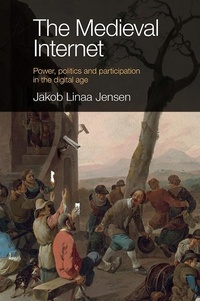
The Medieval Internet
Power, politics and participation in the digital age
Published on 11. September 2020
152 pages
978-1-83909-414-9 (ISBN)
Description

This book sheds light on the world of the Internet and social media through a historical prism drawn from the Medieval Age. Memes and metaphors originating in medieval society have often been used to describe and explain contemporary society. Social shaming has been described as "a pillory", good deeds have been deemed as knightly, persecution or censorship has been labelled as inquisitions and elitist tendencies in political life are sometimes dubbed feudalism. This book argues that terms and concepts originating in medieval society are suitable for describing and discussing a plethora of social and political phenomena, all related to the massive rise and use of new digital media technologies and adherent societal paradoxes, dilemmas and challenges. The author argues that apparently distinct social phenomena related to the spread of new media are related and a product of logics that dominated medieval society, not at least those of control, surveillance and feudalism.
Reviews / Votes
'Jakob Linaa Jensen provides a timely reminder that there's nothing like a detour through history to dispel the facile promise that the Internet will empower the people and revitalize democracy. The Medieval Internet is a sweeping and provocative account of the affinities between our datafied, "post-industrial" era and the brutality of feudal-era exploitation. However, his nuanced approach to the Medieval Era also unearths resources for hope -- but not without a struggle. This is a fascinating and invaluable book that sheds new light on our current predicament.' -- Mark Andrejevic 'This most important book concerns nothing less than whether or not our best norms and practices of democracy, liberal humanism, and rights of individual freedom and privacy can survive in the face of authoritarian threats. These are not just in the obvious forms of political repression and physical violence; as Jakob Linaa Jensen demonstrates in several key ways, the threats derive even more centrally from our own ostensibly free complicity with the tech giants and platform economies that render us ever more into digitized versions of medieval peasants, subject to the all but absolute control of multiple hierarchies. While drawing aptly on the insights and wisdom of others, the book carves out its own distinctive approach ; one that leads to a wonderful array of important and compelling insights. Anticipating the current 'tech lash' (i.e., our increasing recognition of the many profoundly negative aspects of our entanglements in social media, the platform ecologies of Apple, Google, Microsoft, Facebook, et al.) by over a decade, Jensen compellingly demonstrates how these engagements constitute a 'Medieval feudalism'. It accurately describes specific analogies Jensen convincingly demonstrates between Medieval power structures, norms, and practices, and those established through contemporary regimes of algorithms, Big Data, and largely unregulated platform and surveillance capitalism. These regimes further include specific Medieval-like features of our digital lifeworlds such as total surveillance ('the Internet omnopticon') and online communities complete with 'digital pillories,' public shaming, and online witch hunts. Jensen draws from his extensive scholarship and backgrounds in political science, journalism, and media studies to bring together much of the best of contemporary and relevant research and scholarship in political economy and theory, philosophy, media and communication studies into a comprehensive and coherent series of analyses. Jensen then demonstrates in fine-grained detail the close analogies between contemporary digital lives and the Medieval world - specifically in terms of power hierarchies and economic regimes, norms, notions of community, lack of privacy and surveillance. At the same time, Jensen thereby breaks important new ground as he makes still more articulate and clear what he characterizes as the 'break, invisible but vast, with modernity and liberal humanism and democracy' and the Medieval feudalism carefully portrayed here. In my view, the book thus adds essential substance to and dramatically raises the stakes in current debates and concerns swirling around the threats to democracy and privacy presented by surveillance capitalism, algorithms, AI, Big Data, surveillance via social media, and so on; debates that become increasingly urgent as these technologies are deployed and diffused ever more fully in our lives through the emerging Internet of Things; His rich surveys of how internet-facilitated communication can still foster possibilities of dissent and resistance to power are crucial insights and inspiration into how human freedoms, rights, and democracy may survive. Scholars and researchers in the multiple disciplines intersected here and who are concerned - as we all must be -with sustaining and enhancing democratic rights, norms, and processes against these ever increasing arrays of threats will profit enormously from this book. At the same time, it is written in a clear and accessible style that makes it appropriate and compelling as a textbook. Indeed, anyone interested in better understanding the complex problems of protecting basic citizens' rights and freedoms in democratic regimes vis-vis the ever growing temptations to trade these away in the name of consumerism and convenience will find it an invaluable guide and overview.' -- Charles M. EssMore details
Language
English
Place of publication
Bingley
United Kingdom
Target group
Professional and scholarly
File size
0,99 MB
ISBN-13
978-1-83909-414-9 (9781839094149)
Copyright in bibliographic data and cover images is held by Nielsen Book Services Limited or by the publishers or by their respective licensors: all rights reserved.
Schweitzer Classification
Other editions
Additional editions
Book
09/2020
Emerald Publishing Limited
€37.50
Shipment within 3-4 weeks
Person
Jakob Linaa Jensen, Ph.D., M.A. in Politics is Research Director of Social Media at the Danish School of Media and Journalism. He has been associate professor of Media Studies at Aarhus University for nine years. He has published three monographs, three edited volumes and more than 30 international journal articles.
Content
Chapter 1. The Middle Ages and medieval ways of living and thinking Chapter 2. The Medieval and the contemporary landscape of information
Chapter 3. The public - deliberation, visibility and mutual surveillance
Chapter 4. Community and beyond - medieval and modern
Chapter 5. Instruments of Internet power
Chapter 6. Structures of Internet power - algorithms and platforms
Chapter 7. Digital feudalism
Chapter 8. Politics and publics
Chapter 3. The public - deliberation, visibility and mutual surveillance
Chapter 4. Community and beyond - medieval and modern
Chapter 5. Instruments of Internet power
Chapter 6. Structures of Internet power - algorithms and platforms
Chapter 7. Digital feudalism
Chapter 8. Politics and publics
