

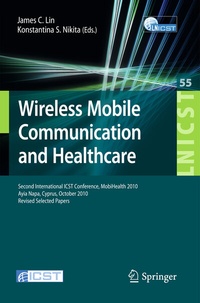
Wireless Mobile Communication and Healthcare
Second International ICST Conference, MobiHealth 2010, Ayia Napa, Cyprus, October 18 - 20, 2010, Revised Selected Papers
Published on 28. June 2011
XIV, 272 pages
978-3-642-20865-2 (ISBN)
Description

This book contains a selection of thoroughly refereed and revised papers from the Second International ICST Conference on Wireless and Mobile Communication in Healthcare, MobiHealth 2010, held in Ayia Napa, Cyprus, in October 2010. The 33 papers in this volume describe various applications of information and communication technologies in healthcare and medicine and cover a wide range of topics such as intelligent public health monitoring services, mobile health technologies, signal processing techniques for monitoring services, wearable biomedical devices, ambient assistive technologies, emergency and disaster applications, and integrated systems for chronic monitoring and management.
More details
Other editions
Additional editions
James C. Lin | Konstantina S. Nikita
Wireless Mobile Communication and Healthcare
Second International ICST Conference, MobiHealth 2010, Ayia Napa, Cyprus, October 18 - 20, 2010, Revised Selected Papers
Book
05/2011
1st Edition
Springer
€53.49
Shipment within 7-9 days
Content
- Title
- Preface
- Organization
- Table of Contents
- Session 1 Intelligent Public Health Monitoring Services
- Tele-psychiatry: Socioeconomic Results and the Way Forward
- Introduction
- Identifying the Beneficiaries of Tele-psychiatry
- Contemporary Means of Tele-psychiatry
- Pilot Assessment: The Key to Global Acceptance
- Financial Considerations: The Cretan Way
- Assessment Methodology for the Chania Tele-psychiatry Platform Effectiveness
- Conclusions
- References
- A Citizen Telemonitoring Strategy as Envisaged for Central Greece
- Introduction
- Initiatives on European Level to Deal with Challenges of Telehomecare
- Description of the Telehealth Project of Central Greece
- The Telehealth Project of the Region of Central Greece in the Renewing Health Project
- Interoperability / Ethical Issues
- Health Technology Assessment
- References
- Estimation and Analysis of Thermal Response of Human Tissue during EM Exposure
- Introduction
- Materials and Methods
- Dipole Antennas
- Monopole Antennas
- PIFA Antennas
- Additional Notes
- Conclusions
- References
- Session 2 Mobile Health Technologies, Applications and Integrated Systems for Chronic Disease Monitoring and Management
- A Logic Simplification Based on Expert System Application for TBC Diagnosis
- Introduction
- Materials
- TBC's Symptoms
- Similar Diseases
- Expert System and Architecture
- Method
- Results
- References
- On Assessing Motor Disorders in Parkinson's Disease
- Introduction
- Materials and Methods
- Methodology
- Results and Discussion
- References
- An Intelligent System for Classification of Patients Suffering from Chronic Diseases
- Introduction
- System Overview
- Data Analysis and Decision Support
- Pre-processing and Feature Extraction
- Intelligent System
- Applied Protocol and Classification Methods
- Conclusions
- References
- Session 3 Intelligent Home Monitoring
- Autonomy, Motivation and Individual Self-management for COPD Patients, the Amica Project
- Introduction
- Background
- Platform Analysis
- Signal Acquisition
- Base Station
- Telemedical Platform Framework
- Signal Analysis
- Future Work
- References
- A Novel System for Hemodialysis Patients Home Monitoring
- Introduction
- Telemonitoring Service - Overview
- Implementation
- Conclusion
- References
- Post Cardiac Surgery Home-Monitoring System
- Introduction
- Methodology
- System's Purpose and System Fuctions
- Basic System Operations and Functions
- System Architecture
- Tools Used for System Implementation
- Results
- Conclusions
- References
- INDEPENDENT: Technology Supported Autonomous Living
- Introduction
- A Criticism on Support Mechanisms
- Mission and Objectives of the INDEPENDENT Project
- Mature Starting Points in Trikala, Implemented by Vidavo S.A.
- The Solution Envisaged for Trikala in the Context of INDEPENDENT
- Conclusions
- References
- Session 4 Interoperability in e-Health
- Towards Interoperability for Telemedicine Systems
- Introduction
- Basic Design Considerations
- Modeling Interoperability Service and the System Architecture
- The Functional Aspect
- Int-service Design
- Implementing the System
- System's Architecture
- Special Mechanism Modules
- Development Issues
- Evaluation
- Conclusions
- References
- Personal Health Systems for Patient Self-management: Integration in Pervasive Monitoring Environments
- Introduction
- Functionality Overview
- System Architecture
- Communication Infrastructure
- MDI Insertion and Presentation Preferences
- Application Scenario and Prototype Implementation
- Conclusion and Future Work
- References
- A Portal for Ubiquitous Access to Personal Health Records on the Cloud
- Introduction
- Motivating Scenario
- System Architecture
- Implementation Issues
- Concluding Remarks
- References
- Session 5 Signal Processing Techniques for Monitoring Services
- Early Diagnosis of Alzheimer's Type Dementia Using Continuous Speech Recognition
- Introduction
- The Proposed Method for Early Detection of AD
- Description of the Proposed System
- Speech Recognition
- Lexical Analysis
- Interpretation of Results
- Training of the ADSMS for Each Subject and Implementation Notes
- Conclusions and Future Work
- References
- An Investigation of Acoustical and Signal Processing Techniques for Classification, Diagnosis and Monitoring of Breathing Abnormalities in Sleep
- Introduction
- Method
- Experimental Results
- Discussion
- Conclusions
- References
- Performance Investigation of Empirical Mode Decomposition in Biomedical Signals
- Introduction
- Synthetic and Experimental ECG Time Series
- Results
- Number of IMFs as a Function of Time Series Length and SNR
- Computation Time
- Discussion - Conclusions
- References
- Session 6 Implantable and Wearable Biomedical Devices
- Design of a Novel Miniaturized Implantable PIFA for Biomedical Telemetry
- Introduction
- Antenna Design
- Antenna Implanted in Skin-Tissue
- Antenna Performance
- SAR Basic Restrictions
- SAR Distribution
- Characterization of the Communication Link
- Conclusions
- References
- Microstrip Antenna Arrays for Implantable and Wearable Wireless Applications
- Introduction
- Flexible Antenna Design
- Flexible Printed Dipole Antennas
- Flexible Printed Square Patch Antennas
- Flexible Printed Spiral Antennas
- Conclusion
- References
- BER Performance of a BPSK Biomedical Telemetry System under Varying Coupling and Loading Conditions
- Introduction
- BPSK Telemetry System Overview
- Inductive Link Channel
- BPSK Modulator
- BPSK Demodulator
- Simulation Results
- Conclusions
- References
- Session 7 Ambient Assistive Technologies
- mPharmacy: A System Enabling Prescription and Personal Assistive Medication Management on Mobile Devices
- Introduction
- Related Work
- Tools and Methods
- The Android OS Mobile Platform
- Communication through Web Services
- Proposed System Architecture
- Mobile Prescription and Medication Management
- Conclusions
- References
- AmIVital: Digital Personal Environment for Health and Well-Being
- Introduction
- Materials and Methods
- AmIVital Architecture
- Conclusions and Future Work
- References
- An Analysis of Bluetooth, Zigbee and Bluetooth Low Energy and Their Use in WBANs
- Introduction
- Wireless Body Area Network (WBAN)
- Overview
- Wireless Communications Technologies in WBANs
- Bluetooth, ZigBee and Bluetooth LE Functionality and Features
- History and Applications
- Topology
- Power Consumption and Data Rate
- Error Correction
- Data Encryption and Authentication
- Modulation
- Conclusions
- References
- Experimental Analysis of RSSI-Based Indoor Location Systems with WLAN Circularly Polarized Antennas
- Introduction
- Measurement Set-Up
- Experimental Results
- Conclusions
- References
- Session 8 Mobile Health Technologies, Applications and Integrated Systems for Chronic Disease Monitoring and Management
- Predictive Metabolic Modeling for Type 1 Diabetes Using Free-Living Data on Mobile Devices
- Introduction
- Materials and Methods
- Materials
- Methods
- Subcutaneous Insulin Absorption
- Carbohydrates Absorption
- Exercise Effects
- Glucose Predictive Model
- Model Training and Evaluation
- Results
- Discussion
- Conclusions
- References
- Architecture for Lifestyle Monitoring Platform in Diabetes Management
- Introduction
- Methods
- Research Phase
- Modeling Phase
- Requirements Phase
- Development Phase
- Evaluation of the Test
- Results
- Discussion and Conclusion
- References
- CLAP: Cross-Layer Protocols for Phealth
- Introduction
- Application Framework
- Network Formation Algorithm
- Phase 1: Assumptions and IEEE 802.15.4 Parameters
- Phases 2-4: Operation Phases
- Presence Information
- Clustering
- Discussion
- Conclusion
- References
- Session 9 Emergency and Disaster Applications
- Future Care Floor: A Sensitive Floor for Movement Monitoring and Fall Detection in Home Environments
- Motivation
- State of the Art
- Future Care Floor
- Integration in the Living Lab
- References
- Monitoring and Assessing Crew Performance in High-Speed Marine Craft - Methodological Considerations
- Introduction
- Method Description
- Experimental Procedure
- Instrumentation and Data Acquisition
- Vibration Data Analysis
- Results and Discussion
- Boat Speed and Vibration
- Vibration Dose Values
- Physiological Data
- Conclusions
- References
- Using Location Information for Sophisticated Emergency Call Management
- Introduction
- Background
- System Architecture and Call Management Policies
- System Architecture
- Call Management Policies
- Conclusions and Future Work
- References
- Session 10 Mobile Devices and Wireless Technologies for Patient Monitoring
- Proof of the Accuracy of Measuring Pants to Evaluate the Activity of the Hip and Legs in Everyday Life
- Introduction
- State of the Art
- Task and Approach
- Dynamic System Concept Description
- Evaluation
- Materials and Methods
- Experiment
- Result
- Conclusions
- References
- Nano-coating Protection of Medical Devices
- Introduction
- Repellency
- What Is a Plasma?
- P2i Plasma Process
- Results and Discussion
- Conclusions
- References
- A UHF Radio Frequency Identification (RFID) System for Healthcare: Design and Implementation
- Introduction
- RFID System Design and Implementation
- References
- Poster Session
- Real-Time, Remote, Home Based, Non-invasive, Elder Monitoring System
- Introduction
- Related Work
- Methods and Methodologies
- Pair of Gloves
- Sensors
- Intelligent Wireless Controller
- Receiver and PC Module
- SMS and Voice Call Gateway (SVCG)
- Elder Monitor Algorithm (EMA)
- Modem Control via HyperTerminal
- Setting Up GSM Modem
- HyperTerminal Configuration
- Conclusion
- Future Work
- References
- Author Index
