

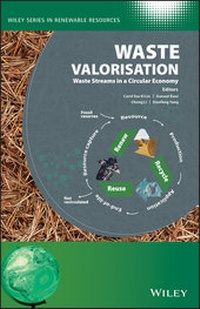
Waste Valorisation
Description

Waste Valorisation provides a comprehensive review of waste chemistry and its application to the generation of value-added products. The authors - noted experts on the topic - offer a clear understanding of waste diversity, drivers and policies governing its valorisation based on the location. The book provides information on the principles behind various valorisation schemes and offers a description of general treatment options with their evaluation guidelines in terms of cost, energy consumption and waste generation.
Each of the book's chapters contain an introduction which summarises the current production and processing methods, yields, energy sources and other pertinent information for each specific type of waste. The authors focus on the most relevant novel technologies for value-added processing of waste streams or industrial by-products which can readily be integrated into current waste management systems. They also provide the pertinent technical, economic, social and environmental evaluations of bioconversions as future sustainable technologies in a biorefinery. This important book:
* Presents the most current technologies which integrate waste and/or by-product valorisation
* Includes discussions on end-product purity and life-cycle assessment challenges
* Explores relevant novel technologies for value-added processing of waste streams or industrial by-products which can be integrated into current waste management systems
* Offers a guide to waste reuse, a key sustainability goal for existing biorefineries wishing to reduce material and environmental costs
Written for academic researchers and industrial scientists working in agricultural and food production, bioconversions and waste management professionals, Waste Valorisation is an authoritative guide to the chemistry and applications of waste materials and provides an overview of the most recent developments in the field.
More details
Other editions
Additional editions
Persons
Editors
Carol Sze Ki Lin, Associate Professor, School of Energy and Environment, City University of Hong Kong.
Guneet Kaur, Assistant Professor, Department of Biology, Hong Kong Baptist University, Kowloon Tong, Hong Kong and Department of Civil Engineering, York University, Toronto, Canada.
Chong Li, Associate Research Fellow, Shenzhen Branch, Guangdong Laboratory for Lingnan Modern Agriculture, Genome Analysis Laboratory of the Ministry of Agriculture, Agricultural Genomics Institute at Shenzhen, Chinese Academy of Agricultural Sciences, Shenzhen, China.
Xiaofeng Yang, Associate Professor, School of Biology and Biological Engineering, South China University of Technology, Guangzhou, China.
Series Editor
Christian V. Stevens, Faculty of Bioscience Engineering, Ghent University, Belgium
Content
List of Contributors xiii
Series Preface xvii
Preface xix
1 Overview ofWaste Valorisation Concepts from a Circular Economy Perspective 1
Jinhua Mou, Chong Li, Xiaofeng Yang, Guneet Kaur and Carol Sze Ki Lin
1.1 Introduction 1
1.2 Development of (Bio)Chemical Process for Utilization of Waste as a Bioresource 4
1.2.1 Mechanical Pretreatment 5
1.2.2 Physical Pretreatment 5
1.2.3 Chemical Pretreatment 5
1.2.4 Biological Pretreatment 6
1.3 Process Integration for Waste-Based Biorefinery 6
1.3.1 Food Waste Biorefinery 7
1.3.2 Agricultural Waste Biorefinery 7
1.3.3 Industrial Waste Biorefinery 8
1.3.4 Wastewater Biorefinery 8
1.4 Closed Loop Recirculation in a Bio-based Economy 8
1.5 Conclusions and Future Trends 9
References 10
2 Waste as a Bioresource 13
Gayatri Suresh, Joseph Sebastian and Satinder Kaur Brar
2.1 Introduction 13
2.2 Waste Streams and Their Suitability as Feedstock for Valorisation: Is All Waste a Resource? 14
2.3 (Bio)diversity and Variability of Waste Feedstock 16
2.3.1 Agro-industrial Wastes 16
2.3.2 Municipal Solid Wastes 18
2.3.3 Livestock Wastes 19
2.3.4 Industrial Wastes 21
2.4 Drivers, Policies, and Markets for Value-added Waste-derived Products 23
2.5 Conclusions and Future Trends 25
Acknowledgements 26
References 26
3 Treatment of Waste 33
Ravindran Balasubramani, Vasanthy Muthunarayanan, Karthika Arumugam, Rajiv Periakaruppan, Archana Singh, Soon Woong Chang, Thamaraiselvi Chandran, Gopal Shankar Singh and Selvakumar Muniraj
3.1 Introduction 33
3.2 Solid Waste Management 34
3.2.1 E-waste Management 34
3.2.2 Hazardous Waste Management 35
3.2.3 Biomedical Waste Management 35
3.2.4 Plastic Waste Management 35
3.2.5 Solid Waste Management Options 35
3.3 General Approach for Waste Treatment and Conversion to Value-added Products: Biochemical, Mechanical, and Thermochemical 36
3.3.1 Conventional Treatment 36
3.3.2 Biological/Biochemical Treatment 37
3.3.3 Thermal Methods 40
3.3.4 Open Burning 40
3.3.5 Mechanical Treatment 40
3.4 Factors Influencing Selection of an Appropriate Valorisation Technique for Specific Waste Types 42
3.4.1 Case Study of Paper Waste Recycling 42
3.4.2 Deinking Process 42
3.4.3 Paper Deinking Residue 43
3.5 Conventional and Novel Techniques: Overall Comparison in Terms of Energy Consumption, Waste Stream Generation and Cost 44
3.5.1 Pyrolysis 44
3.5.2 Gasification 44
3.5.3 Incineration 44
3.6 Energy Consumption, Waste Stream Generation, and Costs of Conventional and Novel Waste Treatment Technologies 45
3.7 Conclusions and Future Trends 45
Acknowledgement 46
References 46
4 Valorisation of Agricultural Waste Residues 51
Srinivas Mettu, Pobitra Halder, Savankumar Patel, Sazal Kundu, Kalpit Shah, Shunyu Yao, Zubeen Hathi, Khai Lun Ong, Sandya Athukoralalage, Namita Roy Choudhury, Naba Kumar Dutta and Carol Sze Ki Lin
4.1 Introduction 51
4.2 Agricultural Waste Definition, Composition, Variability, and Associated Policies and Regulations 53
4.2.1 Agricultural Waste from Farming 55
4.2.2 Agricultural Wastes from Livestock 56
4.2.3 Agricultural Waste Availability 57
4.3 Conventional Techniques - Anaerobic Digestion, Pyrolysis, Gasification, and Solvent Treatment/Extraction 58
4.3.1 Anaerobic Digestion 58
4.3.2 Solvent Treatment 63
4.3.3 Gasification 65
4.3.4 Pyrolysis 67
4.4 Novel Techniques and Envisioned Product Streams: A New Perspective 71
4.5 Case Study: Yard Waste Management 74
4.5.1 Background of Yard Waste in Hong Kong 74
4.5.2 Conventional Yard Waste Reduction and Treatment Strategy 75
4.5.3 Novel Techniques and Strategies for Yard Waste Treatment 76
4.6 Conclusions and Future Trends 76
Acknowledgements 77
References 77
5 Valorisation of Woody Biomass 87
Md Khairul Islam, Chengyu Dong, Hsien-Yi Hsu, Carol Sze Ki Lin and Shao-Yuan Leu
5.1 Generation of Woody Biomass 87
5.2 General Classification and Properties of Woods 88
5.3 Wood Chemistry 89
5.3.1 Cellulose 89
5.3.2 Hemicelluloses 90
5.3.3 Lignin 91
5.3.4 Extractives 92
5.4 Chemical Composition Analysis 93
5.4.1 Structural Carbohydrates and Lignin 93
5.4.2 Extractives 94
5.5 Pretreatment 94
5.6 Saccharification and Fermentation 97
5.7 New Functions of Wood Residues 100
5.7.1 Wood-Plastic Composite for Construction Purposes 100
5.7.2 Cellulose Nanomaterials 100
5.7.3 Wood Extractives 102
5.8 Conclusions and Future Trends 102
Acknowledgement 102
References 103
6 Recovery of Nutrients and Transformations of Municipal/Domestic Food Waste 109
Divyani Panwar, Parmjit S. Panesar, Gisha Singla, Meena Krishania and Avinash Thakur
6.1 Introduction 109
6.2 Characteristics of Food Waste and its Supply Chain 111
6.2.1 Characteristics of Waste Generated from Food Industries 113
6.2.2 Food Waste Supply Chain 114
6.3 Recovery of Valuable Products from Anaerobic Digestion of Food Waste 116
6.3.1 Biogas 118
6.3.2 Digestate 119
6.4 Novel Approaches and Obtainable Products: Biotechnological Processes and Chemical Transformations 124
6.4.1 Chemical Transformations 125
6.4.2 Biotechnological Approaches 130
6.5 Case Study: Production of Methane via Anaerobic Digestion of Food Waste 139
6.5.1 Anaerobic Digestion 140
6.5.2 TEAM Digester for Domestic Food Waste Digestion 143
6.6 Conclusions and Future Trends 144
References 145
7 Bioconversion of Processing Waste from Agro-Food Industries to Bioethanol: Creating a Sustainable and Circular Economy 161
Deepak Kumar and Vijay Singh
7.1 Introduction 161
7.2 Bioconversion Technologies for Bioethanol Production 164
7.2.1 Ethanol Production from Starchy Feedstock (First-Generation Bioethanol) 164
7.2.2 Ethanol from Lignocellulosic Biomass (Second-Generation Bioethanol) 167
7.3 Use of Processing Waste to Produce Ethanol 170
7.3.1 Citrus Peel Waste (CPW) 170
7.3.2 Peel Residue Waste from Other Food Industries 171
7.3.3 Waste from the Brewing Industry 172
7.3.4 Other Processing Wastes 173
7.4 Use of Processing Waste to Enhance Ethanol Yields 174
7.4.1 Improving Fermentation of Dry Fractionated Corn 174
7.4.2 Processing of DDGS to Enhance Ethanol Yields 177
7.5 Conclusions and Future Trends 178
References 179
8 Challenges with Biomass Waste Valorisation 183
Guihua Yan, Yunchao Feng, Sishi Long, Xianhai Zeng, Yong Sun, Xing Tang and Lu Lin
8.1 Introduction 183
8.2 The Pre-Preparation Technologies of Biomass Waste 184
8.2.1 "Cellulose-First" Biorefinery Technologies 185
8.2.2 "Lignin-First" Biorefinery Technologies 185
8.2.3 "Lignin and Hemicellulose-First" Biorefinery Technologies 186
8.2.4 "Cellulose and Hemicellulose-First" Biorefinery Technologies 186
8.3 Handling of Emerging Biomass Wastes by Newly Developed Techniques 188
8.3.1 Catalytic Chemistry Technologies 188
8.3.2 Thermochemical Conversion Technologies 189
8.3.3 Biochemical Technologies 190
8.3.4 Integration with Existing Technologies and Economic Viability 190
8.4 Transforming Biomass Waste to Cellulose by New Techniques 191
8.4.1 Cellulose Extraction or Purification Techniques from Biomass Waste 192
8.4.2 Cellulose Micro/Nanomerization Technologies 192
8.5 Transforming Biomass Waste to Lignin by New Technologies 197
8.6 Conclusions and Future Trends 198
Acknowledgements 199
References 199
9 Lifecycle Approaches for Evaluating Textile Biovalorisation Processes: Sustainable Decision-making in a Circular Economy 203
Karpagam Subramanian, Shauhrat S. Chopra, Cakin Ezgi, Xiaotong Li and Carol Sze Ki Lin
9.1 Introduction 203
9.2 Literature Review 206
9.2.1 Circular Economy and Sustainable Development 206
9.2.2 Textile Industry - Sustainability Issues and Recycling 206
9.3 Methods 208
9.3.1 Description of Environmental Assessment 208
9.3.2 Description of Social Assessment 209
9.4 Case Study 211
9.4.1 Recovery of PET Fiber from Cotton-Polyester Blended Textile Waste 211
9.4.2 System Description of the Biorecycling Method 212
9.4.3 Life Cycle Inventory 214
9.5 Results and Discussion 215
9.5.1 Environmental Sustainability of Bio-based PET Fiber 215
9.5.2 Social and Economic Sustainability of Bio-based PET Fiber 217
9.6 Conclusions and Future Trends 218
Acknowledgement 219
References 219
10 Circular Waste-Based Biorefinery Development 223
Raffel Dharma Patria, Xiaotong Li, Huaimin Wang, Chenyu Du, Carol Sze Ki Lin and Guneet Kaur
10.1 Introduction 223
10.2 Transitioning from Current Linear to Stronger Circular Economy Models 226
10.2.1 Integration of Circular Economy and Sustainable Development 226
10.2.2 Requirements for Transition to a Circular Economy 227
10.3 Case Study 1: Circular Textile Waste-based Biorefinery for Production of Chemicals, Materials, and Fuels 229
10.3.1 Need for a Circular Textile Waste-based Biorefinery 229
10.3.2 Circular Textile Biorefinery 230
10.4 Case Study 2: Circular Food Waste-based Biorefinery for Production of Chemicals, Materials, and Fuels 233
10.4.1 Circular Bioconversion of Food Waste into Polyethylene Furanoate (PEF) 235
10.4.2 Circular Bioconversion of Food Waste into Biosurfactant 240
10.5 Conclusions and Future Trends 246
Acknowledgements 246
References 247
Index 253
1
Overview of Waste Valorisation Concepts from a Circular Economy Perspective
Jinhua Mou1, Chong Li2, Xiaofeng Yang3, Guneet Kaur4, and Carol Sze Ki Lin1
1School of Energy and Environment, City University of Hong Kong, Tat Chee Avenue, Kowloon Tong, Hong Kong
2Shenzhen Branch, Guangdong Laboratory for Lingnan Modern Agriculture, Genome Analysis Laboratory of the Ministry of Agriculture, Agricultural Genomics Institute at Shenzhen, Chinese Academy of Agricultural Sciences, Shenzhen, China
3School of Biology and Biological Engineering, South China University of Technology, Guangzhou, China
4Department of Biology, Hong Kong Baptist University, Kowloon Tong, Hong Kong
1.1 Introduction
Petroleum is one of the most important reserves used as a fundamental raw material for various industries. It has been in a predominant position in the world energy consumption structure since the 1970s. Petroleum-derived products, such as plastics, synthetic fiber, and synthetic rubber, are widely utilized in the agricultural, chemical, and pharmaceutical sectors, and have already become necessities in our daily life. Most industries, like the chemical industries and transportation, are heavily dependent upon petroleum and other fossil resources.
However, this fossil-based economy is facing two serious problems. On one hand, fossil resources are not renewable - they have limited availability on our planet and are running out at a rapid rate. On the other hand, the industrial utilization of fossil resources has already caused many environmental problems, such as greenhouse effects, and air, water, and soil pollution. The serious energy and environmental crisis has aroused global concerns and reflections. The world needs to find substitutes for fossil resources to change the current energy-intensive and environmentally unfriendly economic model. Therefore, a low-consumption and high-value-added sustainable circular economy system needs to be established. Such a circular economy can replace the linear economy model of "make-use-dispose" with a "circular" model, in which the value of resources and products is maintained in the system for a long period. The efficient use of waste or side streams from production processes is another important aspect of a circular economy.
While traditional energy resources, such as petroleum and natural gas, are non-renewable and will be depleted in the near future, the substitution of emerging resources (energy and materials) and awareness of environmental protection outweigh seeking only economic profits and has become a significant worldwide issue. Besides the utilization of solar energy and wind energy, biomass energy, as an alternative form of energy derived from solar energy, has attracted an increasing amount of attention. Data from the US Energy Information Administration show that the percentage of biomass energy in total energy consumption has increased rapidly in recent years. For instance, in 2016, biomass energy contributed 5.8% to the source of US energy consumption. Biomass energy is a renewable (the only renewable carbon resource), clean (little pollution, low carbon emissions), and abundant resource (Field et al. 2008). It will greatly ease the energy and environment burden if biomass energy could be widely accepted and utilized in industries or in our daily life, and replace fossil resources as the preference in energy consumption. In fact, a global industrial revolution has already begun as the foundations of economic development change from hydrocarbon to carbohydrate, i.e., the transition from a petrol-based economy to a bio-based economy, which is a significant trend for sustainable development (Bozell and Petersen 2010) (Figure 1.1).
Figure 1.1 A comparison of petrol-based and bio-based economies.
With the rapid development of industries and improvement in living standards, the generation of waste is also increasing, which has already caused many environmental and social problems (Sharholy et al. 2008). Landfill and incineration are the most commonly used methods of waste management at present. However, they are not ideal solutions owing to the damage to the environment and human health. In particular, organic wastes, characterized by putrescibility, low heat value and high organic matter, could become a great threat to public health, because of the emission of toxic gases (e.g., oxole, dioxine) and the transmission of pathogenic micro-organisms when improperly treated by conventional methods (Polprasert and Koottatep 2017). But "wastes" can be regarded as valuable resources due to the functional components are present within them (Ong et al. 2018). It allows for their transformation into high-value products rather than being discarded as useless and unwanted. Overall, this provides solutions to both efficient waste management and provision of feedstock for industrially important products, which are fundamental solutions for sustainable development (Figure 1.2).
Figure 1.2 Concept of waste valorisation to high-value products.
Together with increasing demand in both substance and spirit, the world today is facing many problems related to food security, energy consumption, and environmental protection. The development of biomass-based industries could be one of the great efforts made in order to change this situation. Biorefinery, aimed at sustainable development through utilisation of renewable (and/or waste) resources and integration of high-efficiency technologies, can play an increasingly important role in achieving a green, circular, and sustainable economy.
In this book, we will take an overview of the development of biochemical processes for the utilization of wastes as a bioresource (Chapters 2 and 3), process integration for waste-based biorefinery (Chapters 4-7), and closed loop recirculation of waste-based biorefinery in a bio-based economy (Chapters 8-10) (Figure 1.3).
Figure 1.3 Book layout.
1.2 Development of (Bio)Chemical Process for Utilization of Waste as a Bioresource
Wastes are often defined as substances that are no longer useful to the holder. The rapid industrial and economic development of recent years has seen a huge amount of waste generated from human activities, which has caused many environmental and social problems. In fact, most of the wastes we are talking about have the potential for further processing and utilization. The main reasons hindering the effective recycling of the wastes are improper handling strategies and inadequate technologies in related industries. Sustainable waste management should be carried out for both environmental and economic benefits.
A waste stream is the flow of a specific waste, referring to the lifecycle from its source to recovery, recycling, or disposal. In general, waste streams are mainly divided into two groups: material-related streams (e.g., metals, plastics, bio-waste) and product-related streams (e.g., e-waste, construction waste) (Bourguignon 2015). When talking about the biorefinery concept in waste valorisation, it aims to utilize waste as a bioresource, so we are more interested in the organic (or biodegradable) parts among the whole waste stream. Basically, the suitable sources for waste biorefineries are municipal/domestic waste, agricultural waste, industrial waste, forestry waste, and animal waste (Table 1.1).
Table 1.1 Suitable waste streams for biorefineries.
Waste stream Examples Municipal/domestic waste Food waste,Waste cooking oil,
Sewage,
Leather,
Textiles Animal waste Fats,
Blood,
Meat,
Manure Forestry waste Leaves,
Straw,
Wood Agricultural waste Crop waste,
Rice straw,
Citrus waste Industrial waste Pulp and paper industry waste,
Sugar industry waste,
Coffee industry waste
In most cases, it is not efficient to convert the waste directly into products. Hence, before they are ready as substrates for biorefineries, certain pretreatments or modifications are required to make them accessible to the following downstream reactions, which may improve the conversion efficiency. Pretreatment methods are mainly classified into mechanical, physical, chemical and biological types, and each method has its advantages and disadvantages depending on the characteristics of the waste or specific need of the subsequent conversion (or production) process. Thus, it is an important consideration for the biorefinery management to decide the best pretreatment option. A brief summary of pretreatment methods is provided below.
1.2.1 Mechanical Pretreatment
The main purpose of mechanical pretreatment is the reduction of the particle size or crystallinity of the materials. It increases the surface area and reduces the degree of polymerization, which can benefit the downstream conversion process, for example, by improving enzymatic hydrolysis (Taherzadeh and...
