

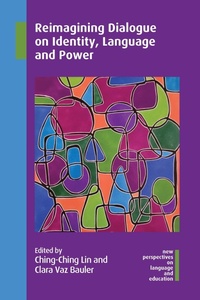
Reimagining Dialogue on Identity, Language and Power
Published on 12. December 2023
232 pages
978-1-80041-474-7 (ISBN)
Description

In this book dialogue is used as a research, knowledge-sharing and community-building tool in which participants engage with each other in reflecting upon the perspectives of self and others: challenging, complementing and contradicting each other as critical peers. The book aims to be an enactment of sociological reimagination, as a way to reimagine public conversations that inspire criticality, innovation and multimodality around the intersection of identity (self), language (mediating mechanism) and power (sociocultural domain). Each chapter illustrates the use of dialogue as a participatory research tool as a way in which the sharing of knowledge and the growth of understanding occurs through meaning- and strategy-making processes. Together they present dialogue as an integrative model of self-inquiry and social activism and provide a valuable standpoint to understand the participatory nature of our very effort to question and investigate our sense of self in the world.
Reviews / Votes
A provocative read! This innovative and risk-taking volume reimagines dialogue by putting it front and center as research method, demonstrating the potential of methods such as critical and collaborative authoethnography, dialogic testimonio, and digitally mediated public scholarship to uncover new insights in identity, language and power. * Wayne E. Wright, Purdue University, USA * With distinct contributions from around the world, this volume is a refreshing reminder and call for attending to dialogue as transformative research. The editors have brought together a select group of authors who are pushing the boundaries of language research with critical and innovative methods approaching dialogue to better understand the nexus of language, identity, and power. * Bedrettin Yazan, The University of Texas at San Antonio, USA * This book embodies the dialogical approach to research, learning and knowledge co-making. The many simultaneously 'personal' and 'political' narratives and conversations break through the straitjacket of conventional academic writing and illustrate how methodological innovation and epistemological pluralism can be beautifully achieved. * Angel M. Y. Lin, The Education University of Hong Kong *More details
Series
Language
English
Place of publication
Bristol
United Kingdom
Target group
College/higher education
Product notice
Reflowable
ISBN-13
978-1-80041-474-7 (9781800414747)
Copyright in bibliographic data and cover images is held by Nielsen Book Services Limited or by the publishers or by their respective licensors: all rights reserved.
Schweitzer Classification
Other editions
Additional editions
Ching-Ching Lin | Clara Vaz Bauler
Reimagining Dialogue on Identity, Language and Power
Book
12/2023
Multilingual Matters
€56.00
Shipment within 10-20 days
Persons
Ching-Ching Lin's career spans more than 20 years of experience as a high school social studies and ESL teacher, college ESL professor, and TESOL and Bilingual Education instructor. She is currently a teacher educator and curriculum developer. She is the co-editor and a contributing author of the following two edited volumes: Inclusion, Diversity, and Intercultural Dialogue in Young People's Philosophical Inquiry (Brill Publishers, 2018) and Internationalization in Action: Leveraging Diversity and Inclusion in Globalized Classrooms (Peter Lang Publishing, 2020).
Clara Vaz Bauler is an Associate Professor of TESOL/Bilingual Education at Adelphi University, NY, USA. She is a sociolinguist and critical discourse analyst who is interested in unveiling unjust and often hidden educational practices that propagate language shaming and discrimination. She investigates language used in news media, social media and classrooms, inquiring on the contexts, purposes and consequences of using certain terms and enacting specific policing practices associated with languaging and migration flows.
Clara Vaz Bauler is an Associate Professor of TESOL/Bilingual Education at Adelphi University, NY, USA. She is a sociolinguist and critical discourse analyst who is interested in unveiling unjust and often hidden educational practices that propagate language shaming and discrimination. She investigates language used in news media, social media and classrooms, inquiring on the contexts, purposes and consequences of using certain terms and enacting specific policing practices associated with languaging and migration flows.
Content
Contributors
Suresh Canagarajah: Foreword
Ching-Ching Lin and Clara Vaz Bauler: Introduction
Part 1: Dialogic Testimonio
Chapter 1. Sandra Rodriguez-Arroyo, Laura C. Walls and Ferial Pearson: Ni de Aqui, Ni de Alla: Reflections on Trying to Fit into a Box
Chapter 2. Priscila Fabiane Farias, Leonardo da Silva and Litiane Barbosa Macedo: On the (Constant) Process of Becoming a Critical Language Educator in the Brazilian Context
Chapter 3. Sumeyra Gok and Angelina Gillispie: Unpacking Raciolinguistic Ideologies and Power Dynamics in Teacher Education through Intersectionality
Chapter 4. Kinsella Valies and Lisa M. Hunsberger: Black Women's Ibasho: Creating a Space of Belonging in Japan
Chapter 5. Lan Wang-Hiles, Ekaterina Goodroad, Tong Zhang and Judith Szerdahelyi: Negotiating Identity, Language and Power: Dialogic Reflections on Non-Native English-Speaking Writing Instructors in the US Composition Classroom
Part 2: Digitally-Mediated Public Scholarship
Chapter 6. Clara Vaz Bauler and Vanja Karanovic: Twitter/X as Thinking Communities: Responding, Reacting and Acting on Linguistic Discrimination
Chapter 7. Ching-Ching Lin, Derek Baylor, Yasmeen Coaxum and Shuzhan Li: Forming Performative Space through Legitimate Peripheral Participation: Digitally-Mediated Dialogic Inquiry of Four BIPOC TESOL Professionals
Chapter 8. A.R. Shearer and Clara Vaz Bauler: Professional Communities in the Making: Critical Dialogues in the ELT Field
Chapter 9. JPB Gerald and Clara Vaz Bauler: Escaping the H-Index: On the Value and Voice of Public Engagement for Racialized Scholars
Part 3: Through a Critical Incident Lens
Chapter 10. Ribut Wahyudi and M. Faisol: When Daily Uses of Language, Identity and 'Power' Intersect with the Global (Center) versus Local (Periphery) Power Relations: An Interdisciplinary Study
Chapter 11. Luciana C. de Oliveira, Destini Braxon, Jia Gui and Tara Willging: A Critical Dialogue Among Participants in a Professional Learning Community
Chapter 12. Edmund Christopher Melville, Rasha Ashkar and Nicholas Douglas: Ebbs, Flows, What's New is Old: A Collaborative Autoethnography of Three EFL Educators in Turkey
Chapter 13. Julia E. Kiernan, Joyce Meier and Xiqiao Wang: Critical Listening: A Teacher-Scholar Dialogue on the Challenges of Linguistically- and Culturally-Centered Coursework
Chapter 14. Wing Shuen Lau and Kristine Mensonides Gritter: Curiosity Matters: Envisioning Intercultural Dialogue in Qualitative Research Practice
Index
Suresh Canagarajah: Foreword
Ching-Ching Lin and Clara Vaz Bauler: Introduction
Part 1: Dialogic Testimonio
Chapter 1. Sandra Rodriguez-Arroyo, Laura C. Walls and Ferial Pearson: Ni de Aqui, Ni de Alla: Reflections on Trying to Fit into a Box
Chapter 2. Priscila Fabiane Farias, Leonardo da Silva and Litiane Barbosa Macedo: On the (Constant) Process of Becoming a Critical Language Educator in the Brazilian Context
Chapter 3. Sumeyra Gok and Angelina Gillispie: Unpacking Raciolinguistic Ideologies and Power Dynamics in Teacher Education through Intersectionality
Chapter 4. Kinsella Valies and Lisa M. Hunsberger: Black Women's Ibasho: Creating a Space of Belonging in Japan
Chapter 5. Lan Wang-Hiles, Ekaterina Goodroad, Tong Zhang and Judith Szerdahelyi: Negotiating Identity, Language and Power: Dialogic Reflections on Non-Native English-Speaking Writing Instructors in the US Composition Classroom
Part 2: Digitally-Mediated Public Scholarship
Chapter 6. Clara Vaz Bauler and Vanja Karanovic: Twitter/X as Thinking Communities: Responding, Reacting and Acting on Linguistic Discrimination
Chapter 7. Ching-Ching Lin, Derek Baylor, Yasmeen Coaxum and Shuzhan Li: Forming Performative Space through Legitimate Peripheral Participation: Digitally-Mediated Dialogic Inquiry of Four BIPOC TESOL Professionals
Chapter 8. A.R. Shearer and Clara Vaz Bauler: Professional Communities in the Making: Critical Dialogues in the ELT Field
Chapter 9. JPB Gerald and Clara Vaz Bauler: Escaping the H-Index: On the Value and Voice of Public Engagement for Racialized Scholars
Part 3: Through a Critical Incident Lens
Chapter 10. Ribut Wahyudi and M. Faisol: When Daily Uses of Language, Identity and 'Power' Intersect with the Global (Center) versus Local (Periphery) Power Relations: An Interdisciplinary Study
Chapter 11. Luciana C. de Oliveira, Destini Braxon, Jia Gui and Tara Willging: A Critical Dialogue Among Participants in a Professional Learning Community
Chapter 12. Edmund Christopher Melville, Rasha Ashkar and Nicholas Douglas: Ebbs, Flows, What's New is Old: A Collaborative Autoethnography of Three EFL Educators in Turkey
Chapter 13. Julia E. Kiernan, Joyce Meier and Xiqiao Wang: Critical Listening: A Teacher-Scholar Dialogue on the Challenges of Linguistically- and Culturally-Centered Coursework
Chapter 14. Wing Shuen Lau and Kristine Mensonides Gritter: Curiosity Matters: Envisioning Intercultural Dialogue in Qualitative Research Practice
Index
