

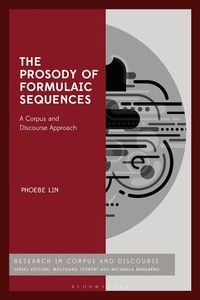
The Prosody of Formulaic Sequences
A Corpus and Discourse Approach
1st Edition
Published on 20. September 2018
248 pages
978-1-4411-0085-6 (ISBN)
Description

To apply the same approaches to analysing spoken and written formulaic language is problematic; to do so masks the fact that the contextual meaning of spoken formulaic language is encoded, to a large extent, in its prosody. In The Prosody of Formulaic Sequences, Phoebe Lin offers a new perspective on formulaic language, arguing that while past research often treats formulaic language as a lexical phenomenon, the phonological aspect of it is a more fundamental facet.
This book draws its conclusions from three original, empirical studies of spoken formulaic language, assessing intonation unit boundaries as well as features such as tempo and stress placement. Across all studies, Lin considers questions of methodology and conceptual framework.
The corpus-based descriptions of prosody outlined in this book not only deepen our understanding of the nature of formulaic language but have important implications for English Language Teaching and automatic speech synthesis.
This book draws its conclusions from three original, empirical studies of spoken formulaic language, assessing intonation unit boundaries as well as features such as tempo and stress placement. Across all studies, Lin considers questions of methodology and conceptual framework.
The corpus-based descriptions of prosody outlined in this book not only deepen our understanding of the nature of formulaic language but have important implications for English Language Teaching and automatic speech synthesis.
Reviews / Votes
As one of the first studies to empirically test the hypothesis of distinct prosodic cues signalling formulaicity, Lin's exploration and careful description of various methods (e.g. automatic extraction, native speaker judgment) allow for an important evaluation of which methods are most appropriate and useful for identifying formulaic language ... Moreover, the level of detail with which Lin describes her method presents a useful research template that is easily transferable to other studies ... Provides a compelling contribution to the study of formulaicity and convincingly demonstrates the potential of prosodic cues for the identification of formulaic sequences. * Journal of Pragmatics * In a linguistic research world dominated by the computer's love of the written word, we need a more methodical approach to the characterization and identification of formulaic language in speech. Phoebe Lin's very welcome book takes the reader through the complex process of empirically identifying contributory factors marking formulaicity in spoken language, and explores methods for improving its identification. * Alison Wray, Research Professor in Language and Communication, Cardiff University, UK * Phoebe Lin's study is a very welcome contribution to the field of applied linguistics. She extends the traditional study of FS as discrete structures and reveals the importance of their functions in different discourse environments. The book is packed with insights and is highly recommended for advanced students and researchers. * Ronald Carter, Research Professor of Modern English Language, University of Nottingham, UK * The volume is a valuable and timely addition to the existing literature on formulaic language. Although recent years have seen a lot of interest in this phenomenon, prosody has been largely overlooked. The three empirical studies that make up the volume shed important light on the prosody of formulaic language, highlighting its unique role in language learning and use, and providing a rich research agenda for future enquiry. * Anna Siyanova, Senior Lecturer in Applied Linguistics, Victoria University of Wellington, New Zealand *More details
Series
Edition
1. Auflage
Language
English
Place of publication
New York
United States
Publishing group
Bloomsbury Publishing PLC (Digital)
Target group
College/higher education
ISBN-13
978-1-4411-0085-6 (9781441100856)
Copyright in bibliographic data and cover images is held by Nielsen Book Services Limited or by the publishers or by their respective licensors: all rights reserved.
Schweitzer Classification
Other editions
Additional editions
Book
03/2020
Bloomsbury Academic
€49.20
Shipment within 15-20 days
Person
Phoebe M. S. Lin is a Research Assistant Professor in the Department of English at the Hong Kong Polytechnic University, Hong Kong.
Content
List of Tables
List of Figures
Acknowledgements
1. Introduction
2. Formulaic language: An overview
3. Can we identify formulaic language based on prosodic cues?
4. Study one: Do formulaic sequences align with intonation units?
5. Study two: A comprehensive profile of the intonation, stress and rhythm of formulaic language
6. Study three: A multimodal approach to the identification of formulaic language by native speaker judgement
7. Conclusions: The prosody of formulaic language
Index
Bibliography
List of Figures
Acknowledgements
1. Introduction
2. Formulaic language: An overview
3. Can we identify formulaic language based on prosodic cues?
4. Study one: Do formulaic sequences align with intonation units?
5. Study two: A comprehensive profile of the intonation, stress and rhythm of formulaic language
6. Study three: A multimodal approach to the identification of formulaic language by native speaker judgement
7. Conclusions: The prosody of formulaic language
Index
Bibliography
