

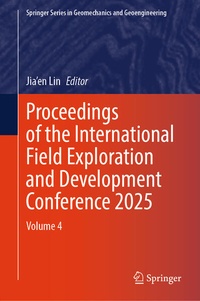
Proceedings of the International Field Exploration and Development Conference 2025
Description

This book compiles selected papers from the 14th International Field Exploration and Development Conference (IFEDC 2025).The work focuses on topics including Reservoir Exploration, Reservoir Drilling & Completion, Field Geophysics, Well Logging, Petroliferous Basin Evaluation, Oil & Gas Accumulation, Fine Reservoir Description, Complex Reservoir Dynamics and Analysis, Low Permeability/Tight Oil & Gas Reservoirs, Shale Oil & Gas, Fracture-Vuggy Reservoirs, Enhanced Oil Recovery in Mature Oil Fields, Enhanced Oil Recovery for Heavy Oil Reservoirs, Big Data and Artificial Intelligence, Formation Mechanisms and Prediction of Deep Carbonate Reservoirs, and other Unconventional Resources.The conference serves as a platform not only for exchanging experiences but also for advancing scientific research in oil & gas exploration and production.The primary audience for this work includes reservoir engineers, geological engineers, senior engineers, enterprise managers, and students.
More details
Other editions
Additional editions
Person
Jia'en Lin, a professor at Xi'An Shiyou University. He holds PhD degree in Mechanics from Tsinghua University, an MS degree from China Petroleum University, Beijing and a BS degree from Southwestern Petroleum University, both in petroleum engineering, He got English training for one year in Dept. of Foreign Language, Eastern China Normal University, Shanghai. He worked as a visiting scholar at University of Houston, USA for one year during 2011-2012 and at Herio-Watt University, UK for half a year in 1998. He worked as petroleum engineer in Xinjiang Petroleum Administration Bureau from 1983-1996 and late worked with Xi'an Shiyou University.
Prof. Lin with more than 30 years of extensive experience with national oil producing companies and university, including reservoir description, reservoir engineering, well test analysis, reservoir information management, prediction of production performance, multi-phase fluid flow in porous media and numerical simulation. Over 50 papers published by Prof. Lin in academic journals and conferences. Prof. Lin also holds two patents and is the author of the book "Practical Well Test Analysis" which was published by Petroleum Industry in 1996 Press. He taught courses including "Reservoir Engineering", "Well Test Analysis", "Oil & Gas Well Production Testing" and "Oil & Gas Production Engineering".
Prof. Lin is a Leader of more than 30 research projects related to reservoir monitoring and
well test data interpretation, reservoir engineering, reservoir description and management from PetroChina, Sinopec and CNOOC in recent 10 years. He created a center for reservoir monitoring and management at the Xian Shiyou University. The team has achieved two important results related to reservoir engineering software. One is Well Test Analysis Software and the other is Web-Based Reservoir Surveillance Information Application System, these softwares have widely been used by many oilfields in China.
Content
Analysis on the Application Effect of Hydraulic Deep Penetration Technology in Class III Reservoirs of Continental Sandstone Oilfields.- Gas-Liquid Two-Phase Flow Characteristics During Gas Migration and Kick Events in Large-Diameter Wellbores.- Numerical Study of Gas-Liquid Two-Phase Flow During the Displacement Process of Kill Heavy Mud in Large-Diameter Boreholes.- Characteristics of gas field produced water and its water property determination.- Dynamic Characteristics of Strong Water-Invaded Carbonate Gas Wells and Drainage Gas Recovery Strategies.- Study on Mechanism of CO2-Assisted Water Control and Production Enhancement in Heavy Oil Reservoir with Bottom Water.- Research on Efficient and Stable Production Development Technologies for Fractured Basement Heavy Oil Reservoirs.- Research and Application on Optimization of Fine Remaining Oil Saturation Calculation Method for Sandstone Oil Reservoirs .- Research on Reasonable Production Allocation under Boosting Production Conditions of EI Gas Field on the Right Bank of Amu Darya River.- Experimental study on water invasion and water control mechanism in Puguang marine gas field.- Reservoir Type Identification of Complex Diamictite Carbonate Reservoir Based on Tubing Flow - PTA/RTA Integration and Its Application--A Case Study in Asmari Reservoir, X Oilfield.- Comprehensive Evaluation Methods and Applications for the Effectiveness and Benefits of Crude Oil Production Capacity Construction.- Research on Comprehensive Measures for Stabilizing Oil Production and Controlling Water Production in High Water Cut Period of Pore Type Carbonate Reservoirs: A Case Study of Oman D Field.- Optimization of Diluent Allocation in Extra-Heavy Oil Field Production Systems.- Evaluation Method for Well Productivity of Ultra Deep Water High Gas Rate Wells Considering Tidal Effect.
