

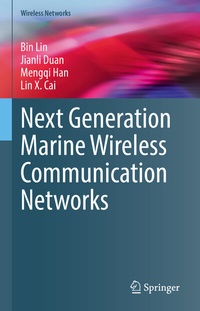
Next Generation Marine Wireless Communication Networks
Description

More details
Other editions
Additional editions
Persons
Jianli Duan received the M.S. and Ph.D. degrees from Dalian Maritime University, Dalian, Liaoning Province, China, in 2003 and 2020, respectively. She is currently a teacher at Qingdao University of Technology, Qingdao, Shandong Province, China. Her research direction is maritime telecommunications and networking, wireless sensor networks, and network planning and optimization.
Mengqi Han received the B.S degree from the Department of Electronic and information, Nanjing University of Science and Technology, Nanjing, China, in 2013. And she received the M.S and the Ph.D degree from the Department of Electrical and Computer Engineering in Illinois Institute of Technology, in 2015 and 2020 respectively. Her research interests include performance analysis of MAC protocol and protocol design for next-generation wireless networks, wireless networks resource management, reinforcement learning, and deep learning.
Lin X. Cai received the M.A.Sc. and Ph.D. degrees in Electrical and Computer Engineering from the University of Waterloo, Waterloo, Canada, in 2005 and 2010, respectively. She is currently an Associate Professor with the Department of Electrical and Computer Engineering, Illinois Institute of Technology, Chicago, Illinois, USA. Her research interests include green communication and networking, intelligent radio resource management, and wireless Internet of Things. She received a Postdoctoral Fellowship Award from the Natural Sciences and Engineering Research Council of Canada (NSERC) in 2010, a Best Paper Award from the IEEE Globecom 2011, an NSF Career Award in 2016, and the IIT Sigma Xi Research Award in the Junior Faculty Division in 2019. She is an Associate Editor of IEEE Transaction on Wireless Communications, IEEE Network Magazine, and a co-chair for IEEE conferences.
