

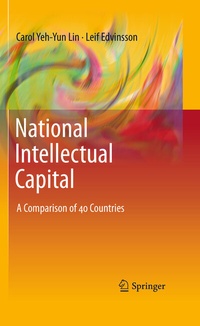
National Intellectual Capital
A Comparison of 40 Countries
1st Edition
Published on 29. October 2010
XVII, 392 pages
978-1-4419-7377-1 (ISBN)
Description

Over the past decade, knowledge assets and intellectual capital have been attracting an increasing amount of attention, not only from academics and CEOs, but also from national policy makers. To date, most studies of intellectual capital have focused at the organizational level, with an emphasis on explaining the role of "intangible assets" as a differentiator between accounting value and market value as a possible source of corporate competitive advantage. More recently, pioneers in the field, including the authors of this book, have begun to apply these methodologies to a broader scope, with the objective of comparing the intellectual capital indices at the national or regional level. As a result, an increasing number of world organizations and researchers are commissioned to investigate this future-oriented crucial national issue. Yet, the linkage between the value of intangible assets and how to quantify or benchmark it is still tenuous, not to mention easily misunderstood by a layman for guiding better decision making.
With the belief that numbers talk and statistics hide valuable information, this book serves to present the authors' research findings, covering 14 years (1995-2008) of intellectual capital information, comprised of human capital, market capital, process capital, renewal capital, and financial capital for 40 countries. The last three chapters go beyond analysis of current intellectual capital factors, and present practical tools for launching initiatives at the national level. The book will serve as an essential resource for researchers, policy makers, and business leaders concerned with issues of economic growth and competitiveness, innovation, and business creation.
More details
Series
Language
English
Place of publication
New York
United States
Publishing group
Springer US
Target group
Professional and scholarly
Product notice
Reflowable
Illustrations
XVII, 392 p.
File size
7,42 MB
ISBN-13
978-1-4419-7377-1 (9781441973771)
DOI
10.1007/978-1-4419-7377-1
Schweitzer Classification
Other editions
Additional editions
Book
10/2014
Springer
€106.99
Shipment within 15-20 days
Book
11/2010
1st Edition
Springer
€106.99
Shipment within 15-20 days
Persons
Dr. Carol Yeh-Yun Lin is Professor of Business Administration at National Chengchi University in Taiwan. She received her Ph.D. in Human Resource Development from the University of Texas at Austin in 1992. Dr. Lin has published extensively, with over 40 scholarly articles and 60 conference presentations on strategic human resource management, international human resource management, intellectual capital, business ethics, and corporate social responsibility. Her papers have appeared in the International Journal of Human Resource Management, Journal of Business Ethics, Long Range Planning, Health Care Management Review, Journal of Small Business Management, Journal of Psychology, and Journal of Intellectual Capital.
Leif Edvinsson, Founding Partner of the consultancy, Universal Networking Intellectual Capital, is the world's leading expert on Intellectual Capital (IC). As former vice president and the world's first corporate director of Intellectual Capital at Skandia of Stockholm, Sweden, Edvinsson has been a key contributor to the theory of IC and oversaw the creation of the world's first corporate Intellectual Capital Annual Report. In 1996 he was awarded by both the American Productivity and Quality Center (US) and Business Intelligence (UK) for his pioneering work on IC. Mr. Edvinsson was formerly senior vice president for training and development of S-E Bank, and president and chairman of Consultus AB, a Stockholm-based consulting company. In light of his work in both training and Intellectual Capital, Edvinsson has been a special advisor on service trade to the Swedish Ministry of Foreign Affairs. He is also special adviser to the Swedish Cabinet on the effects of the new digital economy, special advisor to the United Nations International Trade Center and is a co-founder of the Swedish Coalition of Service Industries.
Mr. Edvinsson holds an MBA from the University of California, Berkeley. He is the author or co-author of numerous publications on IC,including one of the first books on the subject, Intellectual Capital (1997), Corporate Longitude (2002), Leveraging Corporate Knowledge (2004), and Intellectual Capital for Communities (2005). He is a regular speaker before such organizations as the BBC, CIO, Conference Board, Economist, Handelsblatt, Insead, and IMD.
Her serves on the Board of Directors of several knowledge-intensive enterprises, including the Swedish Brain Research Foundation and the Center for Molecular Medicine at Karolinska Institute, Stockholm. Since 2000 he has been the Honorary Chairman of the UK-based Henley College, KM Forum. Since 2000, he has been Adjunct Professor of Intellectual Capital at Lund University, and since 2007 Chair Professor at the Hong Kong Polytechnic University.
Content
1 - Foreword [Seite 6]
2 - Foreword [Seite 8]
3 - Preface [Seite 10]
4 - Preface [Seite 12]
5 - Contents [Seite 14]
6 - Chapter 1: Introduction of National Intellectual Capital [Seite 20]
6.1 - Introduction [Seite 20]
6.2 - Development of National Intellectual Capital [Seite 21]
6.3 - Five Types of Component Capital [Seite 22]
6.4 - Expected Contributions [Seite 24]
6.5 - Chapter Organization of This Book [Seite 25]
7 - Chapter 2: Background of National Intellectual Capital [Seite 26]
7.1 - Motivation for Writing This Book [Seite 26]
7.2 - Current National Intellectual Capital Measurement Models [Seite 27]
7.2.1 - Measurements Proposed by Regional or World Development Organizations [Seite 28]
7.2.1.1 - The World Bank's Knowledge Assessment Methodology [Seite 28]
7.2.1.2 - OECD Measurement Models [Seite 29]
7.2.1.3 - United Nations Economic Commission for Europe Model [Seite 29]
7.2.2 - National Intellectual Capital Models Proposed by Individual Researchers [Seite 30]
7.3 - Obstacles to the Measurement of National Intellectual Capital [Seite 31]
7.4 - Summary [Seite 35]
8 - Chapter 3: Methods and National Intellectual Capital Ranking of 40 Countries [Seite 36]
8.1 - Proposed National Intellectual Capital Measurement Model [Seite 36]
8.2 - Indicator Selection and Validation [Seite 37]
8.3 - Validation of NICI40 Measurement Model [Seite 40]
8.4 - Methods [Seite 40]
8.5 - National Intellectual Capital Indices for 40 Countries [Seite 41]
8.6 - Appendix 1 [Seite 46]
8.7 - Appendix 2 [Seite 49]
9 - Chapter 4: National Intellectual Capital of Five Nordic Countries (Denmark, Finland, Iceland, Norway, Sweden) [Seite 51]
9.1 - Introduction [Seite 51]
9.2 - National Intellectual Capital of Each Individual Country [Seite 52]
9.3 - Comparison of Capital Components of the Five Nordic Countries [Seite 58]
9.4 - Three-Period Progression of National Intellectual Capital Development [Seite 62]
9.5 - General Descriptive Information on the Five Nordic Countries [Seite 65]
9.6 - Summary [Seite 78]
10 - Chapter 5: National Intellectual Capital of Four Larger Western European Countries (France, Germany, Ireland, UK) [Seite 81]
10.1 - Introduction [Seite 81]
10.2 - National Intellectual Capital of Each Individual Country [Seite 82]
10.3 - Comparison of Capital Components of the Four Larger European Countries [Seite 86]
10.4 - Three-Period Progression of National Intellectual Capital Development [Seite 90]
10.5 - General Descriptive Information on the Four Larger European Countries [Seite 93]
10.6 - Summary [Seite 102]
11 - Chapter 6: National Intellectual Capital of Four Smaller Western European Countries (Austria, Belgium, Netherlands, Switzerland) [Seite 104]
11.1 - Introduction [Seite 104]
11.2 - National Intellectual Capital of Each Individual Country [Seite 105]
11.3 - Comparison of Capital Components of the Four Smaller European Countries [Seite 110]
11.4 - Three-Period Progression of National Intellectual Capital Development [Seite 113]
11.5 - General Descriptive Information on the Four Smaller European Countries [Seite 116]
11.6 - Summary [Seite 125]
12 - Chapter 7: National Intellectual Capital of Four Southern European Countries (Greece, Italy, Portugal, Spain) [Seite 128]
12.1 - Introduction [Seite 128]
12.2 - National Intellectual Capital of Each Individual Country [Seite 129]
12.3 - Comparison of Capital Components of the Four Southern European Countries [Seite 134]
12.4 - Three-Period Progression of National Intellectual Capital Development [Seite 137]
12.5 - General Descriptive Information on the Four Southern European Countries [Seite 140]
12.6 - Summary [Seite 151]
13 - Chapter 8: National Intellectual Capital of Four East Central European Countries and South Africa (Czech Republic, Hungary, Poland,South Africa, Turkey) [Seite 153]
13.1 - Introduction [Seite 153]
13.2 - National Intellectual Capital of Each Individual Country [Seite 154]
13.3 - Comparison of Capital Components of the Four East Central European Countries and South Africa [Seite 159]
13.4 - Three-Period Progression of National Intellectual Capital Development [Seite 163]
13.5 - General Descriptive Information on the Four East Central European Countries and South Africa [Seite 166]
13.6 - Summary [Seite 177]
14 - Chapter 9: National Intellectual Capital of Two North American Countries (Canada, USA) [Seite 179]
14.1 - Introduction [Seite 179]
14.2 - National Intellectual Capital of the Two Countries [Seite 181]
14.3 - Comparison of Capital Components of the Two North American Countries [Seite 183]
14.4 - Three-Period Progression of National Intellectual Capital Development [Seite 186]
14.5 - General Descriptive Information on the Two North American Countries [Seite 188]
14.6 - Summary [Seite 188]
15 - Chapter 10: National Intellectual Capital of Four Latin American Countries (Argentina, Brazil, Chile, Mexico) [Seite 196]
15.1 - Introduction [Seite 196]
15.2 - National Intellectual Capital of Each Individual Country [Seite 197]
15.3 - Comparison of Capital Components of the Four Latin American Countries [Seite 201]
15.4 - Three-Period Progression of National Intellectual Capital Development [Seite 204]
15.5 - General Descriptive Information on the Four Latin American Countries [Seite 205]
15.6 - Summary [Seite 208]
16 - Chapter 11: National Intellectual Capital of Australia and New Zealand [Seite 219]
16.1 - Introduction [Seite 219]
16.2 - National Intellectual Capital of Australia and New Zealand [Seite 221]
16.3 - Comparison of Capital Components of Australia and New Zealand [Seite 223]
16.4 - Three-Period Progression of National Intellectual Capital Development [Seite 226]
16.5 - General Descriptive Information on Australia and New Zealand [Seite 228]
16.6 - Summary [Seite 232]
17 - Chapter 12: National Intellectual Capital of Three East Asian Countries (Japan, South Korea, Taiwan) [Seite 235]
17.1 - Introduction [Seite 235]
17.2 - National Intellectual Capital of Each Individual Country [Seite 236]
17.3 - Comparison of Capital Components of the Three East Asian Countries [Seite 240]
17.4 - Three-Period Progression of National Intellectual Capital Development [Seite 243]
17.5 - General Descriptive Information on the Three East Asian Countries [Seite 245]
17.6 - Summary [Seite 252]
18 - Chapter 13: National Intellectual Capital of Four Southeast Asian Countries (Malaysia, Philippines, Singapore, Thailand) [Seite 254]
18.1 - Introduction [Seite 254]
18.2 - National Intellectual Capital of Each Individual Country [Seite 255]
18.3 - Comparison of Capital Components of the Four Southeast Asian Countries [Seite 259]
18.4 - Three-Period Progression of National Intellectual Capital Development [Seite 263]
18.5 - General Descriptive Information on the Four Southeast Asian Countries [Seite 266]
18.6 - Summary [Seite 266]
19 - Chapter 14: National Intellectual Capital of the Four BRIC Countries (Brazil, Russia, India, China) [Seite 276]
19.1 - Introduction [Seite 276]
19.2 - National Intellectual Capital of Each Individual Country [Seite 277]
19.3 - Comparison of Capital Components of the Four BRIC Countries [Seite 281]
19.4 - Three-Period Progression of National Intellectual Capital Development [Seite 285]
19.5 - General Descriptive Information on the Four BRIC Countries [Seite 288]
19.6 - Summary [Seite 298]
20 - Chapter 15: National Intellectual Capital Development: Trajectory from a Poor to a Fast Growth Country [Seite 300]
20.1 - Introduction [Seite 300]
20.2 - National Intellectual Capital of the Five Poorest Countries [Seite 301]
20.3 - National Intellectual Capital of the Five Fastest Growth Countries [Seite 305]
20.4 - Comparison of the Poorest and Fastest Growth Countries [Seite 308]
20.5 - Trajectory from a Poor to a Fast Growth Country [Seite 311]
20.5.1 - Summary [Seite 316]
21 - Chapter 16: Dynamic Systems in National Intellectual Capital [Seite 318]
21.1 - Ranking Changes of the Five Component Capitals [Seite 318]
21.2 - GDP Growth Comparison [Seite 326]
21.3 - Intangible Asset Indicators of Various World Organizations [Seite 328]
21.4 - Paths for Planned National Intellectual Capital Growth [Seite 328]
21.5 - Summary [Seite 346]
21.6 - Appendices [Seite 347]
21.7 - Appendix 1 [Seite 348]
21.8 - Appendix 2 [Seite 350]
21.9 - Appendix 3 [Seite 352]
21.10 - Appendix 4 [Seite 354]
21.11 - Appendix 5 [Seite 356]
21.12 - Appendix 6 [Seite 358]
22 - Chapter 17: Policy Implications and Future Perspectives [Seite 360]
22.1 - Introduction [Seite 360]
22.2 - Internal and External National Intellectual Capital Issues [Seite 361]
22.3 - Policy Implications [Seite 364]
22.3.1 - GDP Implications [Seite 364]
22.3.2 - National Context Implications [Seite 365]
22.3.3 - Currency Effect Implications [Seite 366]
22.3.4 - Effectiveness Implications [Seite 366]
22.3.5 - IC Formula I: Turning Liability into Potential and into Value [Seite 367]
22.4 - On-Going National Intellectual Capital Development [Seite 367]
22.4.1 - Promote National Intellectual Capital Creation Routes [Seite 367]
22.4.2 - Encourage Three Types of National Intellectual Capital Growth Patterns [Seite 368]
22.4.2.1 - Pattern #1: From A to A+ (Capital Score Percentile from 70th to 90th) [Seite 369]
22.4.2.2 - Pattern #2: A Big Stride (Capital Score Percentile from 50th to 90th) [Seite 369]
22.4.2.3 - Pattern #3: From Good to Better (Capital Score Percentile from 40th to 60th) [Seite 370]
22.4.3 - Create Intellectual Capital Accelerator [Seite 372]
22.4.4 - Establish an Intellectual Capital Incubator [Seite 374]
22.5 - Suggestions for BRIC Countries [Seite 374]
22.6 - Limitations and Future Perspectives [Seite 380]
22.7 - Conclusion [Seite 380]
23 - After Note: Looking from Outside [Seite 383]
24 - References [Seite 385]
25 - Glossary [Seite 396]
26 - Author Index [Seite 399]
27 - Subject Index [Seite 401]
2 - Foreword [Seite 8]
3 - Preface [Seite 10]
4 - Preface [Seite 12]
5 - Contents [Seite 14]
6 - Chapter 1: Introduction of National Intellectual Capital [Seite 20]
6.1 - Introduction [Seite 20]
6.2 - Development of National Intellectual Capital [Seite 21]
6.3 - Five Types of Component Capital [Seite 22]
6.4 - Expected Contributions [Seite 24]
6.5 - Chapter Organization of This Book [Seite 25]
7 - Chapter 2: Background of National Intellectual Capital [Seite 26]
7.1 - Motivation for Writing This Book [Seite 26]
7.2 - Current National Intellectual Capital Measurement Models [Seite 27]
7.2.1 - Measurements Proposed by Regional or World Development Organizations [Seite 28]
7.2.1.1 - The World Bank's Knowledge Assessment Methodology [Seite 28]
7.2.1.2 - OECD Measurement Models [Seite 29]
7.2.1.3 - United Nations Economic Commission for Europe Model [Seite 29]
7.2.2 - National Intellectual Capital Models Proposed by Individual Researchers [Seite 30]
7.3 - Obstacles to the Measurement of National Intellectual Capital [Seite 31]
7.4 - Summary [Seite 35]
8 - Chapter 3: Methods and National Intellectual Capital Ranking of 40 Countries [Seite 36]
8.1 - Proposed National Intellectual Capital Measurement Model [Seite 36]
8.2 - Indicator Selection and Validation [Seite 37]
8.3 - Validation of NICI40 Measurement Model [Seite 40]
8.4 - Methods [Seite 40]
8.5 - National Intellectual Capital Indices for 40 Countries [Seite 41]
8.6 - Appendix 1 [Seite 46]
8.7 - Appendix 2 [Seite 49]
9 - Chapter 4: National Intellectual Capital of Five Nordic Countries (Denmark, Finland, Iceland, Norway, Sweden) [Seite 51]
9.1 - Introduction [Seite 51]
9.2 - National Intellectual Capital of Each Individual Country [Seite 52]
9.3 - Comparison of Capital Components of the Five Nordic Countries [Seite 58]
9.4 - Three-Period Progression of National Intellectual Capital Development [Seite 62]
9.5 - General Descriptive Information on the Five Nordic Countries [Seite 65]
9.6 - Summary [Seite 78]
10 - Chapter 5: National Intellectual Capital of Four Larger Western European Countries (France, Germany, Ireland, UK) [Seite 81]
10.1 - Introduction [Seite 81]
10.2 - National Intellectual Capital of Each Individual Country [Seite 82]
10.3 - Comparison of Capital Components of the Four Larger European Countries [Seite 86]
10.4 - Three-Period Progression of National Intellectual Capital Development [Seite 90]
10.5 - General Descriptive Information on the Four Larger European Countries [Seite 93]
10.6 - Summary [Seite 102]
11 - Chapter 6: National Intellectual Capital of Four Smaller Western European Countries (Austria, Belgium, Netherlands, Switzerland) [Seite 104]
11.1 - Introduction [Seite 104]
11.2 - National Intellectual Capital of Each Individual Country [Seite 105]
11.3 - Comparison of Capital Components of the Four Smaller European Countries [Seite 110]
11.4 - Three-Period Progression of National Intellectual Capital Development [Seite 113]
11.5 - General Descriptive Information on the Four Smaller European Countries [Seite 116]
11.6 - Summary [Seite 125]
12 - Chapter 7: National Intellectual Capital of Four Southern European Countries (Greece, Italy, Portugal, Spain) [Seite 128]
12.1 - Introduction [Seite 128]
12.2 - National Intellectual Capital of Each Individual Country [Seite 129]
12.3 - Comparison of Capital Components of the Four Southern European Countries [Seite 134]
12.4 - Three-Period Progression of National Intellectual Capital Development [Seite 137]
12.5 - General Descriptive Information on the Four Southern European Countries [Seite 140]
12.6 - Summary [Seite 151]
13 - Chapter 8: National Intellectual Capital of Four East Central European Countries and South Africa (Czech Republic, Hungary, Poland,South Africa, Turkey) [Seite 153]
13.1 - Introduction [Seite 153]
13.2 - National Intellectual Capital of Each Individual Country [Seite 154]
13.3 - Comparison of Capital Components of the Four East Central European Countries and South Africa [Seite 159]
13.4 - Three-Period Progression of National Intellectual Capital Development [Seite 163]
13.5 - General Descriptive Information on the Four East Central European Countries and South Africa [Seite 166]
13.6 - Summary [Seite 177]
14 - Chapter 9: National Intellectual Capital of Two North American Countries (Canada, USA) [Seite 179]
14.1 - Introduction [Seite 179]
14.2 - National Intellectual Capital of the Two Countries [Seite 181]
14.3 - Comparison of Capital Components of the Two North American Countries [Seite 183]
14.4 - Three-Period Progression of National Intellectual Capital Development [Seite 186]
14.5 - General Descriptive Information on the Two North American Countries [Seite 188]
14.6 - Summary [Seite 188]
15 - Chapter 10: National Intellectual Capital of Four Latin American Countries (Argentina, Brazil, Chile, Mexico) [Seite 196]
15.1 - Introduction [Seite 196]
15.2 - National Intellectual Capital of Each Individual Country [Seite 197]
15.3 - Comparison of Capital Components of the Four Latin American Countries [Seite 201]
15.4 - Three-Period Progression of National Intellectual Capital Development [Seite 204]
15.5 - General Descriptive Information on the Four Latin American Countries [Seite 205]
15.6 - Summary [Seite 208]
16 - Chapter 11: National Intellectual Capital of Australia and New Zealand [Seite 219]
16.1 - Introduction [Seite 219]
16.2 - National Intellectual Capital of Australia and New Zealand [Seite 221]
16.3 - Comparison of Capital Components of Australia and New Zealand [Seite 223]
16.4 - Three-Period Progression of National Intellectual Capital Development [Seite 226]
16.5 - General Descriptive Information on Australia and New Zealand [Seite 228]
16.6 - Summary [Seite 232]
17 - Chapter 12: National Intellectual Capital of Three East Asian Countries (Japan, South Korea, Taiwan) [Seite 235]
17.1 - Introduction [Seite 235]
17.2 - National Intellectual Capital of Each Individual Country [Seite 236]
17.3 - Comparison of Capital Components of the Three East Asian Countries [Seite 240]
17.4 - Three-Period Progression of National Intellectual Capital Development [Seite 243]
17.5 - General Descriptive Information on the Three East Asian Countries [Seite 245]
17.6 - Summary [Seite 252]
18 - Chapter 13: National Intellectual Capital of Four Southeast Asian Countries (Malaysia, Philippines, Singapore, Thailand) [Seite 254]
18.1 - Introduction [Seite 254]
18.2 - National Intellectual Capital of Each Individual Country [Seite 255]
18.3 - Comparison of Capital Components of the Four Southeast Asian Countries [Seite 259]
18.4 - Three-Period Progression of National Intellectual Capital Development [Seite 263]
18.5 - General Descriptive Information on the Four Southeast Asian Countries [Seite 266]
18.6 - Summary [Seite 266]
19 - Chapter 14: National Intellectual Capital of the Four BRIC Countries (Brazil, Russia, India, China) [Seite 276]
19.1 - Introduction [Seite 276]
19.2 - National Intellectual Capital of Each Individual Country [Seite 277]
19.3 - Comparison of Capital Components of the Four BRIC Countries [Seite 281]
19.4 - Three-Period Progression of National Intellectual Capital Development [Seite 285]
19.5 - General Descriptive Information on the Four BRIC Countries [Seite 288]
19.6 - Summary [Seite 298]
20 - Chapter 15: National Intellectual Capital Development: Trajectory from a Poor to a Fast Growth Country [Seite 300]
20.1 - Introduction [Seite 300]
20.2 - National Intellectual Capital of the Five Poorest Countries [Seite 301]
20.3 - National Intellectual Capital of the Five Fastest Growth Countries [Seite 305]
20.4 - Comparison of the Poorest and Fastest Growth Countries [Seite 308]
20.5 - Trajectory from a Poor to a Fast Growth Country [Seite 311]
20.5.1 - Summary [Seite 316]
21 - Chapter 16: Dynamic Systems in National Intellectual Capital [Seite 318]
21.1 - Ranking Changes of the Five Component Capitals [Seite 318]
21.2 - GDP Growth Comparison [Seite 326]
21.3 - Intangible Asset Indicators of Various World Organizations [Seite 328]
21.4 - Paths for Planned National Intellectual Capital Growth [Seite 328]
21.5 - Summary [Seite 346]
21.6 - Appendices [Seite 347]
21.7 - Appendix 1 [Seite 348]
21.8 - Appendix 2 [Seite 350]
21.9 - Appendix 3 [Seite 352]
21.10 - Appendix 4 [Seite 354]
21.11 - Appendix 5 [Seite 356]
21.12 - Appendix 6 [Seite 358]
22 - Chapter 17: Policy Implications and Future Perspectives [Seite 360]
22.1 - Introduction [Seite 360]
22.2 - Internal and External National Intellectual Capital Issues [Seite 361]
22.3 - Policy Implications [Seite 364]
22.3.1 - GDP Implications [Seite 364]
22.3.2 - National Context Implications [Seite 365]
22.3.3 - Currency Effect Implications [Seite 366]
22.3.4 - Effectiveness Implications [Seite 366]
22.3.5 - IC Formula I: Turning Liability into Potential and into Value [Seite 367]
22.4 - On-Going National Intellectual Capital Development [Seite 367]
22.4.1 - Promote National Intellectual Capital Creation Routes [Seite 367]
22.4.2 - Encourage Three Types of National Intellectual Capital Growth Patterns [Seite 368]
22.4.2.1 - Pattern #1: From A to A+ (Capital Score Percentile from 70th to 90th) [Seite 369]
22.4.2.2 - Pattern #2: A Big Stride (Capital Score Percentile from 50th to 90th) [Seite 369]
22.4.2.3 - Pattern #3: From Good to Better (Capital Score Percentile from 40th to 60th) [Seite 370]
22.4.3 - Create Intellectual Capital Accelerator [Seite 372]
22.4.4 - Establish an Intellectual Capital Incubator [Seite 374]
22.5 - Suggestions for BRIC Countries [Seite 374]
22.6 - Limitations and Future Perspectives [Seite 380]
22.7 - Conclusion [Seite 380]
23 - After Note: Looking from Outside [Seite 383]
24 - References [Seite 385]
25 - Glossary [Seite 396]
26 - Author Index [Seite 399]
27 - Subject Index [Seite 401]
