

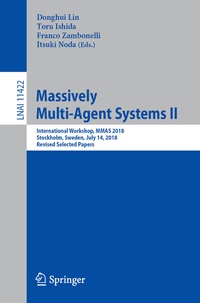
Massively Multi-Agent Systems II
International Workshop, MMAS 2018, Stockholm, Sweden, July 14, 2018, Revised Selected Papers
Published on 18. May 2019
X, 163 pages
978-3-030-20937-7 (ISBN)
Description

This book contains revised selected and invited papers presented at the International Workshop on Massively Multi-Agent Systems, MMAS 2018, held in Stockholm, Sweden, in July 2018.
The 7 revised full papers presented were carefully reviewed and selected for inclusion in this volume. Also included are 3 post-workshop papers. The papers discuss enabling technologies, new architectures, promising applications, and challenges of massively multi-agent systems in the era of IoT. They are organized in the following topical sections: multi-agent systems and Internet of Things; architectures for massively multi-agent systems; and applications of massively multi-agent systems.
The 7 revised full papers presented were carefully reviewed and selected for inclusion in this volume. Also included are 3 post-workshop papers. The papers discuss enabling technologies, new architectures, promising applications, and challenges of massively multi-agent systems in the era of IoT. They are organized in the following topical sections: multi-agent systems and Internet of Things; architectures for massively multi-agent systems; and applications of massively multi-agent systems.
More details
Series
Language
English
Place of publication
Cham
Switzerland
Publishing group
Springer International Publishing
Product notice
Reflowable
Illustrations
X, 163 p. 117 illus., 52 illus. in color.
File size
15,39 MB
ISBN-13
978-3-030-20937-7 (9783030209377)
DOI
10.1007/978-3-030-20937-7
Schweitzer Classification
Other editions
Additional editions

Donghui Lin | Toru Ishida | Franco Zambonelli
Massively Multi-Agent Systems II
International Workshop, MMAS 2018, Stockholm, Sweden, July 14, 2018, Revised Selected Papers
Book
05/2019
Springer
€53.49
Shipment within 7-9 days
Content
- Intro
- Preface
- Organization
- Contents
- Multi-agent Systems and Internet of Things
- Distributed Speaking Objects: A Case for Massive Multiagent Systems
- 1 Introduction
- 2 Speaking Objects as Cognitive Goal-Oriented Agents
- 2.1 Data Collection vs. Cognitive Sensing
- 2.2 Actuating Commands vs. Achieving Goals
- 3 Distributed Coordination as a Conversation
- 3.1 From Coordination to Conversations
- 3.2 Types of Conversations
- 4 Enabling Technologies
- 4.1 Cognitive Reasoning
- 4.2 Machine Learning
- 4.3 Goal-Oriented Computing
- 4.4 Argumentation-Based Coordination
- 5 Integration Recipe: Open Challenges for Realizing the Vision
- 5.1 Massive Scale and Heterogeneity
- 5.2 Middleware
- 5.3 Humans-in-the-Loop
- 5.4 Harnessing Algocracy
- 5.5 Security
- 6 Conclusions
- References
- Injecting (Micro)Intelligence in the IoT: Logic-Based Approaches for (M)MAS
- 1 Introduction
- 2 Background and Related Work
- 2.1 (M)MAS, IoT and Intelligence
- 2.2 Engineering Intelligence in the IoT: Key Challenges
- 3 Logic-Based Approaches for (M)MAS and IoT
- 4 LPaaS & LVLP for Environment Intelligence
- 4.1 Vision
- 4.2 LPaaS in a Nutshell
- 4.3 LVLP in a Nutshell
- 4.4 LPaaS & LVLP in (M)MAS
- 5 ReSpecT and Logical Tuples for Social Intelligence
- 5.1 Vision
- 5.2 TuCSoN and ReSpecT in a Nutshell
- 6 Conclusion
- References
- Integrating Internet of Services and Internet of Things from a Multiagent Perspective
- 1 Introduction
- 2 Background of IoS and IoT
- 2.1 Internet of Services (IoS)
- 2.2 Internet of Things (IoT)
- 3 Issues for Integrating IoS and IoT
- 4 A Multiagent Perspective on Integrated IoS/IoT
- 4.1 Integration of IoS and IoT
- 4.2 The Multiagent-Based Architecture
- 4.3 Multiagent Methodologies for Service Design
- 5 An Example Application of Multilingual Environment Design
- 6 Conclusion
- References
- Architectures for Massively Multi-agent Systems
- Two-Layer Architecture for Distributed Massively Multi-agent Systems
- 1 Introduction
- 2 Two-Layer Architecture
- 2.1 Overlay Networks
- 2.2 Overall Architecture
- 2.3 Macro Agents
- 2.4 Micro Agents
- 3 Meta Scenario
- 3.1 Scenario Description Language Q
- 3.2 Extension of Q for Meta-scenario
- 3.3 Example of Meta-scenario
- 4 Application
- 4.1 Driving Control Using Environment-Embedded Sensors
- 5 Conclusion
- References
- Multi-agent Social Simulation for Social Service Design
- 1 Introduction
- 2 Pedestrian Simulations
- 2.1 Efficiency/Complexity Trade-Off Analysis for Evacuation Guidance
- 2.2 Evacuation Scalability Analysis
- 3 Transportation Simulations for On-Demand Traffic Systems
- 4 OACIS: Exhaustive Simulation Framework
- 5 Concluding Remarks
- References
- Inverse Reinforcement Learning for Agents Behavior in a Crowd Simulator
- 1 Introduction
- 2 Related Work
- 3 Pedestrian Simulator
- 4 Agent Model
- 5 Preliminary Validation
- 6 Conclusions
- References
- FARM: Architecture for Distributed Agent-Based Social Simulations
- 1 Introduction
- 2 Related Work
- 3 FARM Distributed Simulation Architecture
- 4 Github Simulation and Experiment Setup
- 5 Results
- 6 Discussion
- References
- Applications of Massively Multi-agent Systems
- Diversity in Massively Multi-agent Systems: Concepts, Implementations, and Normal Accidents
- 1 Introduction
- 2 The TaaS Spectrum of Coordination
- 2.1 Market Systems
- 2.2 Hierarchical Control Systems
- 3 Ensembles of Hierarchies
- 3.1 Research Challenges
- 3.2 General Framework
- 3.3 Hierarchical Adaptation
- 3.4 Collective Adaptation Engine
- 4 Resilience Engineering for Normal Accidents
- References
- CARAVAN: A Framework for Comprehensive Simulations on Massive Parallel Machines
- 1 Motivation and Significance
- 2 Software Description
- 2.1 Overall Architecture
- 2.2 Requirements for a Simulator
- 2.3 Preparation of a Search Engine
- 3 Implementation
- 4 Application to Multi-agent Simulation
- 4.1 Searching Trade-Off Relationships in Evacuation Planning
- 4.2 Multi-objective Optimization Algorithm
- 4.3 Evacuation Simulator
- 4.4 Results and Discussion
- 5 Conclusions and Future Work
- References
- BASIC: Towards a Blockchained Agent-Based SImulator for Cities
- 1 Introduction
- 2 Background
- 2.1 Car-Sharing Scenario
- 2.2 Agent-Based Simulation
- 2.3 Blockchain and Smart Contracts
- 3 The BASIC Architecture
- 3.1 Data and Simulation Layers
- 3.2 Blockchain Layer
- 3.3 Planner Layer
- 4 Experiment, Results and Analysis
- 5 Discussion and Future Work
- References
- Author Index
