

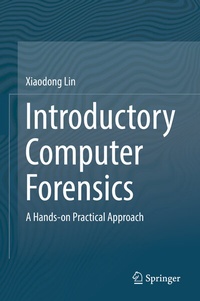
Introductory Computer Forensics
Description

This textbook provides an introduction to digital forensics, a rapidly evolving field for solving crimes. Beginning with the basic concepts of computer forensics, each of the book's 21 chapters focuses on a particular forensic topic composed of two parts: background knowledge and hands-on experience through practice exercises. Each theoretical or background section concludes with a series of review questions, which are prepared to test students' understanding of the materials, while the practice exercises are intended to afford students the opportunity to apply the concepts introduced in the section on background knowledge.
This experience-oriented textbook is meant to assist students in gaining a better understanding of digital forensics through hands-on practice in collecting and preserving digital evidence by completing various exercises. With 20 student-directed, inquiry-based practice exercises, students will better understand digital forensic concepts and learn digital forensic investigation techniques.
This textbook is intended for upper undergraduate and graduate-level students who are taking digital-forensic related courses or working in digital forensics research. It can also be used by digital forensics practitioners, IT security analysts, and security engineers working in the IT security industry, particular IT professionals responsible for digital investigation and incident handling or researchers working in these related fields as a reference book.
More details
Other editions
Additional editions
Person
Dr. Lin serves as an Associate Editor for many international journals. He has served or is serving as a guest editor for many special issues of IEEE, Elsevier and Springer journals and as a symposium chair or track chair for IEEE/ACM conferences. He also served on many program committees. He was Chair of Communications and Information Security Technical Committee (CISTC) (2016-2017), IEEE Communications Society (ComSoc). He is a Fellow of the IEEE. He is also a CISSP (Certified Information Systems Security Professional).
