

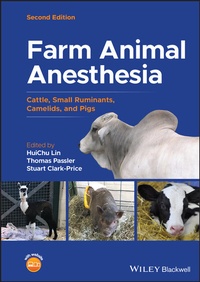
Farm Animal Anesthesia
Description

The newly revised Second Edition of Farm Animal Anesthesia: Cattle, Small Ruminants, Camelids, and Pigs is a practical and easy-to-use manual for techniques associated with anesthesia and pain management in farm animal species. The new edition incorporates advances in surgical and diagnostic techniques, with the latest drugs and equipment, updated images, and new technique descriptions added throughout the book.
Farm Animal Anesthesia offers additional and updated information on drug combinations and anesthetic techniques relevant to small ruminants and potbellied pigs, reflecting their growing popularity. New chapters and topics on paralytic drugs for complete muscle relaxation, use of ventilators for advanced and complex surgeries, updated local and regional anesthetic techniques, and comprehensive standing surgery and diagnostic procedures have been added.
Readers will also benefit from access to a companion website with video clips demonstrating local and regional anesthetic techniques described within. The book also includes:
* A thorough introduction to general preanesthetic considerations for ruminants, camelids, including alpacas and llamas, and potbellied pigs
* A comprehensive exploration of commonly used preanesthetics and injectable anesthetics, including anticholinergics, sedatives, tranquilizers, analgesics, and injectable anesthetics
* Practical discussions of standing sedation and chemical restraint, including new drug combinations for reliable restraint and remote drug delivery
* In-depth description of the use of neuromuscular blocking drugs and monitoring in farm animals
* Complete review of regulatory and legal considerations of anesthetics and analgesics used in farm animals
Farm Animal Anesthesia is an indispensable resource for farm animal practitioners, veterinary surgeons, veterinary anesthetists, and researchers, as well as for veterinary students and residents in surgery and anesthesia.
More details
Other editions
Additional editions
Persons
The editors
HuiChu Lin, DVM, MS, DACVAA, is Professor of Anesthesia in the Department of Clinical Sciences, College of Veterinary Medicine at Auburn University in Auburn, Alabama, USA.
Thomas Passler, DVM, PhD, DACVIM-LA, is Professor of Food and Fiber Animals in the Department of Clinical Sciences, College of Veterinary Medicine at Auburn University in Auburn, Alabama, USA.
Stuart Clark-Price, DVM, MS, DACVIM-LA, DACVAA, CVA, is Associate Professor of Anesthesia in the Department of Clinical Sciences, College of Veterinary Medicine at Auburn University in Auburn, Alabama, USA.
Content
Contributing Authors
Preface
Chapter 1. Preanesthetic Considerations HuiChu Lin
Positioning
Ruminal tympany
Regurgitation
Salivation
Malignant hyperthermia
Differences in sensitivity to anesthetics
Preanesthetic preparation
References
Chapter 2. Commonly Used Preanesthetics HuiChu Lin
Acepromazine (phenothiazine derivatives)
Droperidol and azaperone (butyrophenone derivatives)
Detomidine, dexmedetomidine, medetomidine, romifidine, and xylazine (a2 agonists)
Atipamezole, tolazoline, yohimbine, and vatinoxan (a2 antagonists)
Diazepam and midazolam (benzodiazepine derivatives)
Chloral hydrate
References
Chapter 3. Standing Sedation and Chemical Restraint HuiChu Lin
Cattle
Small ruminants and camelids
Swine
References
Chapter 4. Injectable Anesthetics and Field Anesthesia HuiChu Lin
Injectable anesthetics
Ketamine
Telazol
Alfaxalone
Guaifenesin
Field anesthesia
Cattle
Small ruminants and camelids
Swine
References
Chapter 5. Neuromuscular Blocking Agents Stuart Clark-Price
Physiology of the neuromuscular junction
Mechanism of action of NMBA
Depolarizing neuromuscular blocking agents
Non-depolarizing neuromuscular blocking agents
Clinically useful NMBA
Atracurium
Cis-atracurium
Vecuronium
Rocuronium
Monitoring of NMBA action
Reversal of NMBA
References
Chapter 6. Inhalation Anesthesia and Use of Ventilator HuiChu Lin
Cattle
Small ruminants and camelids
Swine
Use of Ventilators
References
Chapter 7. Perioperative Monitoring and Management of Complications HuiChu Lin
Perioperative monitoring
Supportive fluid therapy
Positioning
Recovery
Perioperative complications
Regurgitation and aspiration pneumonia
Airway obstruction
Ruminal tympany/bloat
Salivation
Hypoventilation
Cardiac arrhythmias
Hypotension
Hypothermia
Malignant hyperthermia
Postanesthetic neuromyopathy
Cardiovascular collapse
References
Chapter 8. Local and Regional Anesthetic Techniques Jessica Rush and Jenna Stockler
Local anesthetic agents
Anesthesia for dehorning
Anesthesia for the eye and eyelids
Nasal anesthesia
Anesthesia for reproductive procedures and for cessation of straining
Caudal epidural anesthesia
Continuous caudal epidural anesthesia
Internal pudendal nerve block
Dorsal penile nerve block
Sacral paravertebral nerve block
Lumbosacral epidural anesthesia
Anesthesia for laparotomy
Line block
Inverted L block
Proximal paravertebral block
Distal paravertebral block
Anesthesia for udder and teats
Anesthesia of the limbs
Castration
References
Chapter 9. Anesthetic Management of Specific Procedures Benjamin Newcomer
Urogenital surgery in the male
Castration
Penile papilloma
Persistent frenulum
Penile translocation
Epididymectomy
Vasectomy
Urogenital surgery in the female
Cesarean section
Ovariectomy
Vaginal prolapse
Perineal laceration
Surgical disorders of the abdomen
Laparotomy
Disorders of the forestomachs
Displacements and volvulus of the abomasum
Small intestine disorders (intussusception, intestinal volvulus, intestinal obstruction)
Urolithiasis and bladder rupture
Umbilical hernias
Musculoskeletal indications
Dehorning
Claw amputation and facilitated ankylosis
Excision of interdigital fibromas
Teeth Floating
Tail docking
Rectal prolapse
Wounds, lumps, bumps, and abscesses
Wound management
Ocular squamous cell carcinoma
Enucleation
Entropion
Abscess removal for caseous lymphadenitis
References
Chapter 10. Pain Management for Farm Animals HuiChu Lin
Local anesthetics
Systemic pain management
Opioid analgesics
Nonsteroidal anti-inflammatory drugs
Alpha-2 agonists
Ketamine
Gabapentin
Drug combinations for pain management
Constant rate infusion
Local or regional analgesia
Caudal epidural analgesia
Lumbosacral epidural anesthesia
Intra-articular analgesia
References
Chapter 11. Fluid Therapy Manuel F. Chamorro and Paul H. Walz
General considerations
Physiology of body fluids
Patient assessment
Fluid and electrolyte therapy in the perioperative period
Quantity and rate of fluid administration
Fluid type selection
Fluid therapy in cases of calf diarrhea
Fluid therapy in cases of acute ruminal acidosis (grain overload)
Fluid therapy in cases of Hepatic lipidosis/Ketosis/Pregnancy toxemia
Fluid therapy in cases of abomasal and small intestinal disorders
Fluid therapy for cases of sepsis (septic peritonitis, septic omphalitis, etc.)
Fluid therapy in cases of urinary tract obstruction/rupture
Whole blood transfusions
Method of administration
Monitoring fluid administration
References
Chapter 12. Regulatory and Legal Considerations of Anesthetics and Analgesics Used in Food Producing Animals Thomas Passler
Alpha-2 agonists and antagonists
Barbiturates
Benzodiazepines
Dissociative anesthetics
Local anesthetics
Opioids
Non-steroidal anti-inflammatory drugs (NSAIDs)
Phenothiazine Derivatives
Propofol
References
13. Euthanasia of Farm Animals Thomas Passler
Considerations prior to Euthanasia
The Process of Euthanasia
Methods of euthanasia
Injectable euthanasia agents
Physical methods
Adjunctive and other methods of euthanasia
Considerations Subsequent to Euthanasia
References
1
Preanesthetic Considerations
HuiChu Lin
Department of Clinical Sciences, College of Veterinary Medicine, Auburn University, Auburn, AL, USA
General anesthesia in farm animals, like cattle, sheep, goats, llamas, alpacas, and pigs, requires special attention due to the uniqueness of the anatomical and physiological characteristics as compared to dogs, cats, and horses. Camelids (llamas and alpacas) only have two forestomachs but are otherwise similar in many ways to cattle and small ruminants. Although some farm animals may cost as much as purebred companion animals, farm animal veterinarians are often faced with economic constraints and a limited number of approved drugs for use in surgical procedures requiring anesthesia. Physical restraint and local anesthetic techniques are most commonly employed to produce immobility and analgesia for these species. Ruminants generally tolerate physical restraint and recumbency well. This, along with local and/or regional anesthetic techniques, allows many minor surgical procedures to be performed in the standing position and under field conditions. General anesthesia is more frequently performed in camelids and swine for even minor surgical procedures due to their intolerance of physical restraint. It is important to remember that farm animals perceive pain no differently than other species, therefore analgesia for prevention and easing of pain is just as important as it is for companion animals. With surgical procedures requiring general anesthesia, balanced anesthetic technique should be employed to provide narcosis, analgesia, and muscle relaxation, thereby minimizing the stress response induced by surgery and anesthesia. Most of the anesthetics and anesthetic adjuncts commonly used in farm animal practice do not have Food and Drug Administration (FDA) approval for use in ruminants, camelids, and swine [1, 2]. However, per the Animal Medicinal Drug Use Clarification Act (AMDUCA) of 1994, extralabel use of drugs is permitted when animal health is threatened or death may result if not treated [3]. While prevention of violative residues should always be considered, anesthetics are usually used for a short duration, and anesthetized animals are unlikely to be marketed immediately after surgery. Furthermore, anesthetics used today tend to have very short half-lives (t½), and they are potent enough that only low doses are required to produce general anesthesia. The possibility of an animal carrying anesthetic residues within its edible tissues after the surgical incision has healed, which normally occurs within an average of 14 days, is extremely low. Thus, problems with anesthetic drug residues appear to be rare [4]. Nevertheless, veterinarians should consult the Food Animal Residue Avoidance Databank (FARAD) for meat and milk withdrawal intervals for extralabel use of analgesics, sedatives, and injectable anesthetics as well as for updates of drugs prohibited from extralabel use [1, 2].
Prior to anesthesia, an appropriate patient history, including breed, age, sex, condition, and temperament of the patient, and a complete physical examination are indicated. Due to economic reasons, blood work including complete blood count and chemistry profile is performed only in farm animals with significant systemic diseases and those considered to have a higher anesthetic risk. For example, animals with severe gastrointestinal (GI) abnormalities often suffer extreme dehydration with or without electrolyte alteration, which may require intervention to optimize the patient's condition with fluid therapy prior to the induction of anesthesia [5]. In healthy animals, total plasma protein and packed cell volume are sufficient indicators of a patient's hydration status.
Most sedatives and general anesthetics cause some degree of cardiovascular depression, which may not be a great concern for healthy patients. However, normal cardiovascular protective mechanisms or reflexes in response to the depressing effects of anesthetics may be obtunded in animals with compromised cardiac function or severe electrolyte imbalances as a consequence of disease conditions. Maintaining a balance of concentrations of electrolytes like calcium, sodium, and potassium across the cell membranes is essential in establishing normal cell membrane potential and contractility. Disturbance of these electrolyte balances across cell membranes changes cellular resting membrane potentials and subsequent initiation and propagation of cellular depolarization and repolarization. Acidosis has been shown to cause electrolyte imbalances resulting in decreased myocardial contractility and increased response of the myocardial cells to circulating catecholamines. Therefore, anesthetic-induced cardiovascular depression combined with severe preexisting acidosis and electrolyte imbalances can lead to detrimental side effects like severe cardiac arrhythmias, bradycardia, decreased myocardial and vascular cellular contractility, reduced cardiac output, and hypotension. As a result, anesthetized animals may not be able to maintain adequate cardiac output or arterial blood pressure leading to significantly decreased peripheral tissue and muscle perfusion with subsequent development of severe adverse effects such as irreversible postanesthetic neuromyopathy [6].
1.1 Positioning
Ruminants, camelids, and swine are susceptible to complications associated with anesthesia and recumbency. Positioning of these animals, particularly adult cattle, in dorsal or lateral recumbency for surgery allows for the weight of abdominal viscera to shift ventrally and cranially, causing the diaphragm to be pushed further into the thoracic cavity, thereby reducing the functional residual capacity of the lungs (Figure 1.1). As a result, an increased ventilation/perfusion mismatch may lead to significant hypoventilation and hypoxemia during anesthesia. Furthermore, the weight of the abdominal viscera may compress great vessels such as the vena cava leading to decreased venous return, cardiac output, and arterial blood pressures [7]. Therefore, close monitoring of cardiovascular and pulmonary functions and institution of appropriate treatments to ensure normal arterial blood pressure and adequate ventilation are important parts of perioperative anesthetic management.
Figure 1.1 The effect of lateral recumbency on the position of the diaphragm in ruminants: A, rumen; B, diaphragm; C, lungs.
Source: Illustration by Kim Crosslin.
1.2 Ruminal Tympany
Ruminal tympany, bloat, regurgitation, and aspiration pneumonia are common problems associated with general anesthesia in farm animal species that should be anticipated and addressed with proper precautions. Ruminal fermentation continues even in anesthetized animals. Postprandial gas production at an average of 30 l per hour has been reported in cattle [8]. Normal, awake animals are able to relieve the gas produced by fermentation through the eructation. Sedatives and anesthetics tend to inhibit GI motility and prohibit eructation, thus allowing gas to accumulate in the rumen. The rumen of an adult large ruminant has a capacity of 115-150 l [9]. An average capacity of 15-18 l has been reported in small ruminants [10]. Bloating, especially in nonfasted animals, can occur during anesthesia and compromise the cardiopulmonary systems by increasing intra-abdominal pressure resulting in compression of the diaphragm and great vessels such as the vena cava in the abdominal cavity, thus further complicating the already compromised cardiopulmonary function resulting from abnormal positioning required by the surgery. Fasting of these animals prior to anesthesia reduces the amount of gas produced by fermentation and minimizes its detrimental effect on the cardiopulmonary systems.
1.3 Regurgitation
Regurgitation and aspiration of stomach content can occur in farm animal species during anesthesia, especially in nonfasted animals. The risk of regurgitation decreases significantly when water is withheld for 6-12 hours and feed is withheld for 12-24 hours prior to anesthesia in small ruminants. Pigs are monogastrics. It has been indicated that alfalfa or any type of hay delays gastric emptying time, and vomiting with possible aspiration may occur during induction of anesthesia after a recommended fasting period of 12 hours. Thus, removal of alfalfa or other types of hay from their routine diet should be instituted 2-3 days prior to anesthesia [11].
Domestic ruminants have a large rumen that is usually full of liquid materials, and it does not empty completely even after 24-48 hours of fasting. Regurgitation can occur either during light (active regurgitation) or deep (passive regurgitation) anesthesia in ruminants and camelids in spite of preoperative fasting and withholding of water. Active regurgitation usually occurs during light anesthesia and is characterized by explosive discharge of large quantities of ruminal materials. Passive regurgitation occurs during deeper planes of anesthesia when the esophageal muscles and transluminal pressure gradients relax as a result of anesthetic-induced muscle relaxation. If the airway is not protected, a large amount of ruminal materials can be aspirated into the trachea and reach the small...
