

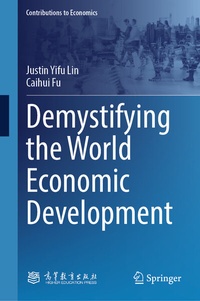
Demystifying the World Economic Development
Description

Taking the new structural economics as the theoretical tools, this book obtains the maximum understanding of the history, development, current situation, and trend of the change of world economic structure, as well as China's role in its development and its underlying laws and policies, analyzes the polarization between the rich and poor for countries worldwide, and provides a way for them to achieve common prosperity.
The world is going through a new round of major transformation. Profound adjustment has been made in international economy, science, culture, security, and politics, and the international development environment is undergoing profound changes. In this context, this book profoundly and systematically explains the underlying economic transition logic of world development and the general trend of China's relationship with the world and presents the entire process of world economic development. Readers who pay close attention to the development of the world economy, China's economic development, and China's role in the world economy will find this book very fascinating.
More details
Other editions
Additional editions
Persons
Justin Yifu Lin is Professor and Dean of Institute of New Structural Economics (INSE), Dean of Institute of South-South Cooperation and Development, and Honorary Dean of National School of Development at Peking University. He was Chief Economist and Senior Vice President of the World Bank between 2008 and 2012,and was the first economist from the developing world to hold this position. Prior to this, Mr. Lin served for 15 years as Founding Director and Professor of the China Centre for Economic Research (CCER) at Peking University. He is a corresponding fellow of the British Academy, a fellow of the World Academy of Sciences for the Developing World, and the author of more than 30 books, including Demystifying the Chinese Economy, which is a companion to this book.
Caihui Fu is a faculty research fellow of Institute of New Structural Economics (INSE) at Peking University, and responsible for China top think-tanks research and discipline construction of new structural economics. He is the author of more than 10 books, including Introduction To New Structural Economics (co-authored with Prof. Justin Yifu Lin) ,which is the first textbook based on China's independent economic knowledge system. Dr. Fu also gives courses on new structural economics at Peking University and Tsinghua University.
Content
Chapter 1 The Age of Drastic Changes.- Chapter 2 Transformation and Upgrading of Economic Structure is the Key to Development.- Chapter 3 Tracing the Trajectory of the Transformation and Upgrading of the World Economic Structure.- Chapter 4 Searching for Typical Examples of Economic Structural Transformation and Upgrading.- Chapter 5 Monitoring the Trajectory of Global Economic Structural Transformation.- Chapter 6 Opportunities in Global Economic Structural Transformation and Upgrading.- Chapter 7 Breaking the "Bottleneck" to Global Economic Structural Transformation and Upgrading.- Chapter 8 China in the Global Economic Structural Transformation and Upgrading.- Chapter 9 Promotion of Global Economic Development through the Belt and Road Initiative.- Chapter 10 The Road to Prosperity, Stability, and Inclusiveness in the World Economy.
