

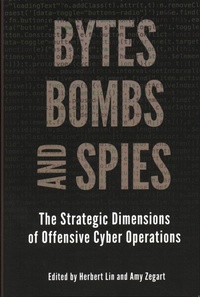
Bytes, Bombs, and Spies
The Strategic Dimensions of Offensive Cyber Operations
1st Edition
Published on 15. January 2019
438 pages
978-0-8157-3548-9 (ISBN)
Description

?We are dropping cyber bombs. We have never done that before.??U.S. Defense Department official
A new era of war fighting is emerging for the U.S. military. Hi-tech weapons have given way to hi tech in a number of instances recently:
A computer virus is unleashed that destroys centrifuges in Iran, slowing that country's attempt to build a nuclear weapon.
ISIS, which has made the internet the backbone of its terror operations, finds its network-based command and control systems are overwhelmed in a cyber attack.
A number of North Korean ballistic missiles fail on launch, reportedly because their systems were compromised by a cyber campaign.
Offensive cyber operations like these have become important components of U.S. defense strategy and their role will grow larger. But just what offensive cyber weapons are and how they could be used remains clouded by secrecy.
This new volume by Amy Zegart and Herb Lin is a groundbreaking discussion and exploration of cyber weapons with a focus on their strategic dimensions. It brings together many of the leading specialists in the field to provide new and incisive analysis of what former CIA director Michael Hayden has called ?digital combat power? and how the United States should incorporate that power into its national security strategy.
A new era of war fighting is emerging for the U.S. military. Hi-tech weapons have given way to hi tech in a number of instances recently:
A computer virus is unleashed that destroys centrifuges in Iran, slowing that country's attempt to build a nuclear weapon.
ISIS, which has made the internet the backbone of its terror operations, finds its network-based command and control systems are overwhelmed in a cyber attack.
A number of North Korean ballistic missiles fail on launch, reportedly because their systems were compromised by a cyber campaign.
Offensive cyber operations like these have become important components of U.S. defense strategy and their role will grow larger. But just what offensive cyber weapons are and how they could be used remains clouded by secrecy.
This new volume by Amy Zegart and Herb Lin is a groundbreaking discussion and exploration of cyber weapons with a focus on their strategic dimensions. It brings together many of the leading specialists in the field to provide new and incisive analysis of what former CIA director Michael Hayden has called ?digital combat power? and how the United States should incorporate that power into its national security strategy.
More details
Edition
1. Auflage
Language
English
Place of publication
New York
United States
Publishing group
Bloomsbury Publishing Plc
Illustrations
10 tables
ISBN-13
978-0-8157-3548-9 (9780815735489)
DOI
10.5771/9780815735489
Copyright in bibliographic data and cover images is held by Nielsen Book Services Limited or by the publishers or by their respective licensors: all rights reserved.
Schweitzer Classification
Other editions
Additional editions
Herbert Lin | Amy Zegart
Bytes, Bombs, and Spies
The Strategic Dimensions of Offensive Cyber Operations
Book
01/2019
Brookings Institution
€61.20
Shipment within 10-20 days
Persons
Dr. Herb Lin is senior research scholar for cyber policy and security at the Center for International Security and Cooperation and Hank J. Holland Fellow in Cyber Policy and Security at the Hoover Institution, both at Stanford University.
Amy Zegart is a senior fellow at the Freeman Spogli Institute of International Studies (FSI), professor of political science (by courtesy) at Stanford University, and a contributing editor to The Atlantic. She is also the Davies Family Senior Fellow at the Hoover Institution, where she directs the Robert and Marion Oster National Security Affairs Fellows program. She is founder and co-director of the Stanford Cyber Policy Program.
Amy Zegart is a senior fellow at the Freeman Spogli Institute of International Studies (FSI), professor of political science (by courtesy) at Stanford University, and a contributing editor to The Atlantic. She is also the Davies Family Senior Fellow at the Hoover Institution, where she directs the Robert and Marion Oster National Security Affairs Fellows program. She is founder and co-director of the Stanford Cyber Policy Program.
Content
Contents:
List of Figures and Tables
Acknowledgments
1. Introduction
2. Illuminating a New Domain: The Role and Nature of Military Intelligence, Surveillance, and Reconnaissance in Cyberspace
3. How Effects, Saliencies, and Norms Should Influence U.S. Cyberwar Doctrine
4. A Strategic Assessment of the U.S. Cyber Command Vision
5. A Cyber SIOP? Operational Considerations for Strategic Offensive Cyber Planning
6. Second Acts in Cyberspace
7. Hacking a Nation's Missile Development Program
8. The Cartwright Conjecture: The Deterrent Value and Escalatory Risk of Fearsome Cyber Capabilities
9. The Cyber Commitment Problem and the Destabilization of Nuclear Deterrence
10. Cyber Terrorism: Its Effects on Psychological Well-Being, Public Confidence, and Political Attitudes
11. Limiting the Undesired Impact of Cyber Weapons: Technical Requirements and Policy Implications
12. Rules of Engagement for Cyberspace Operations: A View from the United States
13. U.S. Offensive Cyber Operations in a China-U.S. Military Confrontation
14. Disintermediation, Counterinsurgency, and Cyber Defense
15. Private Sector Cyber Weapons: An Adequate Response to the Sovereignty Gap?
16. Cyberwar Inc.: Examining the Role of Companies in Offensive Cyber Operations
Index
Contributors
List of Figures and Tables
Acknowledgments
1. Introduction
2. Illuminating a New Domain: The Role and Nature of Military Intelligence, Surveillance, and Reconnaissance in Cyberspace
3. How Effects, Saliencies, and Norms Should Influence U.S. Cyberwar Doctrine
4. A Strategic Assessment of the U.S. Cyber Command Vision
5. A Cyber SIOP? Operational Considerations for Strategic Offensive Cyber Planning
6. Second Acts in Cyberspace
7. Hacking a Nation's Missile Development Program
8. The Cartwright Conjecture: The Deterrent Value and Escalatory Risk of Fearsome Cyber Capabilities
9. The Cyber Commitment Problem and the Destabilization of Nuclear Deterrence
10. Cyber Terrorism: Its Effects on Psychological Well-Being, Public Confidence, and Political Attitudes
11. Limiting the Undesired Impact of Cyber Weapons: Technical Requirements and Policy Implications
12. Rules of Engagement for Cyberspace Operations: A View from the United States
13. U.S. Offensive Cyber Operations in a China-U.S. Military Confrontation
14. Disintermediation, Counterinsurgency, and Cyber Defense
15. Private Sector Cyber Weapons: An Adequate Response to the Sovereignty Gap?
16. Cyberwar Inc.: Examining the Role of Companies in Offensive Cyber Operations
Index
Contributors
