

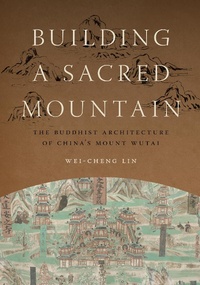
Building a Sacred Mountain
Description

By the tenth century CE, Mount Wutai had become a major pilgrimage site within the emerging culture of a distinctively Chinese Buddhism. Famous as the abode of the bodhisattva Mañjusri (known for his habit of riding around the mountain on a lion), the site in northeastern China's Shanxi Province was transformed from a wild area, long believed by Daoists to be sacred, into an elaborate complex of Buddhist monasteries.
In Building a Sacred Mountain, Wei-Cheng Lin traces the confluence of factors that produced this transformation and argues that monastic architecture, more than texts, icons, relics, or pilgrimages, was the key to Mount Wutai's emergence as a sacred site. Departing from traditional architectural scholarship, Lin's interdisciplinary approach goes beyond the analysis of forms and structures to show how the built environment can work in tandem with practices and discourses to provide a space for encountering the divine.
Art History Publication Initiative. For more information, visit http://arthistorypi.org/books/building-a-sacred-mountain
More details
Other editions
Additional editions
Person
Wei-Cheng Lin is assistant professor of Chinese art history at the University of North Carolina at Chapel Hill.
Content
Acknowledgments
Chronology of Chinese Dynasties
Introduction
1. Building the Monastery, Locating the Sacred Presence
2. Entering the Mountains, Localizing the Sacred Presence
3. The Sacred Presence in Place and in Vision
4. Mediating the Distance to Mount Wutai
5. Reconfiguring the Center
6. Narrative, Visualization, and Transposition of Mount Wutai
Conclusion
Appendix 1
Appendix 2
Appendix 3
Conventions and Abbreviations
Notes
Glossary
Bibliography
List of Illustrations
Index
