

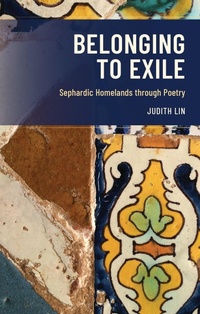
Belonging to Exile
Sephardic Homelands Through Poetry
Will be published approx. on 3. September 2026
144 pages
979-8-216-38149-5 (ISBN)
Description

Belonging to Exile is an ethnographic and literary study of the different national geographies that appealed to Sephardic Holocaust survivors after World War II.
In this book, Judith Lin weaves an analysis of poetry, other literary texts, and conversations in Ladino, the ancestral language of the Sephardic Jews since before the expulsion from Spain in 1492. After World War II, contemporary Sephardic writers were faced with yet another decision of where to make their home. Each chapter takes the reader on an ethnographic and literary journey through different places that the Sephardic community has called home over the centuries: Jerusalem, Israel; Sofia, Bulgaria; Buenos Aires, Argentina; and Thessaloniki, Greece. And while the book spans a wide geographical range, many of the conversations take place in the intimacy of the writers' homes.
Lin uses many different kinds of texts, archives, and personal conversations as a point of departure to analyze Ladino poetry and how this writing was used to remember the past, to work through loss, and to construct a sense of home in different geographic locations. The Sephardic search for belonging is never fully satisfied amid a complex experience of exile, but through their writing, the Ladino language lives on.
In this book, Judith Lin weaves an analysis of poetry, other literary texts, and conversations in Ladino, the ancestral language of the Sephardic Jews since before the expulsion from Spain in 1492. After World War II, contemporary Sephardic writers were faced with yet another decision of where to make their home. Each chapter takes the reader on an ethnographic and literary journey through different places that the Sephardic community has called home over the centuries: Jerusalem, Israel; Sofia, Bulgaria; Buenos Aires, Argentina; and Thessaloniki, Greece. And while the book spans a wide geographical range, many of the conversations take place in the intimacy of the writers' homes.
Lin uses many different kinds of texts, archives, and personal conversations as a point of departure to analyze Ladino poetry and how this writing was used to remember the past, to work through loss, and to construct a sense of home in different geographic locations. The Sephardic search for belonging is never fully satisfied amid a complex experience of exile, but through their writing, the Ladino language lives on.
More details
Series
Language
English
Place of publication
United States
Publishing group
Bloomsbury Publishing Plc
Target group
College/higher education
Professional and scholarly
File size
0,44 MB
ISBN-13
979-8-216-38149-5 (9798216381495)
Copyright in bibliographic data and cover images is held by Nielsen Book Services Limited or by the publishers or by their respective licensors: all rights reserved.
Schweitzer Classification
Other editions
Additional editions
Book
approx. 10/2026
Bloomsbury Academic
€111.50
Not yet published
Content
Acknowledgements
Introduction: A Way to Live
1. From Triumphal Entry to Exilic Memory: Jerusalem in the Mind of the Sephardic Poet
2. "The Jewish Ties that Bind-and Break-in Sofia, Bulgaria"
3. Uncovering Accent and Belonging in Juan Gelman's Dibaxu
4. No Place like Home: Jewish Salonika and the Body for Moshe Ha Elion
Conclusion: The Sephardic Paradox of Belonging
Bibliography
Index
About the Author
Introduction: A Way to Live
1. From Triumphal Entry to Exilic Memory: Jerusalem in the Mind of the Sephardic Poet
2. "The Jewish Ties that Bind-and Break-in Sofia, Bulgaria"
3. Uncovering Accent and Belonging in Juan Gelman's Dibaxu
4. No Place like Home: Jewish Salonika and the Body for Moshe Ha Elion
Conclusion: The Sephardic Paradox of Belonging
Bibliography
Index
About the Author
