

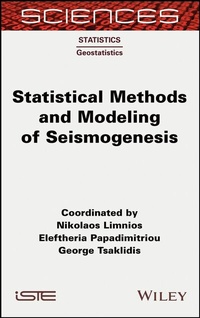
Statistical Methods and Modeling of Seismogenesis
1st Edition
Published on 31. March 2021
336 pages
978-1-119-82503-6 (ISBN)
Description

The study of earthquakes is a multidisciplinary field, an amalgam of
geodynamics, mathematics, engineering and more. The overriding
commonality between them all is the presence of natural randomness.
Stochastic studies (probability, stochastic processes and statistics) can
be of different types, for example, the black box approach (one state),
the white box approach (multi-state), the simulation of different aspects,
and so on. This book has the advantage of bringing together a group of
international authors, known for their earthquake-specific approaches,
to cover a wide array of these myriad aspects.
A variety of topics are presented, including statistical nonparametric and
parametric methods, a multi-state system approach, earthquake
simulators, post-seismic activity models, time series Markov models
with regression, scaling properties and multifractal approaches, selfcorrecting models, the linked stress release model, Markovian arrival
models, Poisson-based detection techniques, change point detection
techniques on seismicity models, and, finally, semi-Markov models for
earthquake forecasting.
geodynamics, mathematics, engineering and more. The overriding
commonality between them all is the presence of natural randomness.
Stochastic studies (probability, stochastic processes and statistics) can
be of different types, for example, the black box approach (one state),
the white box approach (multi-state), the simulation of different aspects,
and so on. This book has the advantage of bringing together a group of
international authors, known for their earthquake-specific approaches,
to cover a wide array of these myriad aspects.
A variety of topics are presented, including statistical nonparametric and
parametric methods, a multi-state system approach, earthquake
simulators, post-seismic activity models, time series Markov models
with regression, scaling properties and multifractal approaches, selfcorrecting models, the linked stress release model, Markovian arrival
models, Poisson-based detection techniques, change point detection
techniques on seismicity models, and, finally, semi-Markov models for
earthquake forecasting.
More details
Other editions
Additional editions
Nikolaos Limnios | Eleftheria Papadimitriou | George Tsaklidis
Statistical Methods and Modeling of Seismogenesis
Book
08/2021
ISTE Ltd
€164.50
Article not available at the moment
Persons
Nikolaos Limnios is Full Professor of Applied Mathematics at Universite
de Technologie de Compiegne, Sorbonne University, France. His
research interests include stochastic processes and statistics, Markov
and semi-Markov processes and random evolutions with varied
applications.
Eleftheria Papadimitriou is Professor of Seismology at the Aristotle
University of Thessaloniki, Greece. Her research interests are related to
Earthquake Seismology and she engages in scientific exchange and
collaboration with several international institutions.
George Tsaklidis is Professor of Probability and Statistics at the Aristotle
University of Thessaloniki, Greece. His research interests include
stochastic processes and computational statistics with applications in
seismology, finance and continuum mechanics, and state-space
modeling.
de Technologie de Compiegne, Sorbonne University, France. His
research interests include stochastic processes and statistics, Markov
and semi-Markov processes and random evolutions with varied
applications.
Eleftheria Papadimitriou is Professor of Seismology at the Aristotle
University of Thessaloniki, Greece. Her research interests are related to
Earthquake Seismology and she engages in scientific exchange and
collaboration with several international institutions.
George Tsaklidis is Professor of Probability and Statistics at the Aristotle
University of Thessaloniki, Greece. His research interests include
stochastic processes and computational statistics with applications in
seismology, finance and continuum mechanics, and state-space
modeling.
Content
- Cover
- Half-Title Page
- Title Page
- Copyright Page
- Contents
- Preface
- 1 Kernel Density Estimation in Seismology
- 1.1. Introduction
- 1.2. Complexity of magnitude distribution
- 1.3. Kernel estimation of magnitude distribution
- 1.4. Implications for hazard assessments
- 1.5. Interval estimation of magnitude CDF and related hazard parameters
- 1.6. Transformation to equivalent dimensions
- 1.7. References
- 2 Earthquake Simulators Development and Application
- 2.1. Introduction
- 2.2. Development of earthquake simulators in the seismological literature
- 2.2.1. ALLCAL
- 2.2.2. Virtual quake
- 2.2.3. RSQSim
- 2.2.4. ViscoSim
- 2.2.5. Other simulation codes
- 2.2.6. Comparisons among simulators
- 2.3. Conceptual evolution of a physics-based earthquake simulator
- 2.3.1. A physics-based earthquake simulator (2015)
- 2.3.2. Frequency-magnitude distribution of the simulated catalog (2015)
- 2.3.3. Temporal features of the synthetic catalog (2015)
- 2.3.4. Improvements in the physics-based earthquake simulator (2017-2018)
- 2.3.5. Application to the seismicity of Central Italy
- 2.3.6. Further improvements of the simulator code (2019)
- 2.4. Application of the last version of the simulator to the Nankai mega-thrust fault system
- 2.5. Appendix 1: Relations among source parameters adopted in the simulation model
- 2.6. Appendix 2: Outline of the simulation program
- 2.7. References
- 3 Statistical Laws of Post-seismic Activity
- 3.1. Introduction
- 3.2. Earthquake productivity
- 3.2.1. The proposed method to study productivity
- 3.2.2. Earthquake productivity at the global level
- 3.2.3. Independence of the proximity function
- 3.2.4. Earthquake productivity at the regional level
- 3.2.5. Productivity in relation to the threshold of the proximity function
- 3.2.6. Discussion
- 3.3. Time-dependent distribution of the largest aftershock magnitude
- 3.3.1. The distribution of the magnitude of the largest aftershock in relation to time
- 3.3.2. The agreement between the dynamic Båth law and observations
- 3.3.3. Discussion
- 3.4. The distribution of the hazardous period
- 3.4.1. A model for the duration of the hazardous period
- 3.4.2. Determining the model parameters
- 3.4.3. Using the early aftershocks
- 3.5. Conclusion
- 3.6. References
- 4 Explaining Foreshock and the Båth Law Using a Generic Earthquake Clustering Model
- 4.1. Introduction
- 4.1.1. Issues related to foreshocks
- 4.1.2. Issues related to the Båth law
- 4.1.3. Study objectives
- 4.2. Theories related to foreshock probability and the Båth law under the assumptions of the ETAS model
- 4.2.1. Space-time ETAS model, stochastic declustering and classification of earthquakes
- 4.2.2. Master equation
- 4.2.3. Asymptotic property of F(m')
- 4.2.4. Foreshock probabilities and their magnitude distribution in the ETAS model
- 4.2.5. Explanation of the Båth law by the ETAS model
- 4.3. Foreshock simulations based on the ETAS model
- 4.3.1. Works by Helmstetter and others
- 4.3.2. Works by Zhuang and others
- 4.3.3. Evidence of statistics between mainshocks and foreshocks
- 4.3.4. Different simulation results
- 4.4. Simulation of the Båth law based on the ETAS model
- 4.4.1. On the simulation study by Helmstetter
- 4.4.2. Observation on Båth's law for volcanic earthquake swarms
- 4.5. Conclusion
- 4.5.1. Back to the starting point
- 4.5.2. On the comparison between foreshock probability in the ETAS model and real catalogs
- 4.5.3. Impracticality of the foreshock concept
- 4.5.4. What should we do?
- 4.6. Acknowledgments
- 4.7. References
- 5 The Genesis of Aftershocks in Spring Slider Models
- 5.1. Introduction
- 5.2. The rate-and-state equation
- 5.3. The Dieterich model
- 5.3.1. Time to instability
- 5.3.2. Initial conditions during stationary seismicity
- 5.3.3. Effect of a constant stress increase ?t
- 5.4. The mechanics of afterslip
- 5.5. The two-block model
- 5.5.1. Synthetic catalogs
- 5.6. Conclusion
- 5.7. References
- 6 Markov Regression Models for Time Series of Earthquake Counts
- 6.1. Introduction
- 6.2. Markov regression HMMs: definition and notation
- 6.3. Application
- 6.3.1. Data
- 6.3.2. Results
- 6.4. Conclusion
- 6.5. Acknowledgments
- 6.6. References
- 7 Scaling Properties, Multifractality and Range of Correlations in Earthquake Time Series: Are Earthquakes Random?
- 7.1. Introduction
- 7.2. The range of correlations in earthquake time series
- 7.2.1. Short-range correlations
- 7.2.2. Long-range correlations
- 7.3. Scaling properties of earthquake time series
- 7.3.1. The probability distribution function
- 7.3.2. A stochastic dynamic mechanism with memory effects
- 7.3.3. The cumulative distribution function
- 7.4. Fractal and multifractal structures
- 7.5. Discussion and conclusions
- 7.6. References
- 8 Self-correcting Models in Seismology: Possible Coupling Among Seismic Areas
- 8.1. Introduction
- 8.2. Review of applications
- 8.3. Formulation of the models
- 8.3.1. Simple Stress Release Model
- 8.3.2. Independent Stress Release Model
- 8.3.3. Linked Stress Release Model
- 8.4. Applications
- 8.4.1. Greece and the surrounding area
- 8.4.2. Gulf of Corinth
- 8.5. Conclusion
- 8.6. References
- 9 Markovian Arrival Processes for Earthquake Clustering Analysis
- 9.1. Introduction
- 9.2. State of the art
- 9.2.1. Earthquake clustering methods and applications
- 9.2.2. Hidden Markov models and applications in seismology
- 9.3. Markovian Arrival Process
- 9.3.1. Definition and basic results
- 9.3.2. Parameter fitting
- 9.3.3. Inference of the latent states
- 9.4. Methodology and results
- 9.4.1. Motivation
- 9.4.2. Clustering detection procedure
- 9.5. Conclusion
- 9.6. References
- 10 Change Point Detection Techniques on Seismicity Models
- 10.1. Introduction
- 10.2. The change point framework
- 10.3. Changes in a Poisson process
- 10.4. Changes in the Epidemic Type Aftershock Sequence model
- 10.5. Changes in the Gutenberg-Richter law
- 10.6. ZMAP
- 10.7. Other statistical tests
- 10.8. Detection of changes without hypothesis testing
- 10.9. Discussion and conclusion
- 10.10. References
- 11 Semi-Markov Processes for Earthquake Forecast
- 11.1. Introduction
- 11.2. Semi-Markov processes - preliminaries
- 11.2.1. Special class of distributions
- 11.3. Transition probabilities and earthquake occurrence
- 11.3.1. Likelihood and estimation
- 11.4. Semi-Markov transition matrix
- 11.5. Illustrative example
- 11.6. References
- List of Authors
- Index
- EULA
