

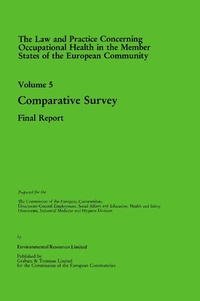
The Law and Practice Concerning Occupational Health in the Member States of the European Community
Comparative Survey
Published on 1. January 1984
396 pages
978-90-411-7765-0 (ISBN)
Description

The Law and Practice Concerning Occupational Health in the Member States of the European Community
More details
Other editions
Additional editions
Law
Law and Practice Relating to Occupational Health in the Member States of the European Community
Comparative Survey
Book
01/1984
1st Edition
Graham & Trotman Ltd
€221.49
Shipment within 15-20 days
Content
- Cover
- Half Title Page
- Title Page
- Copyright Page
- Acknowledgement
- Table of Contents
- General Introduction
- Part I The Systems of Occupational Health Legislation in the Member States of the Community
- Introduction to Part I
- 1 Frameworks for control
- 1.1 INTRODUCTION
- 1.2 CONSTITUTIONAL PROVISIONS
- 1.3 CENTRALISATION OF LEGISLATION
- 1.4 SUBSIDIARY REGULATIONS
- 1.5 OCCUPATIONAL INSURANCE SCHEMES
- 1.6 CLASSIFIED ESTABLISHMENTS
- 1.7 NON-STATUTORY PROVISIONS
- 1.8 COLLECTIVE AND INTERNAL AGREEMENTS
- Table I: The Legislative Framework
- 2 Scope of Application of Legislation
- Table II: Scope of Application of Principal Laws
- 3 Competent Authorities
- Figure IIIA: Government Departments and Organisations Responsible for Health and Safety at Work and Occupational Insurance
- Figure IIIB: Inspectorate Organisation and Staffing
- Table III: Competent Authorities
- 4 Rights and Duties of Employers and Employees
- Table IVA: Summary of General Duties of Employers to Protect Employees
- Table IV: Duties and Rights of Employers, Employees and their Representatives
- 5 Powers of Inspectorates
- Table V.A: Overall Summary of Data on Inspection and Enforcement Activity
- Table V.1: Powers of Government Inspectorates
- Table V.2: Powers of Accident Insurance Inspectorates
- 6 Workplace Health and Safety Organisations
- 6.1 HEALTH AND SAFETY SERVICES
- 6.2 OCCUPATIONAL MEDICAL SERVICES
- 6.3 EMPLOYEE REPRESENTATION ON WORKPLACE COMMITTEES
- Table VI(a) Internal Workplace Organisations for Health and Safety
- Table VI.1 Workplace Health and Safety Organisations
- Table VI.2 Occupational Medical Services
- Table VI.3 Workplace Committees Representing Employees
- 7 The Activities of Employers' and Employees' Organisations
- Table VII Activities of Employers' Organisations and Trades Unions
- Part II Measures to Protect the Health of Workers
- Introduction to Part II
- 8 Prohibitions and Restrietions on the Use of Dangerous Substances
- Table VIII.I: Summary of Substances Prohibited and Restricted under Occupational Health and Safety Legislation
- Table VIII Measures to Prohibit or Restrict the Use of Dangerous Substances
- 9 Restrictions on the Exposure of Workers
- Table IX: Measures to Restrict Exposure of Workers
- 10 Restrietions on the Exposure of Critical Groups of Workers
- Table X Measures to Restrict Exposure of Critical Groups
- 11 The Use of Limit Values
- Table XI Measures to Protect Workers by Use of Limit Values for Exposure to Dangerous Substances
- Table XI.1: Application of Atmospheric Limit Values
- Table XI.2: Comparison of Definitions of Atmospheric Limit Values
- Table XI.3: Application of Biological Limit Values
- Table XI.4: Comparison of Limit Values for Asbestos, Vinyl Chloride Monomer and Lead
- 12 Use of Safe Working Procedures and Methods
- Table XII Measures to Protect Workers by Implementing Safe Working Procedures
- 13 Primary Engineering Controls
- Table XIII Measures to Protect Workers by Primary Engineering Controls at Source
- 14 Secondary Collective Protection Measures
- Table XIV Measures for Secondary Collective Protection of Workers
- 15 Individual Protection Measures
- Table XV Measures for Individual, Personal Protection of Workers
- 16 Hygiene Measures
- Table XVI Provisions for Hygiene at Work to Protect the Health of Employees
- 17 Provision of Information to Employees
- Table XVII Measures Requiring the Provision of Information to Employees
- 18 The Use of Warning and Safety Signs
- Table XVIII Measures Requiring the Use of Warning and Safety Signs and Notices
- 19 Accident and Emergency Procedures
- Table XIX Measures for Establishment of Emergency Procedures and Provision of First Aid
- 20 Medical Surveillance
- 20.1 MEDICAL EXAMINATIONS
- 20.2 REPORTING
- 20.3 RECOGNISED OCCUPATIONAL DISEASES
- 20.4 INCIDENCE OF OCCUPATIONAL DISEASE
- Table XX Requirements for Medical Examinations and Reporting of Diseases and Injuries, Lists of Recognised Occupational Diseases and A vailability of Statistics on Incidence
- Annexes
- Annex 1 Council Directive of 27 November 1980 on the Protection of Workers from the Risks Related to Exposure to Chemieal, Physical and Biological Agents at Work (80/1107/EEC)
- Annex 2 Tables of Statutes in the 10 Member States
- Annex 3 Occupational Insurance Rules on Health and Safety at Work
- Annex 4 Non-Statutory Guidelines
- Annex 5 EEC Directives Concerning Limit Values
- Annex 6 Recognised Occupational Diseases
- Back Cover
