

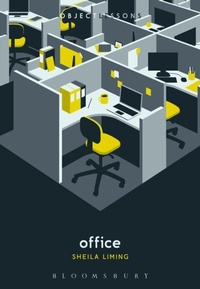
Office
1st Edition
Published on 12. November 2020
152 pages
978-1-5013-4869-3 (ISBN)
Description

Object Lessons is a series of short, beautifully designed books about the hidden lives of ordinary things.
From its origins in the late 19th century to its decline in the 21st, Sheila Liming's Office narrates a cultural history of a place that has arguably been the primary site of labor in the postmodern economy.
During the post-war decades of the 20th century, the office rose to prominence in culture, achieving an iconic status that is reflected in television, film, literature, and throughout the history of advertising. Most people are well versed in the cliches of office culture, despite evidence that an increasing number of us no longer work in offices.
With the development of computing technology in the 1980s and 90s, the office underwent many changes. Microsoft debuted its suite of multitasking applications known as Microsoft Office in 1989, firing the first shot in the war for the office's survival. This book therefore poses the question: how did culture become organized around the idea of the office, and how will it change if the office become extinct?
Object Lessons is published in partnership with an essay series in The Atlantic.
From its origins in the late 19th century to its decline in the 21st, Sheila Liming's Office narrates a cultural history of a place that has arguably been the primary site of labor in the postmodern economy.
During the post-war decades of the 20th century, the office rose to prominence in culture, achieving an iconic status that is reflected in television, film, literature, and throughout the history of advertising. Most people are well versed in the cliches of office culture, despite evidence that an increasing number of us no longer work in offices.
With the development of computing technology in the 1980s and 90s, the office underwent many changes. Microsoft debuted its suite of multitasking applications known as Microsoft Office in 1989, firing the first shot in the war for the office's survival. This book therefore poses the question: how did culture become organized around the idea of the office, and how will it change if the office become extinct?
Object Lessons is published in partnership with an essay series in The Atlantic.
Reviews / Votes
While most of us are all too familiar with the computer screens and supply closets of our own offices, Sheila Liming reintroduces us - through literature, film, television, historical research, and personal memoir - to those other bureaucratic objects that define the office as a distinctive environment: from office plants and office parties to typing pools and networking clubs. In sparkling and witty prose, Liming diagrams the office's anatomy and social ecology as it has evolved from the mid-19th century to today - and as we reassess its relevance in a future defined by freelancing and social distancing. * Shannon Mattern, Professor of Anthropology, The New School, USA, and author of Code + Clay, Data + Dirt: 5000 Years of Urban Media * Office is a feat of delightful prose and a suite of engrossing stories: a mini history of labor, architecture, and pop culture; a stirring analysis of social hierarchies; a smart study of physical spaces that is also a necessary critique of economic ideology. Liming's lithe book is unputdownable! * Anna Kornbluh, Associate Head and Associate Professor of English, University of Illinois, Chicago, USA, and author of Marxist Film Theory and Fight Club (Bloomsbury, 2019) * The author draws on both literature and personal experience to make an accessible and thought-provoking read that in effect poses the question: How did culture become organised around the idea of the office, and how will it change? * Work & Place *More details
Series
Edition
1. Auflage
Language
English
Place of publication
New York
United States
Publishing group
Bloomsbury Publishing PLC (Digital)
Target group
Professional and scholarly
ISBN-13
978-1-5013-4869-3 (9781501348693)
Copyright in bibliographic data and cover images is held by Nielsen Book Services Limited or by the publishers or by their respective licensors: all rights reserved.
Schweitzer Classification
Other editions
Additional editions
Person
Sheila Liming is Associate Professor in the Writing program at Champlain College, USA, and author of What a Library Means to a Woman: Edith Wharton and the Will to Collect Books (2020).
Content
Introduction
1. The Office as Space
2. The Office as Stockpile
3. The Office as Hierarchy
4. The End of the Office
Acknowledgments
Index
1. The Office as Space
2. The Office as Stockpile
3. The Office as Hierarchy
4. The End of the Office
Acknowledgments
Index
