

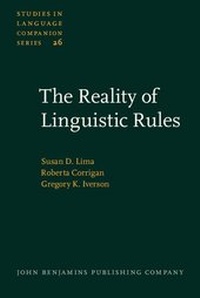
The Reality of Linguistic Rules
1st Edition
Published on 24. November 1994
XXIII, 480 pages
978-90-272-8203-3 (ISBN)
Description

This volume presents a selection of the best papers from the 21st Annual University of Wisconsin-Milwaukee Linguistics Symposium. Researchers from linguistics, psychology, computer science, and philosophy, using many different methods and focusing on many different facts of language, addressed the question of the existence of linguistic rules. Are such rules best seen as convenient tools for the description of languages, or are rules actually invoked by individual language users? Perhaps the most serious challenge to date to the linguistic rule is the development of connectionist architecture. Indeed, these systems must be viewed as a serious challenge to the foundations of all of contemporary linguistics.
Four broad themes emerged from the Milwaukee conference, corresponding to the four parts of the volume. Part I centers on arguments for the existence of symbolic rules in linguistic competence and performance. Part II contains arguments against symbolic rules, presenting connectionist models and other alternatives to the symbolic paradigm. Parts III and IV take up two issues that are central to a number of language researchers: Language acquisition and learnability, and modularity. These issues are addressed from within both rule-based and non-rule-based perspectives.
Contributors: Farrell Ackerman, Michael Barlow, Catherine Best, David Corina, Roberta Corrigan, Kim Daugherty, Bruce Derwing, Jeff Elman, Alice Faber, John Goldsmith, Helen Goodluck, Neil Jacobs, Richard Janda, Brian Joseph, Michael Kac, Alan Kawamoto, Suzanne Kemmer, Susan Lima, Brian MacWhinney, Steven Pinker, Alan Prince, Gerald Sanders, Hinrich Schutze, Mark Seidenberg, Royal Skousen, Nicholas Sobin, Joseph Stemberger, Gregory Stone, Ann Thyme, Robert Van Valin.
Four broad themes emerged from the Milwaukee conference, corresponding to the four parts of the volume. Part I centers on arguments for the existence of symbolic rules in linguistic competence and performance. Part II contains arguments against symbolic rules, presenting connectionist models and other alternatives to the symbolic paradigm. Parts III and IV take up two issues that are central to a number of language researchers: Language acquisition and learnability, and modularity. These issues are addressed from within both rule-based and non-rule-based perspectives.
Contributors: Farrell Ackerman, Michael Barlow, Catherine Best, David Corina, Roberta Corrigan, Kim Daugherty, Bruce Derwing, Jeff Elman, Alice Faber, John Goldsmith, Helen Goodluck, Neil Jacobs, Richard Janda, Brian Joseph, Michael Kac, Alan Kawamoto, Suzanne Kemmer, Susan Lima, Brian MacWhinney, Steven Pinker, Alan Prince, Gerald Sanders, Hinrich Schutze, Mark Seidenberg, Royal Skousen, Nicholas Sobin, Joseph Stemberger, Gregory Stone, Ann Thyme, Robert Van Valin.
More details
Other editions
Additional editions
Susan D. Lima | Roberta Corrigan | Gregory Iverson
The Reality of Linguistic Rules
Book
11/1994
John Benjamins Publishing Co
€146.28
Shipment within 10-15 days
Persons
Content
- THE REALITY OF LINGUISTIC RULES
- Editorial page
- Title page
- Copyright page
- Preface
- Table of contents
- Contributors
- Introduction
- Part I: For the Existence of Symbolic Rules
- Part II: Alternatives to rules
- Part III: Language acquisition and learnability
- Part IV: Modularity and related issues
- Conclusion
- Acknowledgment
- References
- I. For the Existence of Symbolic Rules
- On the Typology of Grammatical Principles
- 1. Introduction
- 2. Parameters of statement variation
- 3. Modalities
- 3.1 Obligations
- 3.2 Permissions
- 3.3 Prohibitions
- 4. Conclusions
- Notes
- References
- A Schema-Based Approach to Grammatical Description
- 0. Introduction
- 1. Data and methodology
- 2. Basic notions
- 2.1 Schemas and schematicity
- 2.2 Form-meaning pairs
- 2.3 Form-meaning pairs in discourse
- 3. Mapping of cognitive domains
- 4. Schema-change in the development of Romance se
- 5. Schema-based vs. rule-based accounts of the development of se
- 6. Conclusion
- Notes
- References
- A Nonpsychological Realist Conception of Linguistic Rules
- Notes
- References
- An Acceptable Ungrammatical Construction
- 1. The concept of acceptable ungrammatically
- 2. The Principles & Parameters treatment of expletives
- 3. Problems of the analysis
- 4. An alternative analysis
- 5. Cursory observations on expletives in Piedmontese
- 6. Final observations
- Notes
- References
- Systematic Hyperforeignisms as Maximally External Evidence for Linguistic Rules
- 0. Preamble: Internal vs. external evidence and language-contact phenomena
- 1. Bases for the study of hyperforeignization
- 2. Segmental examples of hyperforeignization
- 2.1 Hyper-French suppression of final consonants - à la "français(e)
- 2.2 Creation of Franco-German palatal fricatives (palatalized or deaffri-cated)
- 2.3 Substitution of generic foreign [a] for English-sounding [ce] or even [a]
- 3. Suprasegmental examples of hyperforeignization
- 3.1 Hyper-Spanish penultimate stress in vowel-final pseudo-Japanese
- 3.2 Hyper-Hebrew/Spanish final stress in consonant-final pseudo-Hebrew
- 3.3 Hyper-French stress- and vowel-shift with pseudo-Yiddish names in -(e)l
- 4. Hyperforeignization as evidence for the reality of linguistic rules
- Notes
- References
- II. Alternatives to Rules
- Grammar within a Neural Network
- 1. Introduction
- 2. Some specifics
- 3. An example: Inflectional paradigms
- 4. Dynamic computational networks
- 5. Conclusions
- Notes
- References
- The Induction of Prosodic Constraints: Implications for Phonological Theory and Mental Representation
- 1. Introduction to prosodic morphology
- 2. Introduction to connectionism
- 2.1 Linguistics and connectionism
- 2.2 Connectionist account of vowel epenthesis
- 3. Connectionist simulation of syllable based reduplication
- 3.1 The Data
- 3.2 Input and output representations
- 3.3 The network and training regime
- 4. Simulation results
- 4.1 Segment based errors
- 4.2 Generalization
- 5. Re-examination of determinants of reduplicative behavior
- 5.1 Output representation revisited
- 5.2 Simulation 2: The Role of Sonority
- 5.3 Simulation 3: The Role of Similarity
- 6. Summary of simulation findings
- 7. Discussion
- 8. Conclusion
- Notes
- References
- Appendix
- Rule-Less Morphology at the Phonology-Lexicon Interface
- 1. Introduction
- 2. A rule-less model
- 3. Are regulars and irregulars different?
- 3.1 Similarity effects
- 3.2 Lexical frequency effects
- 3.3 U-shaped learning
- 3.4 Plurals inside compounds
- 3.5 Disabling generalization
- 4. Conclusions
- References
- Towards Connectionist Lexical Semantics
- 1. Introduction
- 2. Sublexical representation
- 3. Coactivation
- 3.1 Attachment
- 3.2 Scope
- 4. Deactivation
- 5. Polysemy
- 6. Conclusion
- Acknowledgements
- References
- Productivity and the English Past Tense: Testing Skousen's Analogy Model
- 1. Introduction: Some key features of the analogical model
- 1.1 Rules vs. analogies: some critical empirical and conceptual considerations
- 1.2 Analogical modeling vs. connectionism: two alternative procedural approaches briefly compared
- 1.3 On testing Skousen s model: an overview
- 2. Generating predictions from the model: the English past tense
- 2.1 Creating the data base
- 2.2 The first problem in testing precise predictions: matching the subject sample to the model
- 2.3 Testing some developmental implications of the model
- 2.4 Some general observations
- 3. Extending the model to open-ended cases of novel nonsense forms
- 3.1 Some spurious or pseudo-problems
- 3.2 Further real problems that have to be addressed
- 3.3 Some preliminary predictions for selected nonce words
- 3.4 The fundamental problem: defining variables
- 4. A proposed research strategy
- Notes
- References
- III. Language Acquisition and Learnability
- Current Grammars vs. Rule Driven Guessing in Children's Interpretation of Some Complex Sentence Types
- 0. Introduction
- 1. Object gaps in purpose and temporal clauses
- 2. Some observations and assumptions about child grammars for PRO constructions
- 3. A prediction
- 4. Four experiments
- 4.1 Experiment 1
- 4.2 Experiment 2
- 4.3 Experiments 3 and 4
- 5. Discussion
- 6. Conclusion
- Notes
- References
- Extraction Restrictions, Competing Theories and the Argument from the Poverty of the Stimulus
- 1. Introduction: The logical problem of language acquisition
- 2. Extraction restrictions
- 3. An alternative account
- 4. Implications for acquisition
- 5. Conclusions
- Notes
- References
- The Perceptual Infrastructure of Early Phonological Development
- 1. Introduction
- 1.1 Babbling to early words to full phonological inventory
- 1.2 Accounts of phonological development
- 2. Perception leads production
- 2.1 Methods for study of infant speech perception
- 2.2 From the universal to the particular
- 3. Walking precedes running
- 3.1 Patterns of motor skill development
- 3.2 Speech production as motor skill
- 4. Conclusion: A unified account of learning to talk
- Notes
- References
- IV. Modularity and Related Issues
- The Dinosaurs and the Ring
- 1. The dinosaurs
- 2. The ring
- 3. Two babies and the report card
- 4. Core issues in language acquisition
- 5. The English past tense
- 6. Learning arbitrary form classes
- 7. Lexical items and lexical categories
- 7.1 Lexical associations as nodes
- 7.2 Lexical associations as networks
- 7.3 Segmentation
- 7.4 Allomorphy
- 7.5 Allomorphic resolution
- 7.5 Polysemy
- 8. Lexical control of processing
- 9. Networks and the ring
- References
- Regular and Irregular Morphology and the Psychological Status of Rules of Grammar
- 0. Introduction
- 1. Principal issues and existing theories
- 2. A new approach
- 3. Effects of the laws of association: Evidence for a regular-irregular dissociation
- 3.1 Open questions about associative effects
- 4. Interactions among lexical and morphological processes: Evidence for a regular-irregular distinction
- 4.1 Open questions about lexical-morphological interactions
- 5. Regular-irregular dissociations in special populations
- 6. Regular-irregular interactions and blocking
- 7. Toward a theory of universal morphology
- 8. Conclusions
- Acknowledgements
- References
- Beyond Rules and Exceptions: A Connectionist Approach to Inflectional Morphology
- 0. Introduction
- 1. Background: Theories of the English past tense
- 1.1 The traditional theory
- 1.2 Connectionist alternatives
- 1.3 The modified traditional theory
- 1.4 The current debate
- 2. The Seidenberg and Daugherty model
- 2.1 Simulation 1: Initial corpus
- 2.2 Simulation 2: A more realistic corpus
- 3. Summary and conclusions
- Acknowledgement
- References
- One System or Two to Handle Regulars and Exceptions: How Time-course of Processing can Inform this Debate
- 0. Introduction
- 1. Selected summary of empirical results on naming
- 2. Models of word pronunciation
- 2.1 Dual-route models
- 2.2 Analogy models
- 2.3 Distributed Models
- 3. Final remarks
- Notes
- References
- Combining Connectionist and Symbolic Properties in a Single Process
- Notes
- References
- Finnish Nominal Inflection: Paradigmatic Patterns and Token Analogy
- 0. Introduction
- 1. Illustration of the general problem: German gender
- 1.1 Maratsos and the distributional approach
- 1.2 Zubin & Köpcke, MacWhinney, and the feature cue approach
- 1.3 Summary
- 2. Illustration of the particular problem: Finnish nominal inflection
- 3. A simple model of idealized forms
- 3.1 The computational model
- 3.1.1 Expectations
- 3.2 How the model works
- 3.3 Results
- 3.4 Conclusion
- Notes
- References
- Author Index
- Subject Index
