

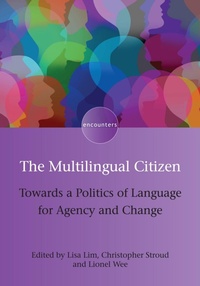
The Multilingual Citizen
Towards a Politics of Language for Agency and Change
Published on 27. February 2018
320 pages
978-1-78309-967-2 (ISBN)
Description

In this ground-breaking collection of essays, the editors and authors develop the idea of Linguistic Citizenship. This notion highlights the importance of practices whereby vulnerable speakers themselves exercise control over their languages, and draws attention to the ways in which alternative voices can be inserted into processes and structures that otherwise alienate those they were designed to support. The chapters discuss issues of decoloniality and multilingualism in the global South, and together retheorize how to accommodate diversity in complexly multilingual/ multicultural societies. Offering a framework anchored in transformative notions of democratic and reflexive citizenship, it prompts readers to critically rethink how existing contemporary frameworks such as Linguistic Human Rights rest on disempowering forms of multilingualism that channel discourses of diversity into specific predetermined cultural and linguistic identities.
Reviews / Votes
Here is a book that helps us think hard about language rights and linguistic citizenship for minoritized populations. Interweaving theoretical argumentation and commentary with empirical accounts primarily from Southeast Asia and Africa, this is a compellingly multi-voiced exploration of tensions, complementarities and affordances of rights and citizenship frameworks as engines for long-overdue educational and social change. * Nancy H. Hornberger, University of Pennsylvania, USA * This important book challenges received notions about language, agency, and multilingualism through the lens of 'linguistic citizenship', a process of engagement that opens doors for respectful and deconstructive negotiations around language forms and practices. This book is required reading for anyone interested in learning how the systematic creation of 'otherness' can be creatively engaged with - and hopefully overcome - through a better understanding of linguistic practices of resistance and hope 'on the ground' in diverse contexts, globally. * Thomas Ricento, University of Calgary, Canada * This volume is particularly useful for researchers interestedin theoretical and methodological considerations of multilingualism and the facilitation
of speaker agency in linguistic research. -- Leonie Schulte, University of Oxford, UK * Language in Society 48:2 (2019) * The Multilingual Citizen is an excellent collection of work that challenges us to think
how language and citizenship are relevant to wider society. The criticisms and words of caution about the concept of Linguistic Citizenship within the book are refreshing and honest, which allow for a deeper reflection on how it can be intellectually relevant. -- Kamran Khan, Universitat Oberta de Catalunya, Spain * Journal of Sociolinguistics, 2019 * The volume constructs a compelling and controversial critique of the popular Linguistic Human Rights (LHR) approach to multilingualism and offers in its stead Linguistic Citizenship (LC), a relatively new approach that goes beyond government institutions and national borders. -- Alicia Pousada, University of Puerto Rico * LINGUIST List 29.4859 * This volume offers insights and examples which help to advance [linguistic citizenship's scholarly and political] agenda, while also pointing the way towards further conceptual and methodological scholarly choices which may enhance future research in this domain. The choice to combine case study chapters with critical commentaries adds a crucial dimension of debate and dissent to the volume, enriching the overall contribution made towards ongoing discussions and initiatives around language politics and social change. -- Haley De Korne, University of Oslo, Norway * Multilingual Margins 2018, 5(1) * This carefully constructed book not only provides clarifications and examples of its point of departure - linguistic citizenship - but it also complicates the surrounding discussion. One of the more important recent books to date on language policy and planning, it is a must read for scholars in the field, and also of interest to sociolinguists, political scientists and educational policy makers. -- John E. Petrovic, The University of Alabama, USA * Journal of Multilingual and Multicultural Development, 2018 * In exploring the notion of LC in-depth, this edited volume remains an important contribution to the field of sociolinguistics. Discussions are thought-provoking as they further examine and question how the LC framework can give minoritized communities their voices back by better considering them as agents of their sociopolitical
change. The commentaries (Chapters 3, 8, and 13) are of particular relevance as they push the debates to the next level. -- Fanny Mace, McMaster University, Canada * Language Policy, 2020 *
More details
Series
Language
English
Place of publication
Bristol
United Kingdom
Publishing group
Channel View Publications Ltd
Target group
College/higher education
Product notice
Reflowable
ISBN-13
978-1-78309-967-2 (9781783099672)
Copyright in bibliographic data and cover images is held by Nielsen Book Services Limited or by the publishers or by their respective licensors: all rights reserved.
Schweitzer Classification
Other editions
Additional editions
Lisa Lim | Christopher Stroud | Lionel Wee
The Multilingual Citizen
Towards a Politics of Language for Agency and Change
Book
02/2018
Multilingual Matters
€61.00
Shipment within 10-20 days
Persons
Lisa Lim is Associate Professor and Head of the School of English, The University of Hong Kong.
Christopher Stroud is Director of the Centre for Multilingualism and Diversities Research and Senior Professor of Linguistics, University of the Western Cape, South Africa, and Professor of Transnational Multilingualism, Centre for Research on Bilingualism, Stockholm University, Sweden.
Lionel Wee is Provost Chair Professor in the Department of English Language and Literature, Faculty of Arts and Social Sciences, National University of Singapore.
Christopher Stroud is Director of the Centre for Multilingualism and Diversities Research and Senior Professor of Linguistics, University of the Western Cape, South Africa, and Professor of Transnational Multilingualism, Centre for Research on Bilingualism, Stockholm University, Sweden.
Lionel Wee is Provost Chair Professor in the Department of English Language and Literature, Faculty of Arts and Social Sciences, National University of Singapore.
Content
Contributors' Bios
Preface and Acknowledgements
Christopher Stroud: Introduction
Language Rights and Linguistic Citizenship
1. Christopher Stroud: Linguistic Citizenship
2. Lionel Wee: Essentialism and Language Rights
3. Stephen May: Commentary. Unanswered Questions: Addressing the Inequalities of Majoritarian Language Policies
Educating for Linguistic Citizenship
4. Blasius A. Chiatoh: Affirming Linguistic Rights, Fostering Linguistic Citizenship: A Cameroonian Perspective
5. Feliciano Chimbutane: Education and Citizenship in Mozambique: Colonial and Postcolonial Perspectives
6. Estevao Cabral and Marilyn Martin-Jones: Paths to Multilingualism? Reflections on Developments in Language-In-Education Policy and Practice in East Timor
7. Suwilai Premsrirat and Paul Bruthiaux: Language Rights and "Thainess": Community-Based Bilingual Education Is the Key
8. Kathleen Heugh: Commentary. Linguistic Citizenship: Who Decides Whose Languages, Ideologies And Vocabulary Matter?
Linguistic Citizenship in Resistance and Participation
9. Umberto Ansaldo and Lisa Lim: Citizenship Theory and Fieldwork Practice in Sri Lanka Malay Communities
10. Tommaso M. Milani and Rickard Jonsson: Linguistic Citizenship in Sweden: Resistance in A Context of Linguistic Human Rights
11. Gregory Kamwendo: Linguistic Citizenship in Post-Banda Malawi: A Focus On the Public Radio and Primary Education
12. Caroline Kerfoot: Making and Shaping Participatory Spaces: Resemiotization and Citizenship Agency in South Africa
13. Ana Deumert: Commentary. On Participation and Resistance
Preface and Acknowledgements
Christopher Stroud: Introduction
Language Rights and Linguistic Citizenship
1. Christopher Stroud: Linguistic Citizenship
2. Lionel Wee: Essentialism and Language Rights
3. Stephen May: Commentary. Unanswered Questions: Addressing the Inequalities of Majoritarian Language Policies
Educating for Linguistic Citizenship
4. Blasius A. Chiatoh: Affirming Linguistic Rights, Fostering Linguistic Citizenship: A Cameroonian Perspective
5. Feliciano Chimbutane: Education and Citizenship in Mozambique: Colonial and Postcolonial Perspectives
6. Estevao Cabral and Marilyn Martin-Jones: Paths to Multilingualism? Reflections on Developments in Language-In-Education Policy and Practice in East Timor
7. Suwilai Premsrirat and Paul Bruthiaux: Language Rights and "Thainess": Community-Based Bilingual Education Is the Key
8. Kathleen Heugh: Commentary. Linguistic Citizenship: Who Decides Whose Languages, Ideologies And Vocabulary Matter?
Linguistic Citizenship in Resistance and Participation
9. Umberto Ansaldo and Lisa Lim: Citizenship Theory and Fieldwork Practice in Sri Lanka Malay Communities
10. Tommaso M. Milani and Rickard Jonsson: Linguistic Citizenship in Sweden: Resistance in A Context of Linguistic Human Rights
11. Gregory Kamwendo: Linguistic Citizenship in Post-Banda Malawi: A Focus On the Public Radio and Primary Education
12. Caroline Kerfoot: Making and Shaping Participatory Spaces: Resemiotization and Citizenship Agency in South Africa
13. Ana Deumert: Commentary. On Participation and Resistance
