

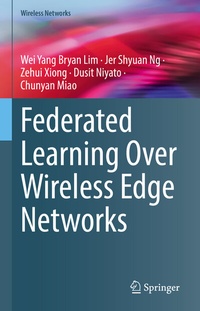
Federated Learning Over Wireless Edge Networks
Description

This book first presents a tutorial on Federated Learning (FL) and its role in enabling Edge Intelligence over wireless edge networks. This provides readers with a concise introduction to the challenges and state-of-the-art approaches towards implementing FL over the wireless edge network. Then, in consideration of resource heterogeneity at the network edge, the authors provide multifaceted solutions at the intersection of network economics, game theory, and machine learning towards improving the efficiency of resource allocation for FL over the wireless edge networks. A clear understanding of such issues and the presented theoretical studies will serve to guide practitioners and researchers in implementing resource-efficient FL systems and solving the open issues in FL respectively.
More details
Other editions
Additional editions
Persons
Jer Shyuang Ng graduated with Double (Honours) Degree in Electrical Engineering (Highest Distinction) and Economics from National University of Singapore (NUS) in 2019. She is currently an Alibaba PhD candidate with the Alibaba Groupand Alibaba-NTU Joint Research Institute, Nanyang Technological University (NTU), Singapore. Her research interests include incentive mechanisms and edge computing.
Zehui Xiong (M'20) is currently an Assistant Professor in the Pillar of Information Systems Technology and Design, Singapore University of Technology and Design. Prior to that, he was a researcher with Alibaba-NTU Joint Research Institute, Singapore. He received the PhD degree in Nanyang Technological University, Singapore. He was the visiting scholar at Princeton Univers is currently an Assistant Professor in the Pillar of Information Systems Technology and Design, Singapore University of Technology and Design. Prior to that, he was a researcher with Alibaba-NTU Joint Research Institute, Singapore. He received the PhD degree in Nanyang Technological University, Singapore. He was the visiting scholar at Princeton University and University of Waterloo. His research interests include wireless communications, network games and economics, blockchain, and edge intelligence. He has published more than 150 research papers in leading journals and flagship conferences and many of them are ESI Highly Cited Papers. He has won over 10 Best Paper Awards in international conferences and is listed in the World's Top 2% Scientists identified by Stanford University. He is now serving as the editor or guest editor for many leading journals including IEEE JSAC, TVT, IoTJ, TCCN, TNSE, ISJ, JAS. He is the recipient of IEEE TCSC Early Career Researcher Award for Excellence in Scalable Computing, IEEE TEMS Technical Committee on Blockchain and Distributed Ledger Technologies Early Career Award, IEEE CSIM Technical Committee Best Journal Paper Award, IEEE SPCC Technical Committee Best Paper Award, IEEE VTS Singapore Best Paper Award, Chinese Government Award for Outstanding Students Abroad, and NTU SCSE Best PhD Thesis Runner-Up Award. He is the Founding Vice Chair of Special Interest Group on Wireless BlockchainNetworks in IEEE Cognitive Networks Technical Committee.
Dusit Niyato (M'09-SM'15-F'17) is a professor in the School of Computer Science and Engineering, at Nanyang Technological University, Singapore. He received B.Eng. from King Mongkuts Institute of Technology Ladkrabang (KMITL), Thailand in 1999 and Ph.D. in Electrical and Computer Engineering from the University of Manitoba, Canada in 2008. His research interests are in the areas of Internet of Things (IoT), machine learning, and incentive mechanism design.
Chunyan Miao received the BS degree from Shandong University, Jinan, China, in 1988, and the MS and PhD degrees from Nanyang Technological University, Singapore, in 1998 and 2003, respectively. She is currently a professor in the School of Computer Science and Engineering, Nanyang Technological University (NTU), and the director of the Joint NTU-UBC Research Centre of Excellence in Active Living for the Elderly (LILY). Her research focus on infusing intelligent agents into interactive new media (virtual, mixed, mobile, and pervasive media) to create novel experiences and dimensions in game design, interactive narrative, and other real world agent systems.
