

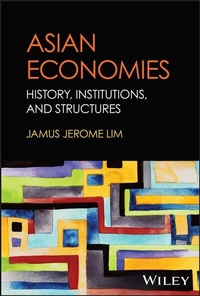
Asian Economies
Description

In Asian Economies: History, Institutions and Structure, seasoned economist and professor Jamus Jerome Lim provides a comprehensive discussion and incisive analysis of the economies of Asia. In addition to discussing the sharp contrasts between the region's three major economies--China, India, and Japan--Lim also provides an overview of the rise of the Dragon economies of the East, to the resource-rich economies of the West. The book adopts a unique approach to the treatment of these economies, weaving in aspects of these countries' economic geography and history, their idiosyncratic institutions and structures, along with providing a comparative and international perspective.
The book offers:
* Careful emphasis on the geographic preconditions and enduring legacy of economic history on the contemporary and future prospects of each of the countries and regions discussed within
* Examinations of the importance of the political and economic institutions, as well as market and industrial structures, in shaping the trajectories of the economies considered in the book
* Discussions of the dramatic differences and similarities between the Asian economies, as well as how these differences shape these economies' interactions with the rest of the world
Perfect for undergraduate and graduate students of economics, Asian Economies will also earn a place on the bookshelves of business and finance professionals seeking to understand the economies of the world's most diverse and dynamic region.
More details
Other editions
Additional editions
Person
Content
Acknowledgments xiii
Abbreviations xv
Introduction: Asia as a Continent in Flux 1
1 China: The Dragon Awakens, But Will It Roar? 23
2 Japan: Asian Standard- Bearer or Has-Been? 79
3 India: Emerging Giant or Slumbering Elephant? 115
4 Rest of South Asia: Finding Relevance in the Shadow of India 153
5 NIEs: From Zero to Hero, but in Need of a New Economic Model 173
6 Southeast Asia: Can Underachieving Cubs Escape the Middle-Income Trap? 213
7 Central Asia: Crossroads in a Globalized World 255
8 Western Asia: An Economic Arab Spring? 271
Sources of Figures 313
Index 321
Preface
Introduction
This book's title-Asian Economies: History, Institutions, and Structures-was deliberately chosen, to capture the book's emphasis on the enduring legacy of economic history on future prospects, the vast importance of political-economic institutions in shaping this trajectory, and the dramatic way that existing economic structures differ between Asian countries, which in turn condition their approach to economic development.
Also implicit in the title is the comparative nature of each country's development journey, as well as the relationship with the rest of the world, both of which we emphasize. Despite their continental nature-which often afford isolation and inward orientation-the economies of Asia have often been deeply integrated with each other, as well as the world at large. We therefore follow this cue, in our treatment of each country and region.
Motivation and Audience
Why another book on Asian economies? To be candid, there are a host of both more specialized references, such as the excellent books by Naughton (2018) on the Chinese economy, Panagariya (2010) on the Indian economy, and Ito and Hoshi (2020) on the Japanese one-and while they are often far more exhaustive, they are often written from the perspective of the economy in question.1
There are also books in this vein that take on a comparative perspective; Bardhan's (2013) comparison of China and India, Vogel's (1993) take on the Newly Industrialized Economies (NIEs), and Noland and Pack's (2007) sweeping dissection of the Arab economies come to mind.2
There are also collected volumes of essays-handbook-like tomes such as Kaur and Singh (2014)-but these tend to be far less constrained in their scope, and single essays within may be repetitive or incomplete.3
Finally, there are books written more for a lay audience, where most recently, the rise of China and India has inspired a cottage industry. Such paperbacks are often featured prominently in airport bookstores, with provocative titles such as Capitalism with Chinese Characteristics, The Argumentative Indian, and Vietnam: Rising Dragon.4 While wonderful reads, they often represent a particular take, and may not be as heavily referenced as the present book attempts to be.
This book-which emerged from many years of lecturing on Asian Economies at ESSEC Business School-positions itself within the gaps left behind by these other efforts. When I first started teaching the course, I felt bereft of a singular text that captured the breadth and scope of the economies across the world's largest continent. I was left with assigning key chapters within existing texts, but while these did a serviceable job (and exposed students to a wider variety of perspectives), they did not have a coherent narrative nor consistent approach. I wanted a book that would more closely match the needs of my course, which was catered to students who would go on to become practitioners, often in multinational corporations or financial institutions, but who may not have the sort of deep economics background or training that upper-level economics majors or graduate students could be expected to possess.
I wasn't entirely satisfied with the books targeted at a wider audience, either. While these offered important (if idiosyncratic) insights and painted vivid vignettes of contemporary events, they did not deliver in terms of the disciplined theoretical framework that I wanted my students to acquire. I wanted to be able to offer at least some basic analytical tools familiar to practicing economists. Many were in sufficiently steeped in the data for my taste, and I felt that it was important that my students gained a comfort level with essential quantitative knowledge.
Approach and Innovations
My hope is that this book fills in the gaps that currently exist in the literature on Asian economies. While it can be profitably deployed as a primary textbook for upper-level undergraduate courses in regional economic studies, or graduate-level classes for non-economics majors-I certainly plan to do so-it can also be used by professionals with less familiarity with this part of the world who seek an in-depth introduction to the region, or by those who already possess some context but want a systematic reference work for diving deeper.
In this vein, this book has several pedagogical innovations that I hope will help with this goal:
- A consistent treatment of each economy or region, with the lens provided by both economic geography and history, before an introduction of the main economic structures and institutions associated with the country/region, which provide essential context. Economic progress is viewed both in a comparative context, as well as set against the country's interactions with the rest of the world. Each chapter then moves on to deal with the latest contemporary developments, before closing with prospects for their future.
- Each chapter is accompanied by a capsule introduction (available online) to a set of analytical tools that is especially relevant to the particular economy at hand. For instance, in trying to understand the growth experience of China, the tools of accounting in the Solow-Swan growth model are extremely useful; similarly, the importance of openness for the export-oriented development of the NIEs is explained via the Ricardian trade model, and fluctuations faced in the Japanese economy by a variation of the Salter-Swan open-economy disequilibrium model.
- As far as possible, each chapter is richly endowed with figures and tables. This serves to cultivate an empirical mindset-so important to the modern observer-as well as build familiarity with essential facts and figures for the economies being discussed.
- Discussion of topics is done in three ways. First, they are used to provide a deeper dive into specific case studies (riffing off the main text), such as the 2016 Indian banknote demonetization or the 1992 Japanese asset bubble. Second, they are used to provide expositional detail for unique structures and institutions, such as Korean chaebol or Singapore's band-basket-crawl exchange rate regime. Third, they could offer the intellectual history of ideas that played prominent roles in Asian economies, such as the East Asian export-oriented industrialization model, or the political economy of the West Asian resource curse.
- Creates discussion of political-economy elements-institutions, regimes, and actors-that tend to be de-emphasized by treatments that are more heavily focused on economics. This choice is deliberate: the only way to fully understand the dramatic, heterogenous development trajectories of Asian economies is to recognize that political economy had at least as much to do with their economic evolution, as purely technocratic considerations.
A Note on Nomenclature
This book is, by design, comparative in nature. Hence, it is necessary to represent many quantitative economic statistics-such as gross domestic product (GDP), trade volumes, and financial metrics-in a comparable format and currency.
By and large, these are shown in terms of constant (inflation-adjusted to a single base year) United States dollars (USD), unless the statistic is applied to a contemporaneous measure, in which case, current (nominal) USD is used. On occasion, where justified, such statistics may also be shown in terms of local currency, or in terms of an international dollar.
Why constant USD? Well, for starters, the Greenback (for the moment) remains the global reserve currency, and the U.S. the world's largest economy. It is most familiar to audiences worldwide, and is easily converted into an alternative, preferred currency. The choice of adjusting for inflation is also logical; with diverse rates of inflation-both within a country and between them-it is useful to get a picture of the true-what economists call real-macroeconomic picture, undistorted by price differentials.
Some authors and books choose to represent economic statistics, especially for GDP, in terms of a purchasing power parity (PPP)-adjusted "international" dollar (Intl$).5 We have chosen not to do so, in general, for three reasons. First, the USD is a visceral, widely held, and frequently traded currency, whereas the Intl$ is abstract and not accepted in any given country or territory. Second, in spite of their best efforts, PPP measures capture quality differentials only imperfectly; for instance, even with so-called hedonic adjustments, it is difficult to imagine that even the best-quality healthcare in Sri Lanka might be comparable to that received in South Korea; by the same token, many purchasers would (and did) shun the purchase of a Proton or Perodua (Malaysian), opting instead for a Mazda or Mitsubishi (Japanese). And third, for international business consultants and financial market players-potentially a significant readership for this book-it is generally profits or returns in a globally-accepted currency that matter most. However, in instances where we are thinking either in terms of the cost of living/quality of life (especially expressed in per capita incomes), or when it is the volume of economic activity that matters, we will work with PPP equivalents.
On occasion, we also report Gross National Product (GNP), when such a metric is more illustrative of the situation at hand. In most instances, there is little...
