

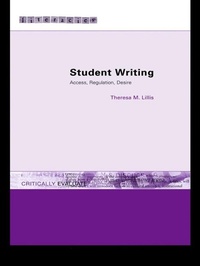
Student Writing
Access, Regulation, Desire
Published on 4. January 2002
208 pages
978-1-134-58657-8 (ISBN)
Description

Student Writing presents an accessible and thought-provoking study of academic writing practices. Informed by 'composition' research from the US and 'academic literacies studies' from the UK, the book challenges current official discourse on writing as a 'skill'. Lillis argues for an approach which sees student writing as social practice.
The book draws extensively on a three-year study with ten non-traditional students in higher education and their experience of academic writing. Using case study material - including literacy history interviews, extended discussions with students about their writing of discipline specific essays, and extracts from essays - Lillis identifies the following as three significant dimensions to academic writing:
* Access to higher education and to its language and literacy representational resources
* Regulation of meaning making in academic writing
* Desire for participation in higher education and for choices over ways of meaning in academic writing.
Student Writing: access, regulation, desire raises questions about why academics write as they do, who benefits from such writing, which meanings are valued and how, on what terms 'outsiders' get to be 'insiders' and at what costs.
The book draws extensively on a three-year study with ten non-traditional students in higher education and their experience of academic writing. Using case study material - including literacy history interviews, extended discussions with students about their writing of discipline specific essays, and extracts from essays - Lillis identifies the following as three significant dimensions to academic writing:
* Access to higher education and to its language and literacy representational resources
* Regulation of meaning making in academic writing
* Desire for participation in higher education and for choices over ways of meaning in academic writing.
Student Writing: access, regulation, desire raises questions about why academics write as they do, who benefits from such writing, which meanings are valued and how, on what terms 'outsiders' get to be 'insiders' and at what costs.
Reviews / Votes
'Despite the seemingly ever-increasing concern with widening participation to higher education and extending opportunities to older adults, it is surprising how little impact the work on academic literacies has had. If there is a text that can help redress that balance and encourage a wider debate, then this is it.' - Richard Edwards, Studies in the Education of Adults, Vol. 33 (2) 2001'Lillis' work makes a valuable contribution to a process of re-evaluation which is long overdue.' - Elaine Millard, Teaching in Higher Education 'Despite the seemingly ever-increasing concern with widening participation to higher education and extending opportunities to older adults, it is surprising how little impact the work on academic literacies has had. If there is a text that can help redress that balance and encourage a wider debate, then this is it.' - Richard Edwards, Studies in the Education of Adults, Vol. 33 (2) 2001
'This book has made a significant contribution to the discourse on issues of diversity and fairness in HE.' - Ellen Grote, Linguist List
'Lillis' work makes a valuable contribution to a process of re-evaluation which is long overdue.' - Elaine Millard, Teaching in Higher Education
'This is an excellent book for anyone wanting to think a bit more deeply than they usually have time for about student writing and how we can improve it.' - Rowena Murray, University of Strathclyde, Journal of Further and Higher Education
More details
Series
Language
English
Place of publication
London
United Kingdom
Publishing group
Taylor & Francis Ltd
Target group
College/higher education
File size
1,08 MB
ISBN-13
978-1-134-58657-8 (9781134586578)
Copyright in bibliographic data and cover images is held by Nielsen Book Services Limited or by the publishers or by their respective licensors: all rights reserved.
Schweitzer Classification
Other editions
Additional editions
Book
04/2001
1st Edition
Routledge
€206.20
Shipment within 15-20 days
Book
04/2001
1st Edition
Routledge
€95.50
Shipment within 15-20 days
Person
Theresa M. Lillis is Lecturer in language and education at the Centre for Language and Communications at the Open University
Content
List of figures and tables, Preface: why write this book?, Acknowledgements, Introduction: focus and research background, 1 Language, literacy and access to higher education, 2Student writing as social practice, 3 Restricted access to a privileged practice, 4 The regulation of authoring, 5 Essayist literacy, gender and desire, 6 Dialogues of participation, 7 Re-thinking student writing in higher education, Appendices, References, Index
