

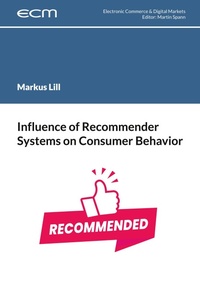
Influence of Recommender Systems on Consumer Behavior
1st Edition
Published on 13. March 2025
190 pages
978-3-7693-8646-2 (ISBN)
Description

In the dynamic landscape of digital platforms, recommender systems silently guide our decisions, shaping what we watch, read, and buy. But how do these algorithms influence our behavior beyond convenience and personalization? This dissertation delves into the psychological undercurrents of recommender systems, uncovering how subtle design choices trigger behavioral biases that affect consumer preferences, beliefs, and decisions.
Through a series of rigorous field experiments, this work explores three critical dimensions of recommender systems: item selection, ranking, and recommendation design. It reveals how phenomena like assimilation and contrast effects, as well as visual cues such as product badges, can subtly yet powerfully steer consumer behavior. Challenging traditional recommender system design priorities, the findings highlight that similarity can sometimes outweigh diversity and that strategic positioning can defy conventional assumptions about user attention.
Combining a systematic literature review with empirical evidence from real-world settings, this dissertation offers insights into the interplay between technology and human cognition. It is an essential read for scholars, practitioners, and platform designers seeking to understand - and ethically harness - the behavioral dynamics of recommender systems.
Through a series of rigorous field experiments, this work explores three critical dimensions of recommender systems: item selection, ranking, and recommendation design. It reveals how phenomena like assimilation and contrast effects, as well as visual cues such as product badges, can subtly yet powerfully steer consumer behavior. Challenging traditional recommender system design priorities, the findings highlight that similarity can sometimes outweigh diversity and that strategic positioning can defy conventional assumptions about user attention.
Combining a systematic literature review with empirical evidence from real-world settings, this dissertation offers insights into the interplay between technology and human cognition. It is an essential read for scholars, practitioners, and platform designers seeking to understand - and ethically harness - the behavioral dynamics of recommender systems.
More details
Other editions
Additional editions
Markus Lill | Martin Spann
Influence of Recommender Systems on Consumer Behavior
Book
02/2025
1st Edition
BoD - Books on Demand
€29.99
Shipment within 10-15 days
