

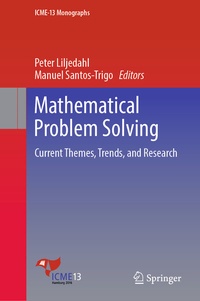
Mathematical Problem Solving
Description

This book contributes to the field of mathematical problem solving by exploring current themes, trends and research perspectives. It does so by addressing five broad and related dimensions: problem solving heuristics, problem solving and technology, inquiry and problem posing in mathematics education, assessment of and through problem solving, and the problem solving environment.
Mathematical problem solving has long been recognized as an important aspect of mathematics, teaching mathematics, and learning mathematics. It has influenced mathematics curricula around the world, with calls for the teaching of problem solving as well as the teaching of mathematics through problem solving. And as such, it has been of interest to mathematics education researchers for as long as the field has existed. Research in this area has generally aimed at understanding and relating the processes involved in solving problems to students' development of mathematical knowledge and problem solving skills. The accumulated knowledge and field developments have included conceptual frameworks for characterizing learners' success in problem solving activities, cognitive, metacognitive, social and affective analysis, curriculum proposals, and ways to promote problem solving approaches.
Reviews / Votes
"The volume will be a useful addition to the libraries of education researchers and to mathematics teacher educators who are charged with supporting preservice or inservice teachers' development of capacities to incorporate problem solving into their instruction. . this volume offer interesting insights into the phenomenon of problem solving and the technological tools and learning environments that support students to engage in problem solving." (Duane Gaysay, MAA Reviews, August 16, 2020)
More details
Other editions
Additional editions
Content
Introduction - Peter Liljedahl & Manuel Santos Trigo.- Section 1: problem solving heuristics.- 1. Looking Back to Solve Differently: Familiarity, Fluency, and Flexibility - Hartono Tjoe.- 2. Future-oriented Thinking and Activity in Mathematical Problem Solving - Wes Maciejewski.- Section 2: problem solving and technology.- 3. A model of mathematical problem solving with technology: the case of Marco solving-and-expressing two geometry problems - Susana Carreira & Hélia Jacinto.- 4. Mathematical problem solving and the use of digital technologies - Manuel Santos-Trigo.- 5. The spreadsheet affordances in solving complex word problems - Nélia Amado, Susana Carreira & Sandra Nobre.- Section 3: inquiry and problem posing in mathematics education.- 6. Is Inquiry-Based Approach possible at the elementary school? - Magali Hersant & Christine Choquet.- 7. How to stimulate in-service teachers' competencein didactic analysis by means of problem posing - Uldarico Malspina et al.- Section 4: assessment of and through problem solving.- 8. Exploring Methods in Evaluating Metacognitive Strategies in Mathematical Problem Solving - Mei Yoke Loh & Ngan Hoe Lee.- 9. Assessing Inquiry-Based-Mathematics-Education with both a summative and formative purpose - Maud Chanudet.- 10. Beyond the standardized assessment of mathematical problem solving competencies: from products to processes - Pietro Di Martino & Giulia Signorini.- Section 5: the problem solving environment.- 11. Creating and sustaining online problem-solving forums: Two perspectives - Boris Koichu & Nelly Keller.- 12. Conditions for Supporting Problem Solving: Vertical Non-Permanent Surfaces - Peter Liljedahl.- 13. The ARPA experience in Chile: Problem Solving for Teachers' Professional Development - Patricio Felmer, Josefa Perdomo-Díaz, & Cristián Reyes.- Conclusion - Peter Liljedahl & Manuel SantosTrigo.
