

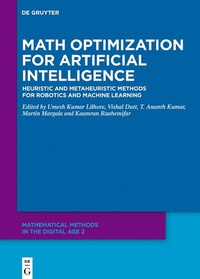
Math Optimization for Artificial Intelligence
Heuristic and Metaheuristic Methods for Robotics and Machine Learning
1st Edition
Published on 21. April 2025
XIII, 417 pages
978-3-11-143618-0 (ISBN)
Description

The book presents powerful optimization approaches for integrating AI into daily life.
This book explores how heuristic and metaheuristic methodologies have revolutionized the fields of robotics and machine learning. The book covers the wide range of tools and methods that have emerged as part of the AI revolution, from state-of-the-art decision-making algorithms for robots to data-driven machine learning models. Each chapter offers a meticulous examination of the theoretical foundations and practical applications of mathematical optimization, helping readers understand how these methods are transforming the field of technology.
This book is an invaluable resource for researchers, practitioners, and students. It makes AI optimization accessible and comprehensible, equipping the next generation of innovators with the knowledge and skills to further advance robotics and machine learning. While artificial intelligence constantly evolves, this book sheds light on the path ahead.
This book explores how heuristic and metaheuristic methodologies have revolutionized the fields of robotics and machine learning. The book covers the wide range of tools and methods that have emerged as part of the AI revolution, from state-of-the-art decision-making algorithms for robots to data-driven machine learning models. Each chapter offers a meticulous examination of the theoretical foundations and practical applications of mathematical optimization, helping readers understand how these methods are transforming the field of technology.
This book is an invaluable resource for researchers, practitioners, and students. It makes AI optimization accessible and comprehensible, equipping the next generation of innovators with the knowledge and skills to further advance robotics and machine learning. While artificial intelligence constantly evolves, this book sheds light on the path ahead.
More details
Other editions
Additional editions
Umesh Kumar Lilhore | Vishal Dutt | T. Ananth Kumar
Math Optimization for Artificial Intelligence
Heuristic and Metaheuristic Methods for Robotics and Machine Learning
Book
04/2025
1st Edition
De Gruyter
€149.95
Shipment within 5-7 days
Umesh Kumar Lilhore | Vishal Dutt | T. Ananth Kumar
Math Optimization for Artificial Intelligence
Heuristic and Metaheuristic Methods for Robotics and Machine Learning
E-Book
04/2025
1st Edition
De Gruyter
€149.95
Available for download
Persons
Dr. Umesh Kumar Lilhore Presently working as a postdoctoral research fellow in Louisiana at Lafayette since 2022. He previously worked in various reputed universities and colleges, including Chandigarh University, Punjab, KIET Group of Institutions NCD, Delhi, Chitkara University Punjab, SAGE University Inore and NIIT Bhopal. He has gained more than 19 years of teaching experience and 8 years of research experience. Finished the PhD degree and Mtech degree in CSE, RGPV, and continued with postdoctoral research in the Institute of advance computing, University of Louisiana at Lafayette. He has published many articles in reputed, peer-reviewed national and international Scopus journals and conferences. Additionally, he has served as a keynote speaker and resource person for several workshops and webinars conducted in India. He has been an ACM and IEEE professional member. His research includes digital transformation technologies such as Artificial Intelligence (AI), Quantum Computing, Internet of Things (IoT), Blockchain, Edge and Serverless computing, Cloud-native computing and Digital Twins. Vishal Dutt I hold a distinguished Gold Medallist MCA degree from MDS University in Ajmer, Rajasthan, India. Currently, I am employed Technical trainer at the esteemed Department of Computer Science & Engineering, located at Chandigarh University, Mohali, Punjab, India. I am a dedicated and experienced professional trainer, specializing in Research and Development. I am a dedicated researcher with extensive experience in healthcare, utilizing data science and quantum computing to drive transformative advancements. Additionally, I have executed numerous projects of data analytics. My expertise lies in uncovering insights from complex healthcare datasets and promoting sustainable practices in water conservation. With a passion for education and a commitment to promoting innovation, I have contributed significantly to the growth and development of various reputed universities like Chandigarh University, Punjab; Chitkara University, Himachal Pradesh; Poornima University, Rajasthan etc. As a core and founding member of various research actively participated in shaping the research culture within the departments. I have a total Academic teaching experience of more than 7.5 years. I have more than 50 publications in reputed, SCI, Scopus, Springer Journals & Conferences, peer-reviewed National and International journals, and Book Chapters. I have edited 1 book with Wiley and 2 books are under process, 4 books with IGI-Global, USA, 1 book with De Gruyter, and 2 books with Eureka. I have been a keynote speaker and resource person for many workshops and webinars in India. I have been a reviewer for Elsevier, Springer, and IEEE Access. I have been a Program Committee Member and Reviewer at the International Conference on Computational Intelligence and Emerging Power Systems ICCIPS 2021. My research area includes- Data Science, Data Mining, Machine Learning, and Deep Learning, IoT, and Natural Resources. I also have Data Analytics Experience in Rapid Miner, Tableau, and WEKA. I have been working for more than 6 years in the field of Java and Android Development. Prof. T. Ananth Kumar Dr. T. Ananth kumar is working as Associate Professor in IFET college of Engineering(Autonomous) affiliated to Anna University, Chennai. He received his Ph.D. degree in VLSI Design from Manonmaniam Sundaranar University, Tirunelveli. He received his Master's degree in VLSI Design from Anna University, Chennai and Bachelor's degree in Electronics and communication engineering from Anna University, Chennai. He has presented papers in various National and International Conferences and Journals. His fields of interest are Networks on Chips, Computer Architecture and ASIC design. He has received awards such as Young Innovator Award, Young Researcher Award, Class A Award - IIT Bombay and Best Paper Award at INCODS 2017. He is the life member of ISTE, IEEE and few membership bodies. He has many patents in various domains. He has edited 4 books and has written many book chapters in Springer, IET Press, and Taylor & Francis press. Dr. Martin Margala Martin Margala, PhD joined the School of Computing and Informatics as Professor and Director in August 2021. Before joining UL Lafayette, from September 2011 to July 2021, Dr. Margala was Professor and Chair of the Electrical and Computer Engineering Department at the University of Massachusetts Lowell and a Co-Director of the Center for Smart Cyber-Physical Systems (SCyPS). He received his PhD degree in Electrical and Computer Engineering from the University of Alberta, Canada (#61 in Global Ranking in North America region; #13 in Global subject specific ranking Electrical and Electronic Engineering in North America region USNews) in the spring of 1998. He is a senior member of ACM, IEEE, and SPIE with more than 50 journal and 200 peer reviewed conference publications in the areas of Design for Testability for Energy Efficient Architectures and Systems, High-Performance Reliable Low-Power Architectures and Reconfigurable Secure Architectures and Systems. Dr. Margala has directed 22 PhD students and 19 MS students, many of whom now hold leading positions in academia and industry. He has served on numerous program committees of international conferences and on workgroups (such as the International Technology Roadmap for Semiconductors) that have a great impact on the future direction of academia and industry. Kaamran Raahemifar Kaamran Raahemifar (S'91-M'99-SM'02) received the B.Sc. degree in electrical engineering from the Sharif University of Technology, Tehran, Iran, in 1988, the MASc. degree from Electrical and Computer Engineering Department, Waterloo University, Waterloo, ON, Canada, in 1993, and the Ph.D. degree from Windsor University, Windsor, ON, Canada. He joined Ryerson University (Currently known as Toronto Metropolitan University or TMU) in 1999 and was tenured in 2001. He had been a Professor with the Department of Electrical, Computer and Biomedical Engineering, TMU since 2011. He is currently a Professor at the Data Science and Artificial Intelligence program at the College of Information Sciences and Technology (IST), Pennsylvania State University. His research interests include but are not limited to 1) Applied Optimization: Data Modeling and Prediction, 2) Small & Large System Simulation and Design, 3) Signal Anomaly Detection and Testing, 4) Blockchain. He is an expert in the following applications: 1) Medical: Image Processing, 2) Energy: Net-zero communities, 3) Finance: Stock Markets, and 4) Transportation: Self-Driving Cars. He has previously worked in the area of VLSI circuit simulation, design, and testing, signal processing and hardware implementation of biomedical signals. He was a recipient of the ELCE-GSA Professor of the Year Award (Elected by Graduate Student's Body, 2010), the Faculty of Engineering, Architecture, and Science Best Teaching Award (April 2011), the Department of Electrical and Computer Engineering Best Teaching Award (December 2011), and the Research Award (December 2014). He has been awarded more than $10M external research fund during his time at TMU.
Content
- Intro
- Foreword
- Contents
- List of Authors
- 1 The Role of Mathematical Optimization in Advanced AI Applications
- 2 An Overview of Mathematical Optimization in Artificial Intelligence
- 3 Robust Optimization Methods for Ensuring AI System Reliability
- 4 Swarm Intelligence and Optimization in AI
- 5 Privacy and Security for 6G's IoT-Connected Future in the Age of Quantum Computing
- 6 Optimization in Natural Language Processing Models for Enhanced Performance and Efficiency
- 7 Unveiling the Intriguing Applications of Mathematical Optimization in Artificial Intelligence
- 8 Unleashing the Power of Evolutionary Algorithms: Advanced Optimization Techniques in Artificial Intelligence
- 9 Introduction to Mathematical Optimization Techniques in AI
- 10 Hybrid Mathematical Optimization Techniques in AI
- 11 Mathematical Optimization for Enhanced AI-Enabled Geospatial Intelligence
- 12 Deep Learning-Based Ultrasound Analysis Using Explainable Artificial Intelligence (XAI) Methods for Breast Cancer
- 13 Explainable Artificial Intelligence Techniques in Deep Learning-Based Liver Tumor Analysis
- 14 A Novel African Wild Dog Optimization (AWDO) Algorithm for Applications of Artificial Intelligence
- 15 Artificial Intelligence-Based Control Strategies for COVID-19 That Target Different Age Groups
- 16 Model Optimization in Deep Learning: Theory and Application
- 17 Quantitative Analysis for LMS Using Mathematical Modeling by Artificial Intelligence
- 18 Optimizing Neural Network Training by Addressing Key Challenges and Advanced Techniques
- 19 Principles and Applications of Bayesian Optimization in AI
- Index
