

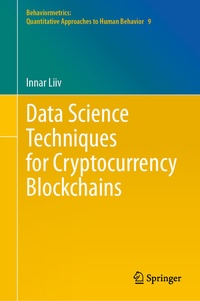
Data Science Techniques for Cryptocurrency Blockchains
Description

This book brings together two major trends: data science and blockchains. It is one of the first books to systematically cover the analytics aspects of blockchains, with the goal of linking traditional data mining research communities with novel data sources. Data science and big data technologies can be considered cornerstones of the data-driven digital transformation of organizations and society. The concept of blockchain is predicted to enable and spark transformation on par with that associated with the invention of the Internet. Cryptocurrencies are the first successful use case of highly distributed blockchains, like the world wide web was to the Internet.
The book takes the reader through basic data exploration topics, proceeding systematically, method by method, through supervised and unsupervised learning approaches and information visualization techniques, all the way to understanding the blockchain data from the network science perspective.
Chapters introduce the cryptocurrency blockchain data model and methods to explore it using structured query language, association rules, clustering, classification, visualization, and network science. Each chapter introduces basic concepts, presents examples with real cryptocurrency blockchain data and offers exercises and questions for further discussion. Such an approach intends to serve as a good starting point for undergraduate and graduate students to learn data science topics using cryptocurrency blockchain examples. It is also aimed at researchers and analysts who already possess good analytical and data skills, but who do not yet have the specific knowledge to tackle analytic questions about blockchain transactions. The readers improve their knowledge about the essential data science techniques in order to turn mere transactional information into social, economic, and business insights.
More details
Other editions
Additional editions
Person
Innar Liiv is Associate Professor of Data Science at Tallinn University of Technology. He also belongs to the Future of Public e-Governance expert group at the Foresight Centre at the Parliament of Estonia. He was previously a Cyber Studies Visiting Research Fellow (2016-2017) and a Research Associate (2018-2020) at the University of Oxford, a Visiting Scholar at Stanford University (2015), and a Postdoctoral Visiting Researcher at the Georgia Institute of Technology (2009). His research interests include data science, financial technology, social network analysis, information visualization, computational international relations, and big data technology transfer to industrial and governmental applications. Innar Liiv has won the Classification Society Distinguished Dissertation Award 2009.
