

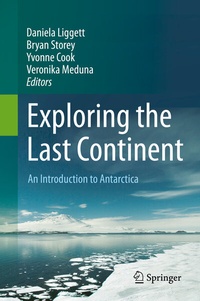
Exploring the Last Continent
Description

Reviews / Votes
"The book is well-organized with frequent subheadings enabling readers to dive in and find information on a particular topic of interest. . This volume will be a useful resource to anyone involved in Antarctic science, environmental regulation, or politics, enabling them to find information about areas beyond their own speciality. At the same time, it covers a wide range of topics presented in a way that is accessible to interested general readers." (Robert Larter, The Quarterly Review of Biology, Vol. 93 (1), March, 2018)
"This book provides an introduction to the exploration of Antarctica . . The volume includes a short introduction followed by four sections of articles arranged thematically. . Broad and thoughtful inits approach, this work is a valuable addition to the expanding canon of analyses of the history and future of Antarctica. Summing Up: Recommended. Upper-division undergraduates through professionals/practitioners; general readers." (H. Doss, Choice, Vol. 53 (9), May, 2016)
More details
Other editions
Additional editions
Content
1. Introduction.- PART 1: Physical Sciences.- 2. A Continent under Ice: Studying Geology in Antarctica.- 3. A Long Journey South: Unravelling Antarctica's Geological History.- 4. Looking Back to the Future: Palaeoclimate Studies in Antarctica.- 5. An Ice-bound Continent: Antarctic's Cryosphere and Hydrological Systems.- 6.Weather and Climate: Antarctica's Role in the Global Atmospheric System.- 7. The Southern Ocean: Antarctica's Northern Boundary.- 8. From Ice to Space: The Antarctic Atmosphere.- PART 2.- 9. Remote Ocean Outposts: Biological Diversity of the Subantarctic Islands.- 10. Life on Land: Aquatic Terrestrial Ecosystems in Antarctica.- 11. Life on Land: Non-aquatic Terrestrial Eccosystems in Antarctica.- 12. Beyond the Ice: Marine Ecosystems in the Southern Ocean.- 13. Antarctic Megafauna: Birds and Mammals of Antarctica.- 14. Surviving in the Cold: Invertebrates and Fish in Antarctica.- 15. Polar Expeditions: Historical and Social Aspects of Antarctic Exploration.- 16. AContinent for Peace and Science: Antarctic Governance.- 17. Extreme and Unusual Psychology in Antarctica.- 18. Destination Icy Wilderness: Antarctic Tourism.- 19. Creativity at the Frozen Frontier: The Arts in Antarctica.- 20. Commercial Harvest: Exploitation of Antarctic Marine Living Resources.- 21. Southern Ocean Fisheries: Managing Harvests of Marine Life.- 22. The Search for Extremophiles: Antarctic Biological Prospecting.- 23. The Question of Mining: Geological Resources in Antarctica.- 24. Ice and Mineral Resources: Regulatory Challenges of Commercial Exploitation.- 25. Recent Climate Change: Causes and Impacts of Climate Change in Antarctica.- 26. Reducing Fossil Fuel Consumption: Renewable Energy in Antarctica.- 27. Alien Invasions and the Impact of Non-native Species: Changing the Face of Life on Land in Antarctica?- 28. Future Challenges in Antarctic Research: International and Interdisciplinary Cooperation.- 29. Antarctic Scientific Collaboration: The Role of SCAR.
