

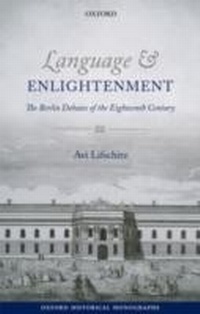
Language and Enlightenment
The Berlin Debates of the Eighteenth Century
1st Edition
Published on 1. September 2012
244 pages
978-0-19-163775-9 (ISBN)
Description

Highlights the importance of language in the social theory, epistemology, and aesthetics of the Enlightenment. Argues that awareness of the historicity and linguistic rootedness of all forms of life was a mainstream Enlightenment notion rather than a feature of the so-called 'Counter-Enlightenment'.
More details
Other editions
Additional editions
Book
09/2012
1st Edition
Oxford University Press
€184.80
Shipment within 15-20 days
Content
- Cover
- Table of Contents
- Note on citations
- Introduction
- 1. The Mutual Emergence of Language, Mind, and Society: An Enlightenment Debate
- No Name-Givers: Ancient Epicureans on the Emergence of Language
- After the Deluge: How to Marry Epicurus and Genesis
- Between Nature and Artifice: The Trouble with Epicurus
- Passionate Speech: Reinterpreting Descartes on Language
- Signs of What? The Crisis of Sensualist Epistemology
- 2. Symbolic Cognition from Leibniz to the 1760s: Theology, Aesthetics, and History
- Leibniz, Wolff, and Pufendorf
- Leibniz on confused ideas and symbolic knowledge
- Leibniz on natural languages and the vernacular
- Wolff on signs and cognition
- Pufendorf and the role of natural law
- Halle, Göttingen, and Berlin
- Reason and language in the Wertheim Bible
- An aesthetic response to the rationalist challenge
- Siegmund Jacob Baumgarten: Pietism, history, and Wolffian philosophy
- Semler and Neology
- Academic history: the beginnings of the Göttingen School
- 'Popular philosophers' probing language and method
- 3. The Evolution and Genius of Language: Debates in the Berlin Academy
- Institutional Preliminaries
- Debating Language
- La Mettrie's barren suggestion
- Maupertuis after Condillac
- Responses to Rousseau's conundrums
- The genius and politics of language
- The prize question for 1759
- 4. J. D. Michaelis on Language and Vowel Points: From Confessional Controversy to Naturalism
- Prelude: In Defence of the Ancient Vowel Points
- Sacred Poetry without Vowels: English Encounters
- From Göttingen to Arabia: Research and Discovery
- Ancient Legislation: The Case of the Hebrews
- Natural Evolution: The Case of Hebrew
- 5. A Point of Convergence and New Departures: The 1759 Contest on Language and Opinions
- Academic Arrangements and Expectations
- Origins versus Mutual Influence: Replies to the Prize Question
- Language as a Democracy: Michaelis's Prize Essay
- The Labyrinth of Language: Responses to the Prize Essay
- 6. Language and Cultural Identity: The Controversy over Prémontval's Préservatif
- How to Germanize Oneself: Prémontval's Préservatif
- Freedom of the Press and Academic Manners
- Fatalism and Providence, Content and Form
- Group Identities between French and German
- 7. Tackling the Naturalistic Conundrum: Instincts and Conjectural History to 1771
- Language, Method, and the Animal-Human Boundary
- Historical Evolution from Unknown Origins: Abbt, Herder and Sulzer
- Naturalism and Instincts in the 1771 Contest
- 8. Conclusion and a Glimpse into the Future
- Bibliography
- Index
- A
- B
- C
- D
- E
- F
- G
- H
- I
- J
- K
- L
- M
- N
- O
- P
- R
- S
- T
- U
- V
- W
