

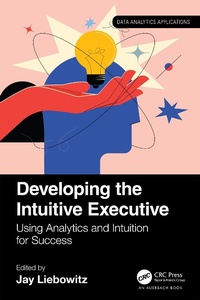
Developing the Intuitive Executive
Using Analytics and Intuition for Success
1st Edition
Published on 19. October 2023
232 pages
978-1-003-80889-3 (ISBN)
Description

The leading traits of executives often include creativity and innovation. Research shows that intuition can significantly enhance these traits. Developing intuitive executives and honing intuition, coupled with the ability to apply data and evidence to inform decision making, is the focus of Developing the Intuitive Executive: Using Analytics and Intuition for Success.
Some researchers call the complement of applying data analytics to intuition as quantitative intuition, rational intuition, or informed intuition. Certainly, in today's data-driven environment, analytics plays a key role in executive decision-making. However, an executive's many years of experiential learning are not formally considered as part of the decision-making process. Learning from both failures and successes can help fine-tune intuitive awareness-what this book calls intuition-based decision-making. Research also shows that many executives do not trust the internal data quality in their organizations, and so they rely on their intuition rather than strictly on data.
This book presents the work of leading researchers worldwide on intuition in the management and executive domain. Their chapters cover key issues, trends, concepts, techniques, and opportunities for applying intuition as part of the executive decision-making process. Highlights include:
Using intuition to manage new opportunities
Intuition in medicine
Rules based on intuition
Balancing logic and intuition in decision-making
Smart heuristics to manage complexity
Intuition and competitiveness
Intuitive investment decision-making across cultures
Showing how intuition in executive decision-making should play an important role, this book enables managers to complement their knowledge gained from experience with analytics to improve decision-making and business success.
Some researchers call the complement of applying data analytics to intuition as quantitative intuition, rational intuition, or informed intuition. Certainly, in today's data-driven environment, analytics plays a key role in executive decision-making. However, an executive's many years of experiential learning are not formally considered as part of the decision-making process. Learning from both failures and successes can help fine-tune intuitive awareness-what this book calls intuition-based decision-making. Research also shows that many executives do not trust the internal data quality in their organizations, and so they rely on their intuition rather than strictly on data.
This book presents the work of leading researchers worldwide on intuition in the management and executive domain. Their chapters cover key issues, trends, concepts, techniques, and opportunities for applying intuition as part of the executive decision-making process. Highlights include:
Using intuition to manage new opportunities
Intuition in medicine
Rules based on intuition
Balancing logic and intuition in decision-making
Smart heuristics to manage complexity
Intuition and competitiveness
Intuitive investment decision-making across cultures
Showing how intuition in executive decision-making should play an important role, this book enables managers to complement their knowledge gained from experience with analytics to improve decision-making and business success.
More details
Series
Edition
1. Auflage
Language
English
Place of publication
London
United Kingdom
Publishing group
Taylor & Francis Ebooks
Target group
Professional and scholarly
Product notice
Reflowable
ISBN-13
978-1-003-80889-3 (9781003808893)
Copyright in bibliographic data and cover images is held by Nielsen Book Services Limited or by the publishers or by their respective licensors: all rights reserved.
Schweitzer Classification
Other editions
Additional editions
Book
10/2023
1st Edition
Auerbach
€73.10
Shipment within 10-20 days
Book
10/2023
1st Edition
Auerbach
€170.30
Shipment within 10-20 days
Person
Dr. Jay Liebowitz has recently served as the inaugural Executive-in-Residence for Public Service at Columbia University's Data Science Institute. He was previously a Visiting Professor in the Stillman School of Business and the MS-Business Analytics Capstone & Co-Program Director (External Relations) at Seton Hall University.
Dr. Liebowitz previously served as the Distinguished Chair of Applied Business and Finance at Harrisburg University of Science and Technology. Before HU, he was the Orkand Endowed Chair of Management and Technology in the Graduate School at the University of Maryland University College (UMUC). He served as a Full Professor in the Carey Business School at Johns Hopkins University.
Dr. Liebowitz previously served as the Distinguished Chair of Applied Business and Finance at Harrisburg University of Science and Technology. Before HU, he was the Orkand Endowed Chair of Management and Technology in the Graduate School at the University of Maryland University College (UMUC). He served as a Full Professor in the Carey Business School at Johns Hopkins University.
Content
1. The Intuitive Executive Revisited 2. Training Intuition: Challenges and Opportunities 3. Intuition and Analysis: Past, Present, and Future 4. Using Temporal Intuition to Navigate New Opportunities 5. Who's Afraid of Intuition in Medicine? 6. Turning Intuition into Managerial Simple Rules 7. Executive Decision Making: Logic or Intuition? 8. Top Managers' Intuition and Analytics in Trusting Individuals from Inside and Outside of the Organization 9. Knowledge for a World of Complexity: The Intuitive Executive and Smart Heuristics 10. Intuition and Competitiveness 11. Intuitive Investment Decision-Making Across Cultures 12. Intuition, Analysis and Sensemaking: How to Select Ideas for Innovation 13. A Literature Review of Intuition in Strategic Decision-Making
