

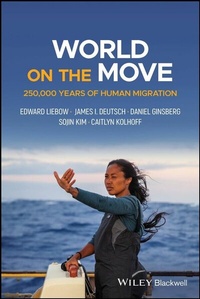
World on the Move
Description

Provides an encompassing overview of migration routes and dispersal of human populations around the world
World on the Move brings together the current state of knowledge about migration and displacement in a single, easily accessible volume. Written as a companion to "World on the Move: 250,000 Years of Human Migration," a traveling exhibition developed by the American Anthropological Association and the Smithsonian Center for Folklife and Cultural Heritage, this thought-provoking book helps us reframe the ways we think and talk about migration.
World on the Move opens by describing the basic patterns and processes of migration and discussing the evidence used to measure migration, displacement, and their impacts. Subsequent chapters trace major population movements through human history, review the different reasons that propel the movement of human populations, and illustrate the many ways that migration affects us all. The final section focuses on international and national policies on immigration and displacement, including perspectives on birthright citizenship, migrant mothers and their children, and migration driven by climate change.
Drawing on a wealth of case studies of diverse cultures from across human history, World on the Move:
- Employs the "Crossroads" concept, an innovative narrative device that reveals connections between peoples, cultures, and moments when crucial decisions are made
- Discusses ways research on migration and displacement have been used to support public policy
- Highlights the roles of ever-evolving genetic, archaeological, and linguistic evidence in reshaping understanding of human population movements
- Explains basic terms, patterns, and processes of migration and displacement, as well as various evaluation and interpretation methods
- Addresses timely and complex issues such as enslavement and trafficking, border walls, immigration policy, and climate change
Presenting the latest scholarship on the peopling of the continents, World on the Move: 250,000 Years of Human Migration is an excellent textbook for undergraduate courses in anthropology, sociology, political science, cultural geography, and immigration studies, particularly those exploring migration, displacement, diaspora, and immigration policy.
More details
Other editions
Additional editions
Persons
Edward Liebow is Affiliate Associate Professor of Anthropology at the University of Washington and Research Associate at the Smithsonian Center for Folklife and Cultural Heritage. From 2012-2023 he served as Executive Director of the American Anthropological Association (AAA). He has been the leader of the public education initiative, World on the Move: 250,000 Years of Human Migration.
James I. Deutsch is Curator at the Smithsonian Center for Folklife and Cultural Heritage and Professorial Lecturer in American Studies at George Washington University. He has planned and developed public programs on California, China, the Peace Corps, the Apollo Theater, NASA, the Mekong River, the US Forest Service, and World War II, among others.
Daniel Ginsberg is Director of Strategic Initiatives at the American Anthropological Association. They manage the AAA's institutional research program, which studies anthropologists' careers and anthropology education. They support AAA fellowship and internship programs, public education initiatives, academic relations, and professional services.
Sojin Kim is Curator at the Smithsonian Center for Folklife and Cultural Heritage. She formerly served as a curator at the Japanese American National Museum and the Natural History Museum of LA County. She currently serves on the board of Asian and Pacific Islander Americans in Historic Preservation (APIAHiP).
Caitlyn Kolhoff is Manager of Continuing Education Services for the American Speech-Language Hearing Association. She formerly managed education programs at the American Anthropological Association. She has a versatile background in historical archaeology and innovations in educational technology for improved teaching and learning.
Content
List of Figures vi
Acknowledgments vii
Section 1 Introduction and Overview 1
1 Basic Concepts and Patterns of Migration and Displacement 7
2 The Crossroads Concept 34
Section 2 Where Do We Come From? 61
3 Out of Africa 63
4 The Peopling of Europe, Australasia, and the Pacific 78
5 Peopling of the Americas 92
Section 3 Why Do We Move? 105
6 Movement and the Social Production of Vulnerability 107
Section 4 How Does Migration Change Us? 139
7 Language and Migration 141
8 Economic Development and Gentrification 159
9 Enslavement and Coercion 194
Section 5 Where Are We Going? 219
10 National and International Policy 221
11 At A Crossroads 255
Index 257
Section 1
Introduction and Overview
This book was conceived as a companion to a traveling exhibition developed by the American Anthropological Association and the Smithsonian Center for Folklife and Cultural Heritage. The exhibition, World on the Move: 250,000 Years of Human Migration, brings together the current state of knowledge about migration and displacement to reach a variety of audiences, including schoolchild and their families, educators, and community-based organizations. We aim to reframe the ways in which we think - and talk - about migration. World on the Move challenges people to consider the scale, composition, and time-depth of human population movements, the ways in which research on migration and displacement have been used (and misused) to support public policy, and the lived experiences of individuals, families, and communities on the move.
We hear a great deal of talk these days about how people move around much more than they used to. We also hear about what this moving does to our communities - and often it is not good news. Economic hardships, a shortage of affordable housing, religious persecution, war and conflict, the threat of disease, and even the effects of climate change may force people to move. People may also move in search of economic and educational opportunity. At the end of a migrant family's journey, sometimes the reception is a hearty embrace. But the reception is not always with open arms. In some places, there is concern that too many immigrants will take away jobs or change the character of a place beyond recognition.
Drawing on a wealth of case studies from across human history and its breadth of cultures, World on the Move aims to help people appreciate migration histories - their own and those of others. The exhibition has been designed to travel to public libraries, museums, and community centers around the world for a target audience of primary and secondary school-age visitors. As host institutions may not have educators or docents on hand to actively guide and interact with visitors, the exhibition design accommodates flexible self-navigation, with modular panel displays and accessible interactive components. Host institutions can customize their presentations with displays that feature local stories and public programs.
Refugees in transit charge their cell phones outside a train station in Budapest, Hungary. The city is a common transit point for migrants moving from Southwestern Asia to Central Europe.
Source: Photo by Zoltan Balogh / MTI via AP.
This exhibition has been designed to inspire visitors to:
- Be curious about the long history of human migration.
- Appreciate the complexity and diversity of migration stories.
- Recognize that migration is a shared human experience.
- Feel safe to discuss issues surrounding migration.
- Share migration stories with family members, neighbors, and friends.
- Feel proud of their family's migration stories.
- Gain greater empathy toward migrants in their communities and elsewhere.
- Ask critical questions about migration.
- Consider their beliefs and opinions about migration.
One may notice that the overall goals for the visitors' experiences are as affective as they are cognitive. The exhibition does not directly ask visitors to identify the migration routes through which humans have come to populate the world or the types of evidence that have enabled researchers to recreate these routes, as a classroom teacher might do. Instead, we mean for visitors to be curious, appreciate complexity, share stories, and feel proud.
As a companion to the exhibition, this book fills in some of the gaps about migration routes and timing of dispersal of human populations around the world, along with the basic patterns, processes, causes, and consequences of such movements. This does not contradict the aims of the exhibition. Instead, it aims to answer some of the key questions that the exhibition raises and amplify the sense of curiosity with which we pursue greater understanding of this essential element of the human condition.
Prevailing Exhibition Narratives
World on the Move's narrative approach differs from the typical migration exhibition narrative structure. Most public exhibitions that focus on migration and displacement use a geographic reference frame involving places of origin and destination with a narrative that emphasizes the destination as the receiver and host of successive waves of new arrivals. At France's National Immigration Museum in Paris, for example, the central problem of the long-term exhibition on display is how to represent two centuries of immigration in France? The exhibition invites the visitor to follow along with immigrants' experiences when adapting to a new home in a sometimes welcoming, more frequently hostile, France.
At Britain's Migration Museum, the tone of the exhibition is set by the prologue label text, which quotes Robert Winder's Bloody Foreigners: The Story of Immigration to Britain: "Ever since the first Jute, the first Saxon, the first Roman and the first Dane leaped off their boats and planted their feet on British mud, we have been a migrant nation. Our roots are neither clean nor straight, they are impossibly tangled."
And in the United States, the Smithsonian's National Museum of American History presents Many Voices, One Nation, a long-term exhibition that takes visitors through a chronology of migrants "settling in" and "unsettling" America. It advances a narrative of diverse populations that blend or co-exist in service to the project of nation building.
As a traveling exhibition, World on the Move is not tied to a home institution nor committed to telling the story of any particular region. Instead, we take a more encompassing view that centers less on one specific place and more on the patterns and processes of migration and displacement. We feel it is necessary to complicate the orderly sense of place and time packed into this narrative structure. We resist the framing that begins with a privileged "we," which most typically corresponds to the imagined community of a nation-state, and the challenges presented by the arrival of a foreign "they." And we must call attention to the way such stories often rely heavily on a rational choice-making model of individual decision making to account for when, where, and why people move.
The linear narrative structure - people come from there (a place of origin) and move to here (a destination) - does not account for cyclical movement over seasonal, annual, lifetime, and intergenerational patterns. It cannot neatly account for agricultural and construction workers who shift locations with short-term employment prospects, for children who shuttle between rural and urban family members along with the yearly school calendar, for retirees and pensioners who divide their time between places, those who relocate for care-giving or cost of living accommodations, or for refugee and asylum seekers who retain a strong inclination to return - and may enable their children to return once conflict subsides.
The use of push-pull factors to explain migration dismisses altogether the coercive conditions of enslavement and trafficking, while discounting the widely prevalent circumstances in which the social production of vulnerabilities leaves individuals and families without any good options. Our decisions to move are usually influenced by forces beyond our control, such as where and when we were born and what the political, economic, and environmental conditions are like in our area. Migrants are often forced to choose between equally bad options. Stay and you may face difficulties and danger. Leave and you may face an uncertain future in a place you know nothing about and where you know no one.
Syrian and Iraqi refugees arrive in Lesvos, Greece from Turkey. Those who make it to the island are often fleeing poverty and violence and face an uncertain future.
Source: Photo by Georgios Giannopoulos (Wikimedia Commons, CC BY-SA 4.0)
.A narrative that involves the origin-destination binary, when coupled with the push-pull rational choice model, reinforces inequities that must be dismantled. It reinforces the structure of hierarchies - people from some places of origin and for selected reasons are more worthy than others of a welcome reception at their intended destination. In a world where just about everyone has a story of migration or displacement somewhere in their family history, we believe that it is time to change the narrative and public conversation to better understand our own stories and the stories of others.
The book is organized into five main parts. In the remainder of this introductory section, we describe some basic patterns and processes of migration over time; evidence that is used to measure migration, displacement, and their impacts; and the crossroads concept, a narrative device that informs the traveling exhibition. We feel this approach helps give observers a vantage point from which to see a variety of patterns in human movement.
Section 2, "Where Do We Come From?", presents an overview of major population movements over the course of human history. We begin with the first waves of movement out of Africa and describe the...
