

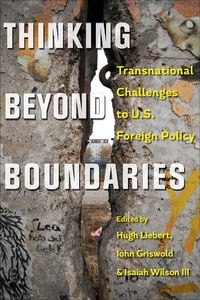
Thinking beyond Boundaries
Transnational Challenges to U.S. Foreign Policy
Published on 16. February 2015
256 pages
978-1-4214-1530-7 (ISBN)
Description

Managing a national response to transnational, boundary-crashing events requires leaders to link the strategic tools of defense, diplomacy, and development.
Written under the direction of West Point social sciences faculty for its Student Conference on U.S. Affairs (SCUSA), Thinking beyond Boundaries introduces undergraduates to aspects of transnational conflict that extend beyond traditional political and intellectual boundaries, providing context to a variety of contemporary issues including immigration, terrorism, and environmental security. This volume challenges students to behave not as passive observers but as decision makers who engage in policy-level debate and formulate specific policy recommendations.
The contributors ask students to consider how the United States promotes or even determines an effective and appropriate policy response to boundary-spanning problems. Since future political and military leaders, as well as policymakers, will face the challenge of collective action within the confines of an uncoordinated international system, the book urges students to consider the role of domestic and foreign factors in their decision-making processes. The book's three-part organization considers the blurred line between domestic and foreign policy, the cross-border implications of foreign policy, and the challenges and opportunities that extend beyond the boundaries separating the world's regions. Each chapter includes a list of recommended readings and resources.
Touching on civil-military relations and the global challenges involved with hacking, foreign aid, weapons proliferation, international trade, and climate change, Thinking beyond Boundaries draws thoughtful conclusions about the proper role of the United States around the world.
Written under the direction of West Point social sciences faculty for its Student Conference on U.S. Affairs (SCUSA), Thinking beyond Boundaries introduces undergraduates to aspects of transnational conflict that extend beyond traditional political and intellectual boundaries, providing context to a variety of contemporary issues including immigration, terrorism, and environmental security. This volume challenges students to behave not as passive observers but as decision makers who engage in policy-level debate and formulate specific policy recommendations.
The contributors ask students to consider how the United States promotes or even determines an effective and appropriate policy response to boundary-spanning problems. Since future political and military leaders, as well as policymakers, will face the challenge of collective action within the confines of an uncoordinated international system, the book urges students to consider the role of domestic and foreign factors in their decision-making processes. The book's three-part organization considers the blurred line between domestic and foreign policy, the cross-border implications of foreign policy, and the challenges and opportunities that extend beyond the boundaries separating the world's regions. Each chapter includes a list of recommended readings and resources.
Touching on civil-military relations and the global challenges involved with hacking, foreign aid, weapons proliferation, international trade, and climate change, Thinking beyond Boundaries draws thoughtful conclusions about the proper role of the United States around the world.
More details
Language
English
Place of publication
Baltimore
United States
Target group
College/higher education
Illustrations
3 s/w Zeichnungen, 6 Karten
6 Maps; 3 Line drawings, black and white
File size
3,79 MB
ISBN-13
978-1-4214-1530-7 (9781421415307)
DOI
10.1353/book.49258
Copyright in bibliographic data and cover images is held by Nielsen Book Services Limited or by the publishers or by their respective licensors: all rights reserved.
Schweitzer Classification
Other editions
Additional editions
Hugh Liebert | John Griswold | Isaiah Wilson III
Thinking beyond Boundaries
Transnational Challenges to U.S. Foreign Policy
Book
02/2015
Johns Hopkins University Press
€26.50
Shipment within 10-20 days
Persons
Hugh P. Liebert is an assistant professor of American politics, policy, and strategy in the Department of Social Sciences at the United States Military Academy. He is coeditor of Executive Power in Theory and Practice. John Griswold is a strategic planner in the U.S. European Command. Isaiah Wilson III is a professor of political science at the United States Military Academy. He is the founding director of the West Point Grand Strategy Program and currently serves as a staff officer in the U.S. Central Command. He is the author of Thinking beyond War: Civil-Military Relations and Why America Fails to Win the Peace.
Content
List of Contributors
Foreword
Acknowledgments
Introduction
Part I: Tracing Domestic Issues in U.S. Foreign Policy
Chapter 1. Politics along the Water's Edge
Chapter 2. Challenges to Achieving Whole- of- Government Solutions
Chapter 3. E Pluribus Unum? Education and Foreign Policy
Chapter 4. Disorder at the Border? Immigration and Homeland Security
Chapter 5. American Society and Its Military
Chapter 6. Thinking Beyond Terrorism and Insurgency
Part II: Distinguishing Regional Dynamics in U.S. Foreign Policy
Chapter 7. Challenges and Opportunities in Sino- American Relations
Chapter 8. U.S. Policy Challenges in the Contemporary Middle East
Chapter 9. Promoting Security and Prosperity after Af ghan i stan
Chapter 10. Whither Eu rope? Economic Crisis and the Future of NATO
Chapter 11. Aid, Development, and Human Security
Chapter 12. Drugs, Crime, and State Fracture
Part III: Turning Global Challenges Into Foreign-Policy Opportunities
Chapter 13. Governing the Electronic Commons
Chapter 14. Foreign- Policy Challenges in 3D: Diplomacy, Democracy, and Development
Chapter 15. Securing Peace and Stability
Chapter 16. Trade, Globalization, and the International Economy
Chapter 17. Resources and Energy
Chapter 18. Thinking beyond Oil
Conclusion
Epilogue: The Student Conference on United States Affairs
Index
Foreword
Acknowledgments
Introduction
Part I: Tracing Domestic Issues in U.S. Foreign Policy
Chapter 1. Politics along the Water's Edge
Chapter 2. Challenges to Achieving Whole- of- Government Solutions
Chapter 3. E Pluribus Unum? Education and Foreign Policy
Chapter 4. Disorder at the Border? Immigration and Homeland Security
Chapter 5. American Society and Its Military
Chapter 6. Thinking Beyond Terrorism and Insurgency
Part II: Distinguishing Regional Dynamics in U.S. Foreign Policy
Chapter 7. Challenges and Opportunities in Sino- American Relations
Chapter 8. U.S. Policy Challenges in the Contemporary Middle East
Chapter 9. Promoting Security and Prosperity after Af ghan i stan
Chapter 10. Whither Eu rope? Economic Crisis and the Future of NATO
Chapter 11. Aid, Development, and Human Security
Chapter 12. Drugs, Crime, and State Fracture
Part III: Turning Global Challenges Into Foreign-Policy Opportunities
Chapter 13. Governing the Electronic Commons
Chapter 14. Foreign- Policy Challenges in 3D: Diplomacy, Democracy, and Development
Chapter 15. Securing Peace and Stability
Chapter 16. Trade, Globalization, and the International Economy
Chapter 17. Resources and Energy
Chapter 18. Thinking beyond Oil
Conclusion
Epilogue: The Student Conference on United States Affairs
Index
