

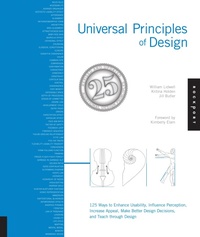
Universal Principles of Design, Revised and Updated
125 Ways to Enhance Usability, Influence Perception, Increase Appeal, Make Better Design Decisions, and Teach through Design
Published on 1. January 2010
272 pages
978-1-61058-065-6 (ISBN)
Description

Universal Principles of Design, Revised and Updated is a comprehensive, cross-disciplinary encyclopedia covering 125 laws, guidelines, human biases, and general considerations important to successful design. Richly illustrated and easy to navigate, it pairs clear explanations of every design concept with visual examples of the ideas applied in practice. From the 80/20 Rule to the Weakest Link, every major design concept is defined and illustrated.
Whether a marketing campaign or a museum exhibit, a video game or a complex control system, the design we see is the culmination of many concepts and practices brought together from a variety of disciplines. Because no one can be an expert on everything, designers have always had to scramble to find the information and know-how required to make a design work-until now.
Just a few of the principles that will broaden your design knowledge, promote brainstorming, and help you check the quality of your work:
Baby-Face Bias
Expectation Effect
Golden Ration
Ockham's Razor
Proximity
Scaling Fallacy
The book is organized alphabetically so that principles can be easily and quickly referenced by name. For those interested in addressing a specific problem of design, the principles havealso been indexed by questions commonly confronting designers (How can I help people learn from my design? How can I enhance the usability of a design? How can I make better design decisions? ...).
Each principle is presented in a two-page format. The first page contains a succinct definition, a full description of the principle, examples of its use, and guidelines for use. Side notes are included, and provide elaborations and references. The second page contains visual examples and related graphics to support a deeper understanding of the principle.
This landmark reference is the standard for designers, engineers, architects, and students who seek to broaden and improve their design expertise.
Whether a marketing campaign or a museum exhibit, a video game or a complex control system, the design we see is the culmination of many concepts and practices brought together from a variety of disciplines. Because no one can be an expert on everything, designers have always had to scramble to find the information and know-how required to make a design work-until now.
Just a few of the principles that will broaden your design knowledge, promote brainstorming, and help you check the quality of your work:
Baby-Face Bias
Expectation Effect
Golden Ration
Ockham's Razor
Proximity
Scaling Fallacy
The book is organized alphabetically so that principles can be easily and quickly referenced by name. For those interested in addressing a specific problem of design, the principles havealso been indexed by questions commonly confronting designers (How can I help people learn from my design? How can I enhance the usability of a design? How can I make better design decisions? ...).
Each principle is presented in a two-page format. The first page contains a succinct definition, a full description of the principle, examples of its use, and guidelines for use. Side notes are included, and provide elaborations and references. The second page contains visual examples and related graphics to support a deeper understanding of the principle.
This landmark reference is the standard for designers, engineers, architects, and students who seek to broaden and improve their design expertise.
More details
Language
English
Place of publication
Beverly
United States
Publishing group
Quarto Publishing Group USA Inc
Illustrations
400
File size
5,87 MB
ISBN-13
978-1-61058-065-6 (9781610580656)
Copyright in bibliographic data and cover images is held by Nielsen Book Services Limited or by the publishers or by their respective licensors: all rights reserved.
Schweitzer Classification
Other editions
Additional editions
William Lidwell | Kritina Holden | Jill Butler
Universal Principles of Design, Revised and Updated
125 Ways to Enhance Usability, Influence Perception, Increase Appeal, Make Better Design Decisions, and Teach through Design
Book
02/2010
Rockport Publishers
€52.19
Article exhausted; check for reprint
Persons
William Lidwell is the Chief R&D Officer at Avenues: The World School, where he leads teams tasked with conducting research in education and the learning sciences; the development of new educational curricula, programming, and technologies; and the architecture and design of new campuses around the world. The co-author of Universal Principles of Design and The Pocket Universal Principles of Design, he has written other books in a variety of disciplines, including design, education, and management. His online lectures on the psychology of color are available at TheGreatCourses.com, and his online courses on the universal principles of design and logo design are available at LinkedInLearning.com. He lives in Houston, Texas.
Content
- Cover
- Title
- Contents
- Foreword
- Introduction
- 80/20 Rule
- Accessibility
- Advance Organizer
- Aesthetic-Usability Effect
- Affordance
- Alignment
- Anthropomorphic Form
- Archetypes
- Area Alignment
- Attractiveness Bias
- Baby-Face Bias
- Biophilia Effect
- Cathedral Effect
- Chunking
- Classical Conditioning
- Closure
- Cognitive Dissonance
- Color
- Common Fate
- Comparison
- Confirmation
- Consistency
- Constancy
- Constraint
- Contour Bias
- Control
- Convergence
- Cost-Benefit
- Defensible Space
- Depth of Processing
- Design by Commitee
- Desire Line
- Development Cycle
- Entry Point
- Errors
- Expectation Effect
- Exposure Effect
- Face-ism Ratio
- Factor of Safety
- Feedback Loop
- Fibonacci Sequence
- Figure-Ground Relationship
- Fitts' Law
- Five Hat Racks
- Flexibility-Usability Tradeoff
- Forgiveness
- Form Follows Function
- Framing
- Freeze-Flight-Fight-Forfeit
- Garbage In-Garbage Out
- Golden Ratio
- Good Continuation
- Gutenberg Diagram
- Hick's Law
- Hierarchy
- Hierarchy of Needs
- Highlighting
- Horror Vacui
- Hunter-Nurturer Fixations
- Iconic Representation
- Immersion
- Inattentional Blindness
- Interference Effects
- Inverted Pyramid
- Iteration
- Law of Prägnanz
- Layering
- Legibility
- Life Cycle
- Mapping
- Mental Model
- Mimicry
- Mnemonic Device
- Modularity
- Most Advanced Yet Acceptable
- Most Average Facial Appearance Effect
- Normal Distribution
- Not Invented Here
- Nudge
- Ockham's Razor
- Operant Conditioning
- Orientation Sensitivity
- Performance Load
- Performance Versus Preference
- Personas
- Picture Superiority Effect
- Priming
- Progressive Disclosure
- Propositional Density
- Prospect-Refuge
- Prototyping
- Proximity
- Readability
- Recognition Over Recall
- Red Effect
- Redundancy
- Rosetta Stone
- Rule of Thirds
- Satisficing
- Savanna Preference
- Scaling Fallacy
- Scarcity
- Self-Similarity
- Serial Position Effects
- Shaping
- Signal-to-Noise Ratio
- Similarity
- Stickiness
- Storytelling
- Structural Forms
- Symmetry
- Threat Detection
- Three-Dimensional Projection
- Top-Down Lighting Bias
- Uncanny Valley
- Uncertainty Principle
- Uniform Connectedness
- Veblen Effect
- Visibility
- Visuospacial Resonance
- von Restorff Effect
- Wabi-Sabi
- Waist-to-Hip Ratio
- Wayfinding
- Weakest Link
- Credits
- Acknowledgments
- About the Authors
- Index
- A
- B
- C
- D
- E
- F
- G
- H
- I
- J
- K
- L
- M
- N
- O
- P
- Q
- R
- S
- T
- U
- V
- W
- Z
